


Qualcomm’s Snapdragon 8 Elite Gen 5 is fast, on paper and in action. Early benchmarks from a Qualcomm reference device indicate the CPU has class-leading throughput, competitive single-core performance, and some meaningful GPU gains—though there are familiar worries around sustained performance. As with all such figures on a reference platform, these are peak potential, not guaranteed at retail.
The test mule was unabashedly high end: 24GB of LPDDR5X, 1TB of UFS 4.1, and a 6.8-inch 3,200×1,440 LTPO AMOLED panel. That ample thermal and memory headroom can help demonstrate what the silicon can do before phone makers dial it back for size, battery life, and comfort.
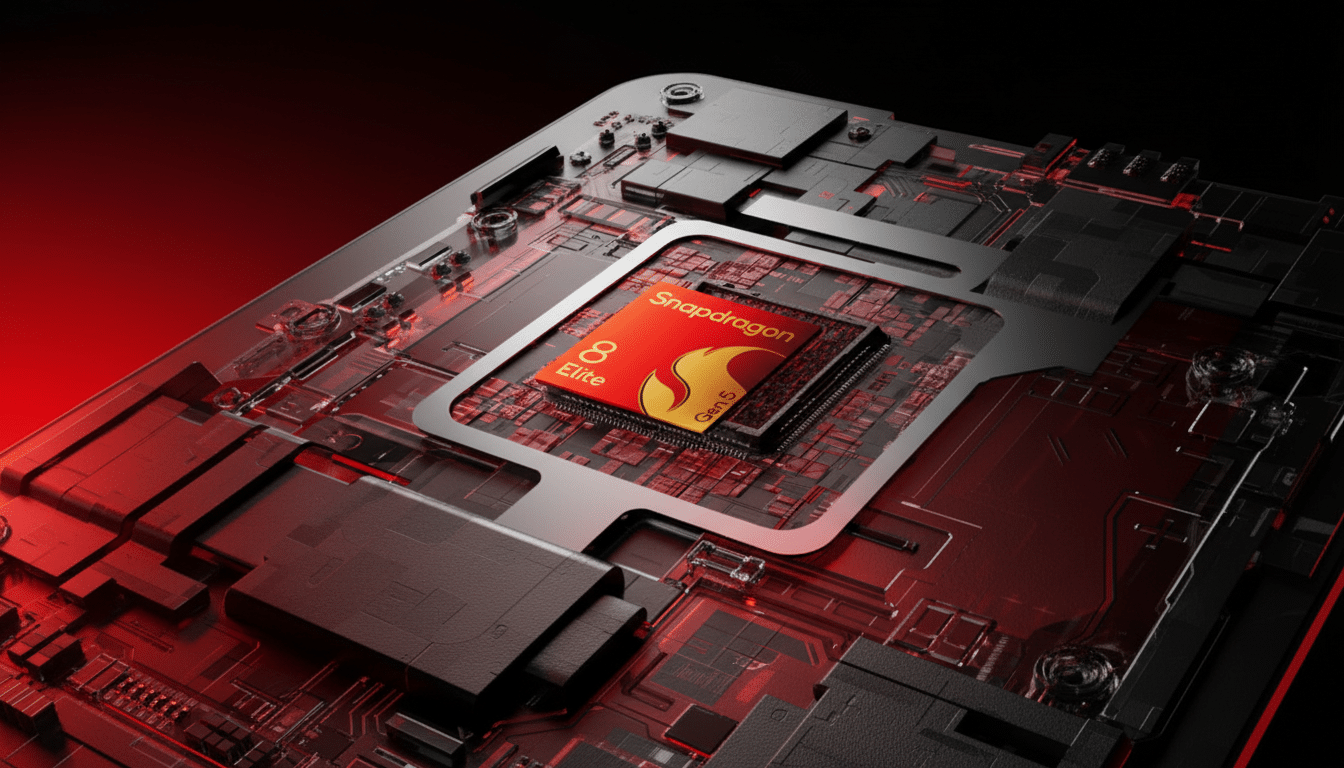
CPU Winning In Actual Benchmarks Only In Our Early Tests
Based on Qualcomm’s third-generation Oryon CPU design for Arm, the 8 Elite Gen 5 takes a Prime core to 4.6GHz and Performance cores to 3.62GHz. Alongside that, Qualcomm has introduced other cache and microarchitectural improvements, but is touting up to 20% more performance at around 16% better efficiency compared to its predecessor.
Our Geekbench 6 results on the reference unit draw near those claims: about a 19% boost in single- and multi-core versus last year’s reference platform. Compared to Snapdragon 8 Gen 3, the new chip falls somewhere around a 65% increase in the same benchmarks, which is a significant two-node jump in actual CPU speed.
Numbers are less blunt when it comes to taking on rivals. Multi-core throughput leaves Google’s Tensor G5 in the dust and edges out Apple’s latest Pro-tier silicon by roughly 25% in our comparisons. Single-core, on the other hand, is virtually a statistical tie between Apple’s custom Arm silicon and Qualcomm Oryon, with less than a percentage point delta depending on run-to-run variance.
Graphics And Ray Tracing Performance In 3DMark Tests
Qualcomm boasts up to 23% more performance at up to 20% lower power with the new Adreno GPU. In real usage, UL’s 3DMark Unlimited off-screen tests reveal a roughly 15–18% frame-rate advantage for the new generation when run at a static 2560×1440 render target. So that’s not a miss — just an even more real-world read on the claim when you take into consideration thermals and methodology.
Once converted to 3DMark scores for cross-reference, the 8 Elite Gen 5 finishes around 23% ahead of a top-end retail Snapdragon flagship like the OnePlus 13. Compared to Samsung’s modestly overclocked “for Galaxy” version from last generation, we saw about 21% improvement in Wild Life Extreme, and it was roughly an 18% jump in the ray-tracing-heavy Solar Bay. And in that selfsame test suite, we’re talking ray-tracing performance outpacing Apple’s recent iPhone model.
Our own Wild Life Stress Test first-run score (29,258) lagged Qualcomm’s best internal result (30,561), as is par for the course when transitioning from lab numbers to hands-on outcomes. Either way, the GPU packs a remarkable wallop and should be primed for high-refresh gaming, even heavier emulation workloads, and some close-to-console replicas provided the device can keep it cool.

Sustained Performance And Thermals Under Heavy Load
The catch: after four complete loops of Wild Life Stress Test, performance dropped to roughly 58% of peak. The reference hardware in both cases holds max clocks longer than many retail phones do, but the eventual drop-off is similar to what we’ve seen from recent Snapdragon flagships under extended load. Marathon sessions and hot rooms are still limited by throttling.
Most non-stress-looping Android games won’t work the GPU as hard, so shorter to medium sessions should still feel uniformly snappy. Still, you can bet that phone makers will adjust to optimize for comfort and battery life — two factors that matter as much as raw silicon.
AI Throughput And SME On CPU For On-Device Tasks
AI benchmarking paints a more nuanced picture.
Image classification, for example, makes use of a new Qualcomm-tuned implementation of Facebook’s QNNPACK library for ML performance to be able to run on the low-power cores, which allows them to achieve higher peak performance compared with its last-gen but also results in just 19% improvement over the company’s existing data against MLCommons’ MLPerf-style workloads such as image classification and is even smaller when running image segmentation and super-resolution — they go 55% faster versus the prior Snapdragon. This Hexagon NPU’s headline increase puts it around 37%, although as ever, results vary widely from model to model and precision to precision.
There is an interesting plot twist, though, with the CPU: progress has also been made when it comes to its support for Arm’s Scalable Matrix Extension (SME). If an app uses Qualcomm’s libraries or leverages SME when the NPU is asleep, a few on-device AI tasks can be much quicker than a flat CPU path, by covering the gap when frameworks or models are not entirely optimized for the NPU. That’s a clear victory for early adopters of new AI tools.
Bottom Line For Buyers Considering Snapdragon 8 Elite Gen 5
Does the Snapdragon 8 Elite Gen 5 soundly vanquish its closest competition? When it comes to things like multi-core CPU throughput and GPU speed, yes — often by a lot. The lead shrinks again in single-core and some graphics cases, and with sustained heat performance nosedives into familiar numbers. That context means more than any one number would give.
If you care about fast video exports, high-refresh gaming with ray tracing or running generative AI locally, this chip paces the pack. Just keep in mind that real-world performance will depend a lot on the phone maker’s cooling design, power limits, and software. The silicon’s ready: now the hardware needs to catch up and let it breathe.
