


Samsung is updating its lineup of portable projectors with a new model that addresses the one thing that almost all projectors find most problematic: less-than-perfect walls. The new Freestyle+ leverages AI-based correction to identify angled, curved, or textured surfaces and remold the image so that movie night has at least a decent shot no matter what you project onto, from brick to bedroom curtains.
Why Auto Alignment Matters for Portable Projectors
Portable projectors inherently have to make compromises because the ideal conditions are always what you left behind.
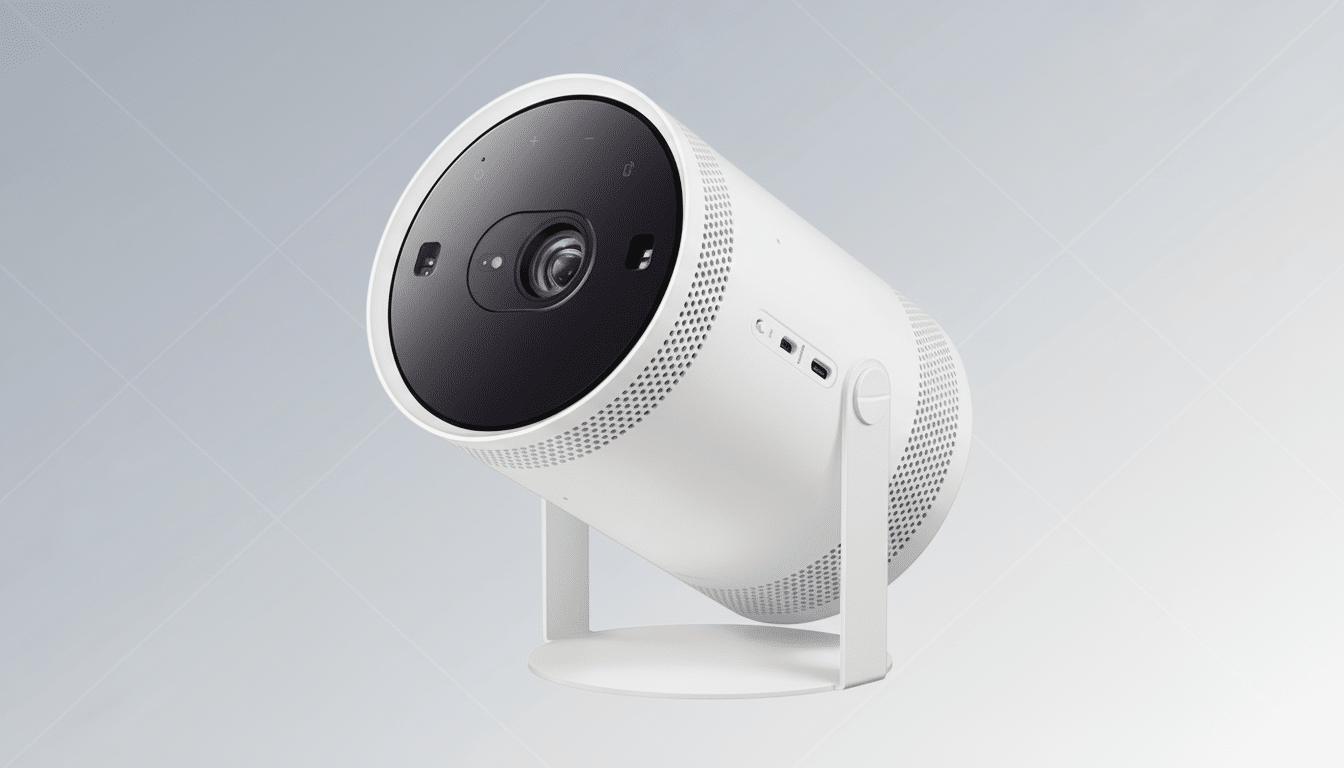
You might project onto a rental, a dorm, a campsite, or even the living room with the weirdly sloped ceiling; and your screen is rarely flat or centered. Old-fashioned auto keystone only corrects tilt, not ripples or patterns. Samsung’s method tries to take things further: the Freestyle+ uses 3D scene analysis and adapts geometry, focus, and color to accommodate uneven surfaces so the picture remains rectangular and legible.
AI OptiScreen Can Handle Uneven Surfaces
At the heart of it is AI OptiScreen, Samsung’s catch-all for image optimization. It comes equipped with 3D Auto Keystone, Real-time Focus, Screen Fit, and Wall Calibration. In practice, that means the projector adjusts keystone and perspective, maps edges and contours, and straightens trapezoids or walls or pillars—even when the unit moves around a little or the wall isn’t perfectly flat. Wall Calibration analyzes paint color or your patterned backdrop and nudges white balance and gamma so whites are really white, not beige or blue.
This has been the direction the category has been heading. Brands such as XGIMI, from which Anker thinks it cribbed this look, have been talking up fast autofocus and 2D keystone for years; Samsung’s “3D” correction is meant to account not just for trapezoiding (you know what I mean) but lens-in-lens issues, shape irregularities on soft or angular surfaces—think fabric curtains or a tent wall—without manual tweaking. From sources like ProjectorCentral and Rtings we’ve known for years that aggressive keystone can blur detail; Samsung’s processing is designed to actively counteract these trade-offs.
Fuller Output And Motion-Sensitive Focus
Samsung claims the Freestyle+ has 430 ISO lumens, which is said to be 2x brighter than its previous model. Standard projected lumens are measured by ISO 21118, and though 430 isn’t out to conquer a sunlit room, it’s a nice little bump for an anywhere-anytime unit. You can expect best results at night or in low light, especially above 80 inches. The company did not share resolution or max image size, but the previous Freestyle offered 1080p with a range of 30 to 100 inches, which informs what one might expect.
Real-time Focus is tuned for how people actually use these devices: grabbing them, tilting them skyward, nudging them across a coffee table. The optics automatically adjust several thousand times a second to cut down on blur or micro-jitter that can come in as the unit shifts a few degrees mid-scene.
When Apps and Audio Can Truly Go Portable
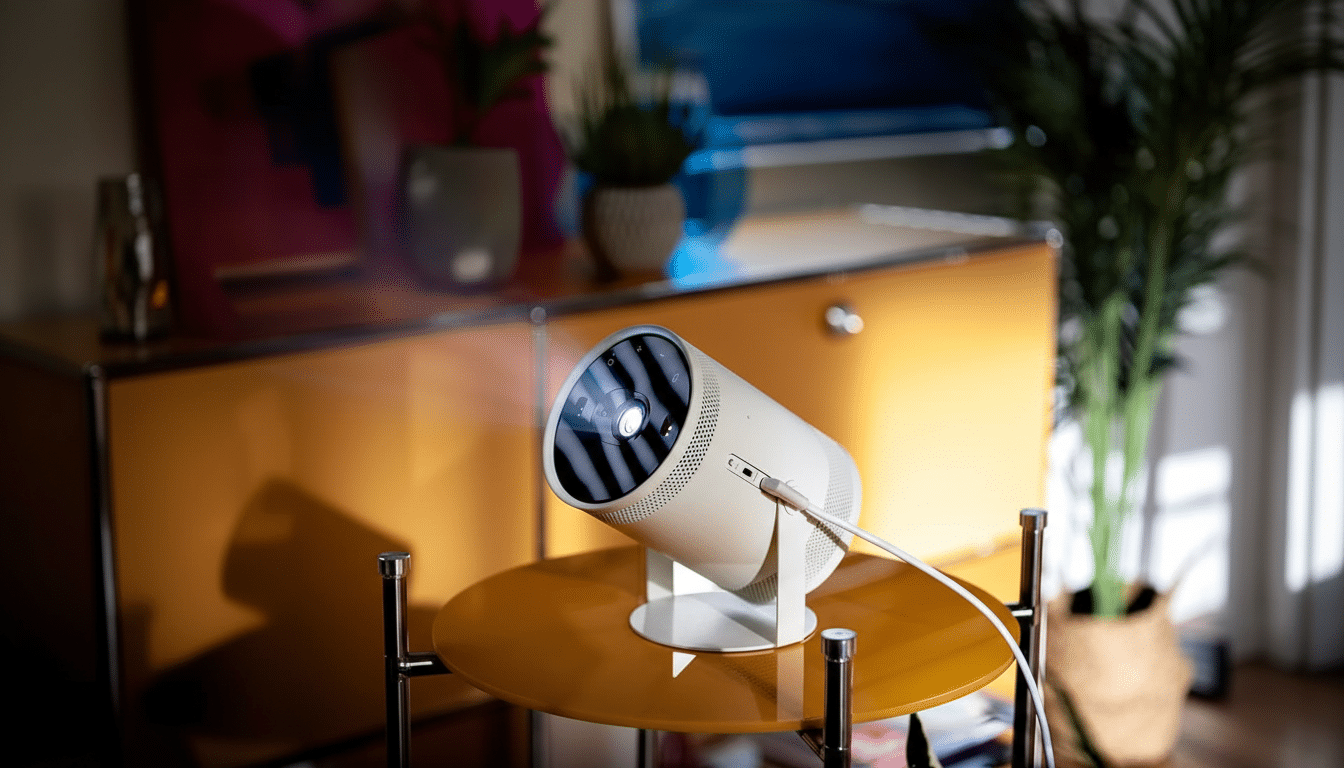
The Freestyle+ benefits from a 360-degree speaker to aid in rapid one-box setup. Q-Symphony allows the projector to sync with compatible existing Samsung soundbars, expanding the soundstage—helpful when you’re throwing a 90-inch picture and don’t want the audio to seem as if it’s confined within the device.
On the content front, streaming apps are baked in, with Samsung TV Plus for free, ad-supported channels and Samsung Gaming Hub for cloud gaming without a console. Now at CES 2019, the Vision AI Companion becomes even more conversational by adding new controls you can chat with: summon Bixby, search for a title online, or ask questions about what’s on screen—all using Samsung’s TV-first AI antics but in pocket-sized form.
Real-World Use Cases for Everyday Spaces
So, throw it onto a textured apartment wall, a slanted attic ceiling, or an outdoor screen with a few wrinkles—the Freestyle+ was made for those edge cases. In practice, this version has me playing casual sports against a patio brick wall or watching a kids’ movie beamed to the bedroom ceiling without 10 minutes of menus.
- Good for 60–100 inches, with 430 ISO lumens
- Look for dusk or indoor settings with controlled ambient light
- Figure out optimal placement for strong contrast
How It Compares and What to Watch Before Buying
Portable projectors increasingly claim to offer set-it-anywhere convenience, but uneven-surface correction is still rare. Most competitors offer autofocus and auto keystone; fewer even try useful geometry fixes for soft or angled surfaces (or color compensation for wall tint). And that’s where Samsung is aiming to differentiate itself. The big remaining questions: final price, specific resolution, and whether the auto-correction indeed maintains fine detail throughout an entire image.
As the Consumer Technology Association maintains its focus on smarter home entertainment at CES, the Freestyle+ exemplifies how the category has shifted from raw specs to adaptive intelligence. (If Samsung’s claims ring true, then the best, brightest screen in your house might be on the wall you already put up—no need for a tape measure, bubble level, or special paint.)
