


Ring is rolling out a new authenticity check for its doorbells and security cameras, aiming to make it far harder to pass off edited clips as the real thing. Called Ring Verify, the feature lets anyone confirm whether a shared Ring video is an exact, untouched copy of what the device originally recorded.
Think of it as a digital safety seal: if the footage has been trimmed, brightened, cropped, filtered, or re-encoded by social networks, the seal breaks and the video won’t verify. If it passes, you know the pixels match what the camera produced at capture.
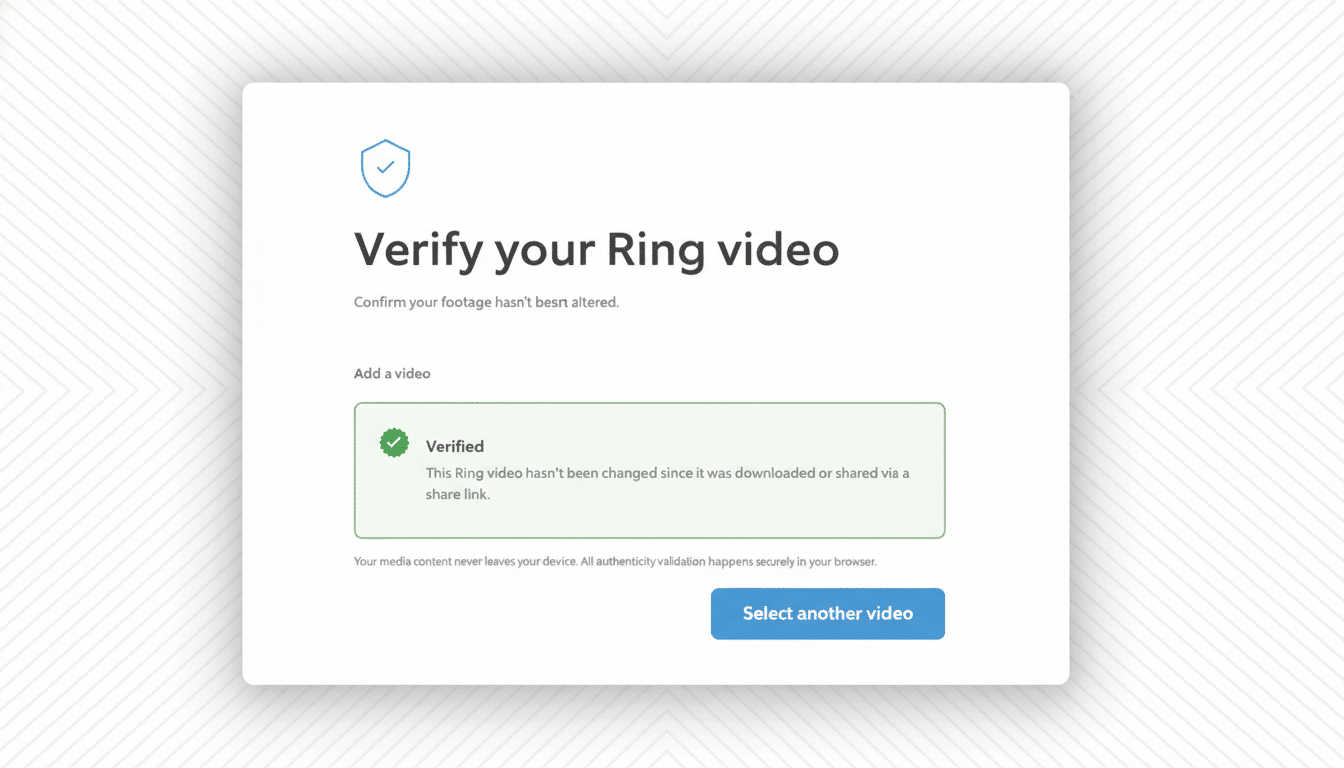
How Ring Verify Works to Authenticate Shared Videos
The verification tag is automatically applied to new videos stored in Ring’s cloud. When someone shares or downloads a clip, recipients can submit the link on Ring’s verification page and get an instant pass or fail. The check is device-agnostic, covering footage from doorbells, floodlight cams, and other Ring models.
Edits break the seal by design. Even seemingly harmless changes—like cutting a few seconds from the beginning, tweaking exposure, or the compression applied by many social apps—alter the underlying data. That’s the point: Ring is attesting to byte-level integrity, not just what the clip looks like to the eye.
There’s one important exception. Videos recorded with Ring’s end-to-end encryption enabled won’t verify. Because the content is encrypted in a way that keeps Ring’s servers from accessing it, the company can’t apply or confirm the integrity tag. Those clips will show as “not verified” even if they are authentic.
Practical example: your neighbor shares a “porch pirate” video. If you check the link and it verifies, you know the footage hasn’t been modified since it left the camera. If it fails, you can request the unedited original from the owner before you pass it to a neighborhood group, insurer, or the police.
What Verification Can and Cannot Prove About Footage
A failed check doesn’t automatically mean the video is fake. It might have been edited for clarity, exported through a different app, or captured before the rollout of the feature. Conversely, a pass doesn’t guarantee that the scene itself wasn’t staged—it simply proves the file is an unchanged copy of what the device recorded.
For legal and insurance contexts, that distinction matters. Under the Federal Rules of Evidence, parties must authenticate digital evidence. A built-in integrity tag won’t replace chain-of-custody procedures, but it can streamline review and reduce disputes over whether a clip was doctored after capture.
Part of a Broader Authenticity Push Across Media
Ring’s move slots into a larger industry effort to restore trust in digital media as AI-generated and edited content proliferates. The Coalition for Content Provenance and Authenticity (C2PA)—a standards group backed by Adobe, Microsoft, Intel, Nikon, Leica, the BBC, and others—promotes cryptographic “Content Credentials” that travel with images and videos to document origin and edits.
Major platforms have started to adopt provenance signals. Adobe embeds Content Credentials in creative tools, camera makers like Nikon and Leica have announced support at the hardware level, and social platforms have begun testing ways to display provenance or label synthetic media. Google has explored watermarking for AI outputs, and media verification firms such as Truepic have provided similar authenticity tech to newsrooms.
Ring’s approach is intentionally strict. Because it flags even routine recompression, a verified status is a high-confidence indicator that the clip hasn’t been altered at any step. The trade-off is that provenance doesn’t survive most reposts unless the original Ring link or file is used.
Why It Matters for Homeowners and Investigators
Home security footage frequently ends up in insurance claims and neighborhood alerts. The FBI estimates insurance fraud costs more than $40B annually in the U.S., excluding health-related cases. Clearer authenticity signals can help carriers and adjusters quickly assess claims involving theft, vandalism, or property damage.
For law enforcement, a quick check can help triage tips and reduce time spent vetting manipulated clips. Police departments that review doorbell videos for investigations will likely appreciate a pass/fail indicator at intake, even though verified status is just one piece of the evidentiary puzzle.
Tips to Preserve Verification When Sharing Clips
Share the original Ring link or the untouched file from Ring’s cloud to keep the seal intact. Avoid uploading to platforms that recompress video if you need the verified status to persist. If a clip fails verification, ask the owner for the original unedited version. Users who prioritize end-to-end encryption should be aware that they’ll trade verification for maximum privacy.
Bottom line: Ring Verify doesn’t certify the truth of an event, but it does deliver a robust, easy-to-check signal that a video is the same one a device captured—no trims, tweaks, or filters in between. In an era of fast-moving clips and ubiquitous editing tools, that’s a meaningful step toward trust.
