


Congestion-plagued Wi‑Fi and dodgy indoor 5G are facing a mighty tech rival as LiFi finally gets real with gigabits in smart lighting hardware! At a major tech event, Edinburgh‑based pureLiFi showed off a set of light‑based networking products that stream data through windows and across rooms using invisible light — marking what feels like a noticeable jump from lab demo to real consumer application.
What LiFi Is and Why It Matters for Connectivity
LiFi beams data by flickering LEDs in the infrared or visible part of the spectrum, rather than competing over crowded radio frequencies. Crucially, it isn’t some proprietary side trip: the technology now lives within the Wi‑Fi family as IEEE 802.11bb, completed in 2023 by the standards body with oversight of Wi‑Fi. That means the LiFi link can speak the same MAC layer language as Wi‑Fi, leading to simpler device support and standard networking tools.
In demonstrations, pureLiFi delivered sustained rates of up to one gigabit per second in real‑world indoor situations. Lab tests at research organisations including Fraunhofer HHI have previously gone beyond multi‑gigabit speeds with optical wireless, but the story here is about readiness: smallish modules that handset makers can try out, and access points that are recognisable as day‑to‑day hardware.
How a Window Bridge Can Deliver Better 5G at Home
One standout: a through‑glass bridge that addresses an ordinary headache of 5G fixed wireless access. Most homes use windows with low‑emissivity coatings that are fantastic for saving energy, but brutal on radio waves. Carrier and building experiments have recorded signal attenuation of 10–40 dB through modern glazing, while mmWave bands do worse. The new bridge affixes to a window and changes this weakened radio link into a strong light link through the glass, before converting it back to radio again on the other side.
It gets power wirelessly from the indoor side so you don’t have to run any cable or drill holes. It’s hooked up inside to your 5G modem at its strongest signal point; in practice, you get a far cleaner path for high‑capacity home internet — and don’t need to wrestle with RF‑unfriendly architecture.
The Privacy and Interference Advantages of LiFi
Since light doesn’t travel through walls to escape your home or office, LiFi has a real line‑of‑sight privacy advantage. While radio waves can zip through walls, it is much harder to sniff an optical link from down the hall. That containment also reduces interference in crowded apartment blocks, where crosstalk between Wi‑Fi channels often slows down speeds.
There are safety and reliability angles, also. Light doesn’t produce radio frequency emissions, so LiFi is appealing in places like hospitals and industrial sites where RF regulations apply (and electromagnetic immunity matters), or on aircraft where minimising interference with other networked systems is key. Signify’s Trulifi and early deployments by European airlines have already demonstrated the concept in these controlled environments, typically achieving triple‑digit Mbps with predictable latency.
Phones Without the Pain: Easier LiFi Integration
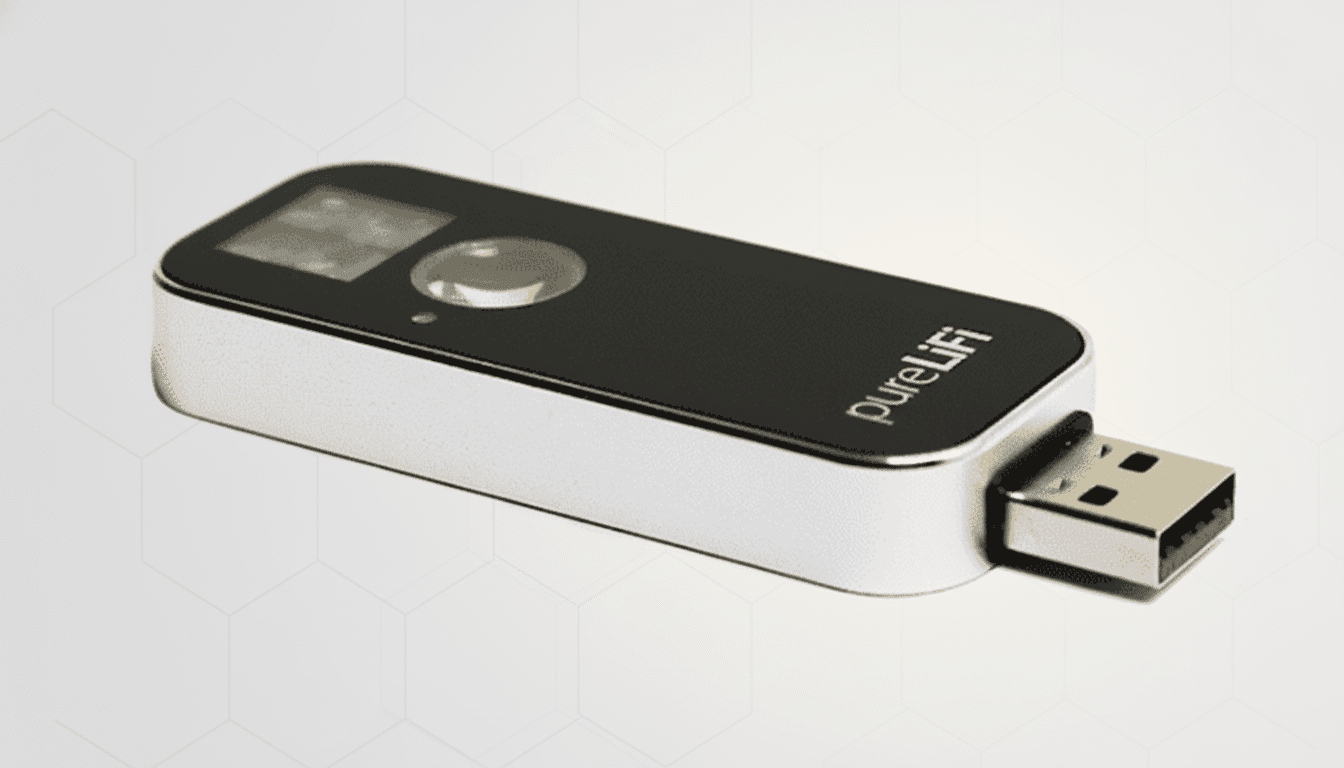
The pureLiFi display here shows off a phone case holding its all‑in‑one transmitter LED and receiver module, as well as an attachable data‑receiver dongle bespoke to standard devices. The clever bit: as 802.11bb aligns with the Wi‑Fi stack, phones don’t require a ground‑up rework. In theory, a handset could regard LiFi as another physical layer and shift between 2.4 GHz, 5 GHz, or even the emerging “6G” that’s just starting to get rolled out — except this “band” is light.
That kind of plug‑and‑play is crucial for adoption. This will open up new use cases for device manufacturers to connect without using the crowded spectrum in schools, offices, and stadiums. Component suppliers can also focus on pre‑existing Wi‑Fi chipsets and drivers rather than wading into the deep end from scratch. It is in hybrid scenarios that this really starts to open up in terms of options, allowing a phone to roam from one technology (LiFi) to another (conventional Wi‑Fi) while still actively engaged with the network.
A Reality Check for LiFi in Real Homes and Rooms
LiFi isn’t a magic bullet. Optical links do require a more or less unobstructed path; people walking through the beam, or moving a laptop, will cause fades. Good systems also compensate for that with multiple beams, fast adaptive optics and support for reflected paths off walls and ceilings, but physics still rewards thoughtful placement. Strong sunlight introduces noise in some bands, so robust filtering and infrared operation enable performance stability.
Coverage across rooms is another thing to be planned, too. In the same way you use Wi‑Fi mesh nodes, LiFi will require access points — basically little “cubes” or ceiling fixtures — to lay down coverage. Good thing: vendors seem to be designing these with the idea that they’re familiar PoE‑friendly nodes, with normal Ethernet backhaul and policy controls. And that, for IT teams, is less of a learning curve.
Why LiFi Momentum Feels Different This Time Around
Two developments make LiFi’s renewed push feel significant. First is standardization: IEEE 802.11bb provides a single target for device makers and reassures buyers their gear won’t be left an orphan. The second is a specific application in 5G fixed wireless whereby, by solving the window problem, we can instantly enhance real‑world speeds and reliability without having to rewire a home.
Attach to that the wider ecosystem — research from Fraunhofer HHI, early enterprise deployments from Signify, defense trials listed by government programs, and OEM interest in tiny modules — and they seem to be falling into place. If vendors can keep costs in Wi‑Fi‑adjacent territory, and provide gigabit‑class reliability, LiFi may go from niche to a standard checkbox item on routers and phones.
The premise is straightforward and of the moment: where radio has failed, light can succeed. And if your Wi‑Fi or indoor 5G is causing you headaches, a beam‑based backup propped up at 1 Gbps is more than a shiny idea — it’s a life hack for better connectivity.
