


OpenAI has unveiled Prism, a free, collaborative workspace designed to streamline scientific writing and analysis. Built around the company’s GPT-5.2 model, Prism centralizes drafting, revision, references, equations, and collaboration in a LaTeX-native environment—without a subscription barrier.
What Prism Is: a cloud-based AI research editor hub
Prism is a cloud-based research editor that sits at the junction of a document processor and an AI copilot. OpenAI positions it as a hub where scientists can draft papers, manage citations, refine mathematical notation, and coordinate co-authors in one place, avoiding the usual shuffle across editors, PDFs, reference managers, and separate chat tools.
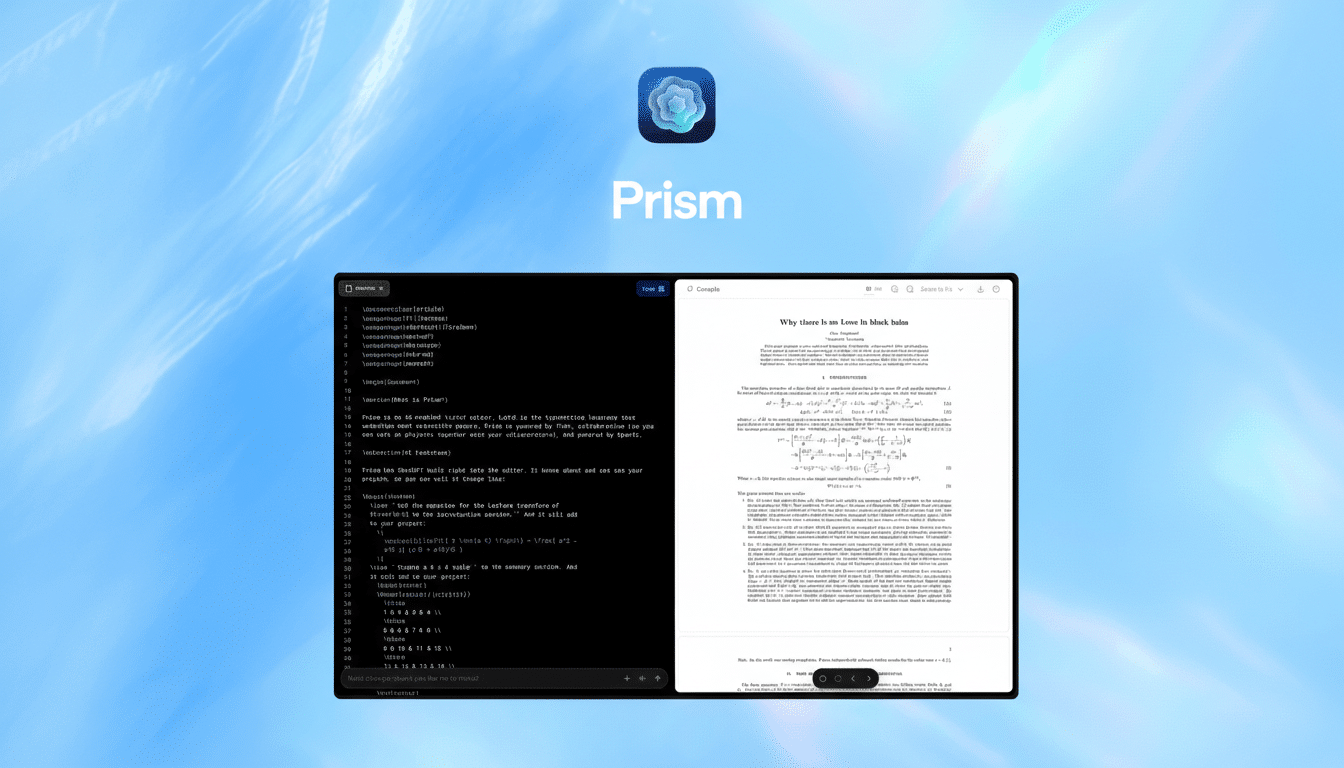
The workspace is powered by GPT-5.2, which OpenAI says performs at or above human expert level on a range of benchmarks. The company emphasizes, however, that Prism is a “power tool,” not an autonomous researcher. Think augmented drafting and analysis—not push-button discovery.
Key Features for Scientists Using OpenAI’s Free Prism
- LaTeX-first editing: Prism supports LaTeX natively, which means equations, figures, and formatting remain publication-grade from the first draft to the final manuscript. That reduces conversion headaches when submitting to journals or preprint servers.
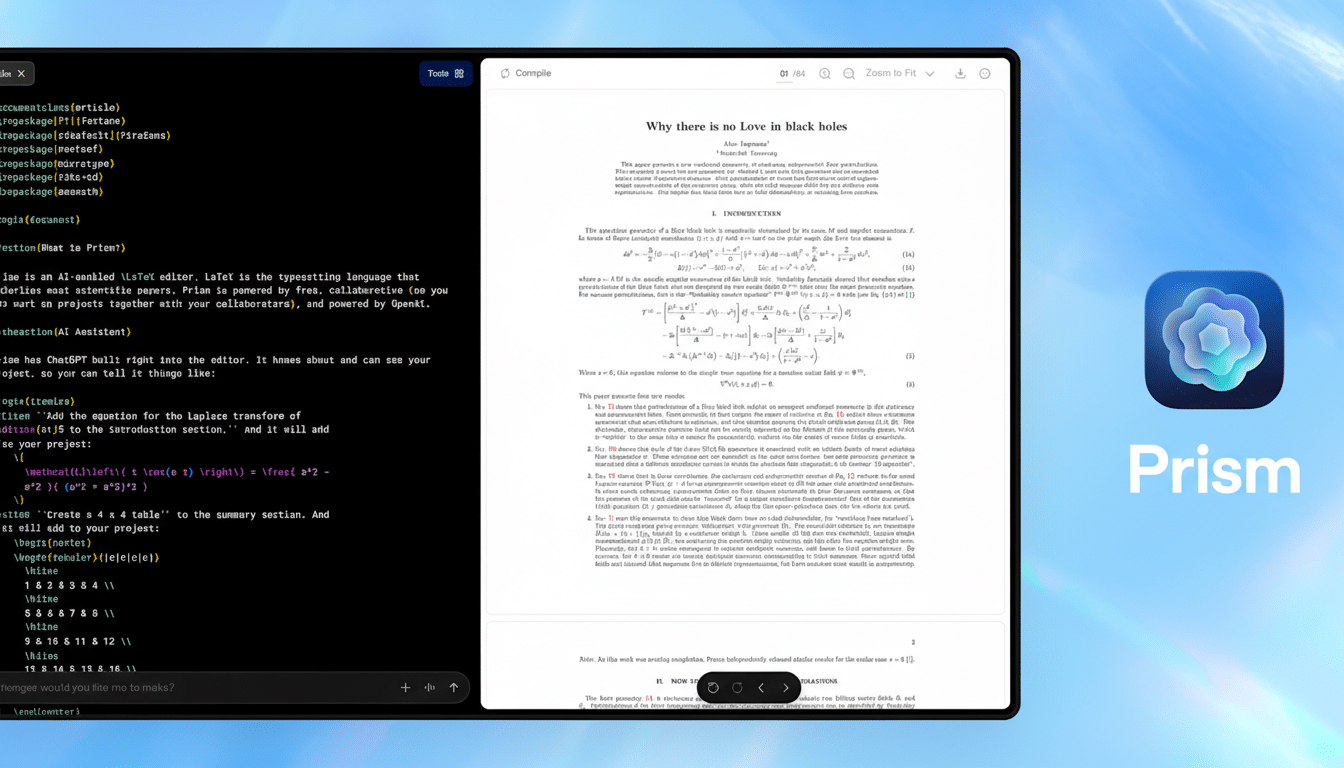
- Contextual agents inside your project: A split interface—chat on one side, manuscript on the other—lets you engage multiple agents with distinct roles. In demos, agents pulled relevant sources from arXiv, generated lecture notes with citations, tightened arguments, and helped tune equations and diagrams, all while preserving document context.
- Project-level collaboration: Teams can co-edit multiple documents within a project and iterate rapidly across sections, appendices, and supplementary materials. OpenAI says Prism is based on Crixet, a platform it acquired and integrated into this release.
- Reasoning to reduce bad citations: OpenAI argues that advanced reasoning in GPT-5.2 lowers the risk of fabricated references by forcing more deliberate checking steps. While independent verification remains essential, this design aims to address one of the most common AI pitfalls in scholarly work.
How to try Prism now with a free ChatGPT account
Getting started is straightforward: sign in with your personal ChatGPT account and open Prism from your account experience. Create a new project, start a LaTeX manuscript, and invite collaborators by adding seats to the project—OpenAI says both projects and seats are unlimited at no cost.
Within a project, open the chat panel to activate agents. Ask one agent to fetch recent preprints from arXiv on your topic, have another propose an outline with properly formatted citations, and use a third to polish equations or translate figures into LaTeX. You can iterate on drafts, track changes, and keep all sources and notes tied to the same workspace.
Prism is available immediately to individual ChatGPT users, with Business, Team, Enterprise, and Education availability coming soon. OpenAI also signals that more powerful AI features will roll out to paid ChatGPT plans, but the core Prism workspace remains free to access.
Privacy and responsible use guidelines for Prism users
Because Prism is accessed through your ChatGPT account, OpenAI says the same privacy protections apply to content you upload or draft within the workspace. Even so, researchers should be cautious with embargoed data, sensitive participant information, or unpublished findings—especially when collaborating across institutions with differing compliance requirements.
OpenAI cautions against delegating research end-to-end to GPT-5.2. The model can broaden exploration, stress-test arguments, and accelerate drafting, but domain experts should retain control over study design, data analysis, and final claims. That guidance echoes concerns from journal editors and research-integrity groups such as the Committee on Publication Ethics, which urge transparency about AI assistance and rigorous verification of citations.
Why Prism matters for scientific writing and trust
Scientific work has long been fragmented across specialty tools. Prism’s bet is that a single, AI-assisted hub can compress the administrative overhead—citations, equations, figure tweaks, and cross-author coordination—so researchers spend more time on the hard problems. The approach mirrors a broader shift in productivity software, where models sit inside the workflow rather than off to the side.
Competitors are pursuing similar visions; for example, Claude’s workspace integrations aim to place AI inside daily tools. What differentiates Prism is its LaTeX-native foundation, project-level agents, and a clear stance that human oversight remains non-negotiable. If that balance holds, Prism could make manuscript preparation faster and more reliable without eroding trust—an outcome the scientific community needs as AI becomes embedded in everyday research.
