


OpenAI introduced Frontier, a platform built to let large organizations design, deploy, and govern AI agents at scale. Framed as end-to-end infrastructure for enterprise teams, Frontier centralizes how agents are created, connected to business systems, and controlled—positioning agent management as a first-class IT capability rather than an experimental side project.
Inside Frontier: A control plane for enterprise AI agents
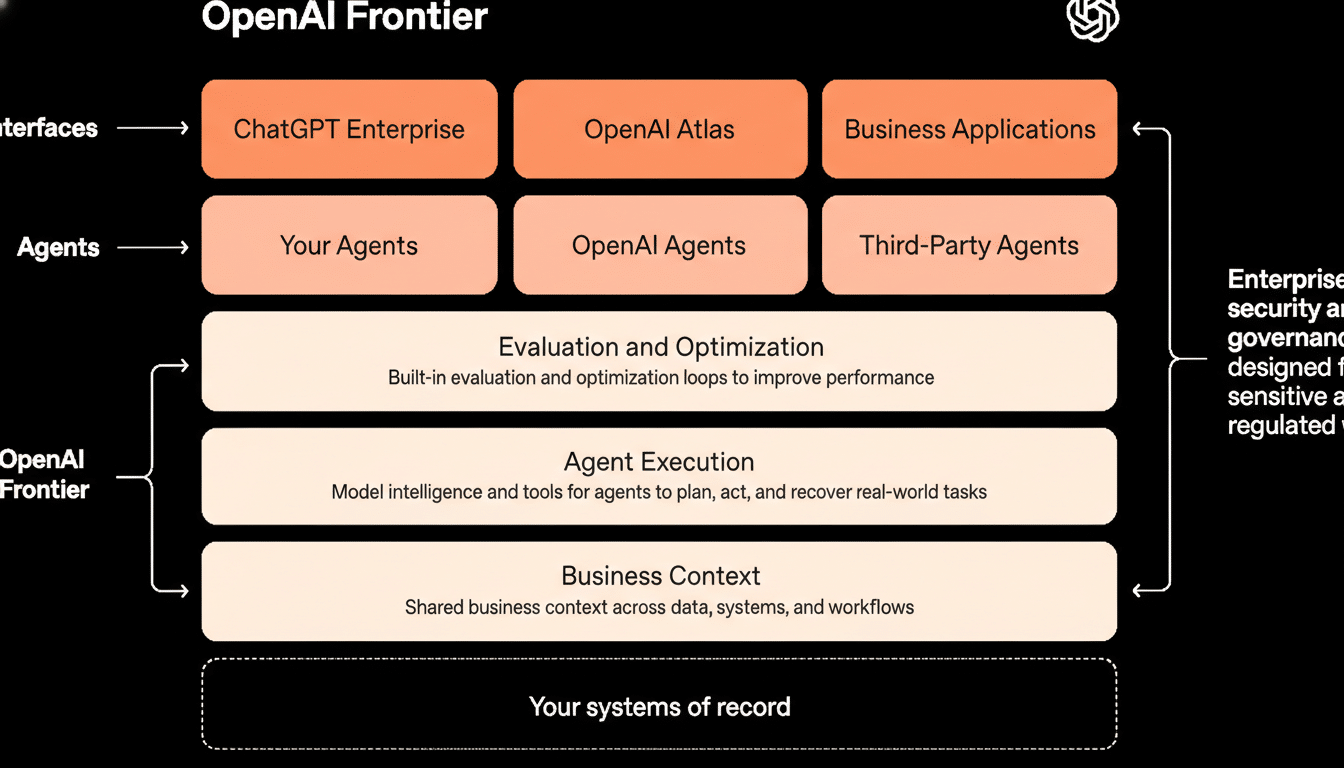
At its core, Frontier acts as a control plane for AI agents. Teams can program agents to tap external data sources and applications, then define the boundaries of what those agents can see and do. Crucially, Frontier is “open” in scope: it’s designed to manage agents built on OpenAI models as well as those developed with other stacks, acknowledging the multi-model reality inside most enterprises.
- Inside Frontier: A control plane for enterprise AI agents
- Why centralized agent management now matters for IT
- How Frontier compares to other enterprise agent tools
- Security and governance controls for enterprise agents
- Early access, enterprise customers, and pricing outlook
- What to watch next as the enterprise agent race evolves
OpenAI likens the experience to managing human employees. Organizations can onboard agents with defined roles and permissions, monitor their performance, and deliver feedback to improve results over time. That framing resonates with IT leaders who already run identity, access, and review cycles for people—and now need the same playbook for software actors that can reason, take actions, and orchestrate workflows.
Consider a claims agent in insurance that reads policy data, drafts correspondence, and triggers payouts; or a sales agent that pulls CRM context, composes proposals, and logs activity. Frontier aims to house that full lifecycle—design, permissioning, monitoring, and iteration—under one roof.
Why centralized agent management now matters for IT
As autonomous and semi-autonomous agents moved from demos to pilots in 2024, many enterprises hit a predictable wall: agent sprawl. Without centralized governance, teams spun up overlapping bots with inconsistent access rules, limited observability, and uncertain accountability. Research firm Gartner has described these management layers as prime real estate in AI, calling them essential to safe, scalable adoption.
The operational need is straightforward. If agents can take actions, they need the same guardrails humans get—least-privilege access, change control, and auditable trails. Frontier’s focus on agent onboarding and continuous feedback is an attempt to make those disciplines part of the default, not an afterthought.
How Frontier compares to other enterprise agent tools
Agent-management tools are quickly becoming table stakes. Salesforce rolled out Agentforce in 2024, tying agents to its data and workflow ecosystem. In the developer arena, LangChain, founded in 2022, has raised more than $150 million to power agentic applications, while CrewAI has drawn more than $20 million as a nimble challenger. Frontier enters as a control plane from a model provider, not a CRM vendor or open tooling layer—an important strategic distinction.
OpenAI’s “open” posture is notable. CIOs have been wary of vendor lock-in and increasingly favor neutral control layers that span multiple models and platforms. By allowing management of third-party agents alongside its own, Frontier attempts to thread that needle while potentially offering tighter learning loops between models, tools, and governance than best-of-breed assemblies typically deliver.
Security and governance controls for enterprise agents
Enterprises will scrutinize how Frontier enforces boundaries: which tools an agent can invoke, which data it can touch, and how those decisions are logged. OpenAI says organizations can restrict and manage agent access, with an onboarding-and-review model that mirrors human management. Expect risk teams to press for deep auditability, approval workflows, and robust incident response for when an agent’s actions need to be paused, rolled back, or explained.
In regulated sectors, this is not optional. A banking agent that drafts loan terms or an insurer agent that initiates payments must map to compliance controls, red-teaming practices, and internal policies. Alignment with emerging frameworks—such as the NIST AI Risk Management Framework and ISO/IEC 42001—will be a key adoption signal.
Early access, enterprise customers, and pricing outlook
Frontier is rolling out to a limited set of customers first, with OpenAI citing enterprises such as HP, Oracle, State Farm, and Uber as early adopters. Wider availability is expected in the coming months.
OpenAI has not disclosed pricing. Reporting from The Verge noted the company declined to share details during a press briefing, a common stance for products still in controlled release.
The launch tracks with OpenAI’s broader pivot into enterprise platforms, following alliances announced this year with ServiceNow and Snowflake. Those partnerships hint at deeper integrations where agents can act across IT workflows and data clouds while remaining under centralized governance.
What to watch next as the enterprise agent race evolves
The near-term questions are pragmatic: how quickly Frontier integrates with identity providers, data governance suites, and security operations tools; how thoroughly it supports non-OpenAI agents; and how well it resolves the twin challenges of observability and control without slowing teams down.
The race to own the enterprise agent control plane is on. If Frontier can balance openness with strong guardrails—and prove measurable productivity gains without ballooning risk—it will set the tone for how AI agents are hired, trained, and managed inside the modern enterprise.
