


OpenAI is introducing advertising to ChatGPT, starting with tests for U.S. users on the free and Go tiers, while keeping Pro, Business, and Enterprise experiences ad-free. The company frames the move as a way to subsidize a widely used service without paywalls, promising clear labeling, strict separation from answers, and controls that keep trust at the center of the chat experience.
How ads will work for ChatGPT’s free and Go users
OpenAI says ads will appear as distinct, signposted units adjacent to conversation results, not blended into generated responses. They’ll surface only when a sponsored product or service is relevant to the user’s query, and users will be able to dismiss ads or turn off personalization entirely.
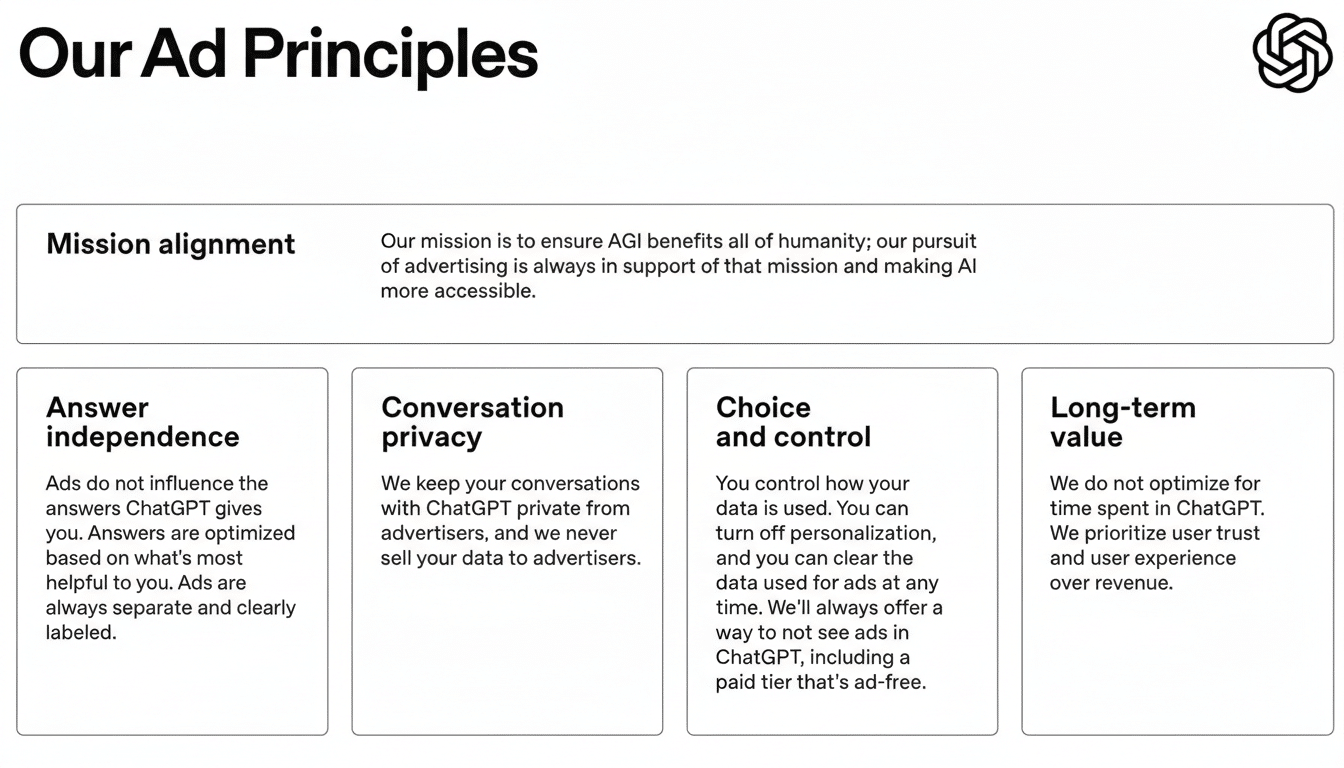
The company emphasizes data protections: conversations won’t be sold to advertisers and sponsored placements will not determine how the model answers. Ads will be withheld from accounts identified as under 18 and avoided around sensitive topics such as health or politics. This mirrors long-standing expectations from the Federal Trade Commission on ad disclosures and relevance, adapted to a conversational interface.
Why OpenAI is introducing ads to ChatGPT now
ChatGPT’s scale is enormous, and so are its compute bills. OpenAI disclosed more than 100 million weekly active users during its developer conference, and industry analysts have estimated inference costs at cents per interaction for large models. At global volumes, that adds up to billions annually, even before accounting for training and frequent model upgrades.
Advertising is the most mature monetization engine in consumer tech. Insider Intelligence projects U.S. digital ad spending to surpass $300B mid-decade, and search-style ads remain among the highest intent inventory online. For OpenAI, carefully designed sponsored units can fund free usage while reserving an ad-free path for paying customers.
The UX and trust challenge of ads in conversational AI
Embedding ads in a chatbot is a design tightrope. If promotions appear to steer answers, trust erodes. If they sit too far from the conversation, advertisers see weak performance. The middle ground is a clearly marked module that is relevant without being determinative—think a separate “Sponsored” card next to a balanced, citation-backed response.
Consider a user planning a weekend trip asking for “family-friendly activities in Seattle.” A non-intrusive approach would show an independently generated itinerary, with a labeled unit for discounted museum passes or hotel deals that the user can ignore, expand, or save. That keeps utility first while offering commercial opportunity only when the query suggests purchase intent.

Measurement and safety are equally hard problems. Advertisers will want outcomes beyond clicks—calls, bookings, or in-chat conversions—without compromising privacy. On brand safety, models must avoid placing ads near sensitive or controversial outputs and ensure generative text doesn’t inadvertently endorse claims beyond what a sponsor provides.
A shifting competitive landscape for AI advertising
OpenAI’s move lands as the broader industry tests ad formats for AI answers. Google has experimented with ads in AI Overviews, Microsoft has shown promotions in Copilot experiences via its advertising network, and AI-native search startups have piloted sponsored citations. The throughline is clear: where queries show intent, ads follow.
For marketers, conversational inventory represents high-intent moments—product comparisons, travel planning, local services, and educational resources. Expect early budgets to come from search and social performance teams, with bidding models that blend cost-per-click with lead and purchase signals captured in privacy-safe ways.
What to watch as ChatGPT ad tests expand and evolve
The initial U.S. rollout will set baselines for three questions: Do users perceive ads as clearly separate from answers? Does ad load stay low enough to preserve utility? Do relevance and controls meet expectations across sensitive categories? Clear labeling, conservative frequency, and transparent settings will be critical to passing that test.
Regulators will also be watching. The FTC has repeatedly underscored that disclosures must be unavoidable and understandable, including in emerging interfaces like voice and chat. In Europe, the Digital Services Act heightens scrutiny on profiling and sensitive data. OpenAI’s commitments around no sale of conversation data and exclusion of minors and sensitive topics align with those expectations.
For users, the promise is continuity: free access without degraded answers, with an easy upgrade path to ad-free tiers. For OpenAI, success means proving that a conversational ad model can fund large-scale AI responsibly—delivering relevance without eroding trust. If it works, the ad-free chatbot may become the exception, not the rule.
