


The Agentic AI Foundation, a new industry group, has been set up by the Linux Foundation to keep the fast-emerging world of AI agents interoperable and open. OpenAI, Anthropic, and Block are providing fleshed-out code and protocols to anchor the effort, establishing it as a standards hub rather than a logo parade.
A Push to Prevent Fragmented Agent Ecosystems
AI agents are going from chat interfaces to become systems that plan, call tools, write to databases, and execute workflows. Without agreed-upon interfaces, that momentum could fracture into proprietary stacks in which each vendor has to define its own tooling, orchestration, and safety patterns. The Agentic AI Foundation (AAIF) is working to provide a universal substrate so that agents built by disparate teams and models can talk to each other, fuse together, and be audited in compatible ways.
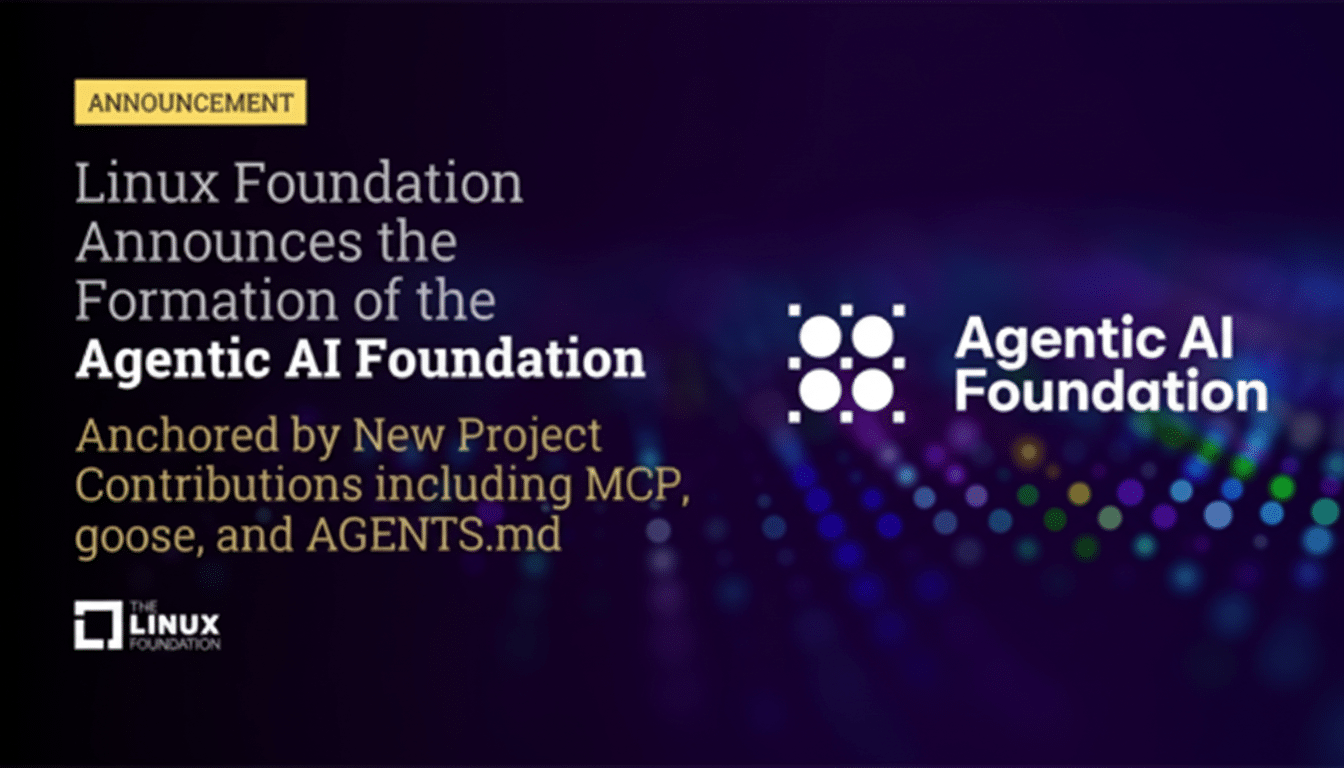
Leaders at the Linux Foundation frame the mission in down-to-earth terms: make it easy for agents to “speak” the same protocols, plug into the same tool registries, and follow similar safety and evaluation practices. That mirrors the way the modern web grew up around open standards and not vendor lock-in.
What’s Included in the First Standards Stack
Anthropic is contributing the Model Context Protocol (MCP), a specification for integrating models and agents with external tools, data stores, and applications. Conceptually, you can think of MCP as a shared adapter layer that reduces one-off integrations and allows us to trace tool invocation. In reality—let’s say we have a procurement agent that is asking for an ERP system and a third-party risk feed—MCP can standardize how the agent finds those resources and makes a call to them.
Block is donating its own Goose, the open-source agent framework used internally throughout the company that owns Square and Cash App. Goose has already become a coding aid for thousands of engineers, data analysts, and documentation workers, who use the AI to help with their jobs. Donating it provides the community with a battle-hardened framework and gives us motivation to stress-test Goose against additional models, tools, and environments.
OpenAI is adding AGENTS.md, a lightweight instruction file in the repo on how AIs should behave, what they’re constrained by, and what interfaces are available. It’s straightforward, but powerful: a documented contract that can eliminate surprises when an agent works across multiple repos or organizations.
Who Else Is at the Table in the AAIF Launch
Aside from the three anchors, initial participants include AWS, Bloomberg, Cloudflare, and Google. The mix of cloud platforms, enterprises, and infrastructure providers indicates an awareness that agents will have to interoperate across networks, APIs, and corporate data planes, not just within a single vendor’s sandbox.
If it’s successful, AAIF could do for agents what the Cloud Native Computing Foundation did for containers and orchestration—supply neutral governance, a reference architecture in common use, and a smooth path from experiments to production-grade ecosystems.
Governance And The Vendor-Neutral Promise
AAIF is set up as a Linux Foundation directed fund: companies pay dues, but technical steering committees steer roadmaps. The foundation’s counter-pitch is that money doesn’t mean control, and standards are the result of open processes, tests, and adoption. History supports the model. Kubernetes, developed within a similar foundation program, didn’t become the default container orchestrator just because someone had decreed it from on high—it happened through community and industry adoption.
There’s a balance to strike in practical terms. And with neutral oversight, the strongest or most popular implementation can be a de facto standard. Supporters will say that’s a feature, not a bug—market-tested components, openly governed, reduce fragmentation while preserving choice.
Early Signals to Watch as AAIF Adoption Progresses
There are three adoption signs marking when AAIF becomes real infrastructure:
- Toolmakers and platforms ship native MCP support.
- Developers regularly add AGENTS.md to repos and CI pipelines.
- Agent frameworks conform to Goose-like interfaces for orchestration and safety hooks.
Reference implementations, conformance suites, and red-team playbooks are forthcoming.
Regulatory alignment will matter, too. Aligning agent protocols with the NIST AI Risk Management Framework, emerging ISO/IEC AI standards, and industry-specific controls can provide your enterprise the ability to make audit requirements easier by not needing to recreate a checklist for every agent deployment.
Why This Matters for Builders And Buyers
“For developers it’s going to mean less of that kind of custom glue code and less brittle integrations. Shared protocols facilitate uniform enforcement and logging and evaluation of policy by security- and platform teams across models and vendors. And for buyers, compatibility lowers switching costs and decreases vendor lock-in—both critical in the early days when organizations are running foundation models and agent frameworks in parallel.”
The larger vision here is an agent ecosystem that more resembles the web (modular, composable, and auditable!) than siloed apps. With MCP, Goose, and AGENTS.md as a starting point, AAIF is betting that shared plumbing can help hasten innovation, and perhaps keep the doors open.
