


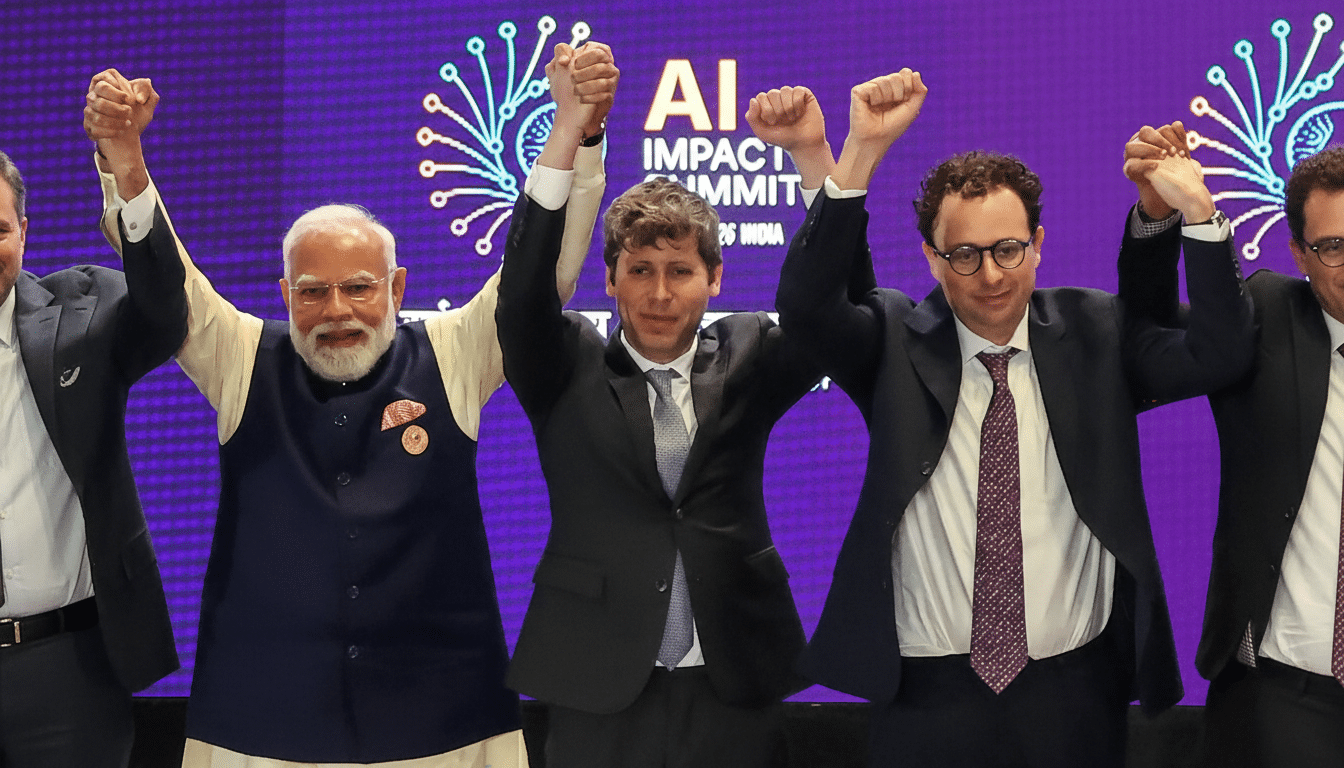
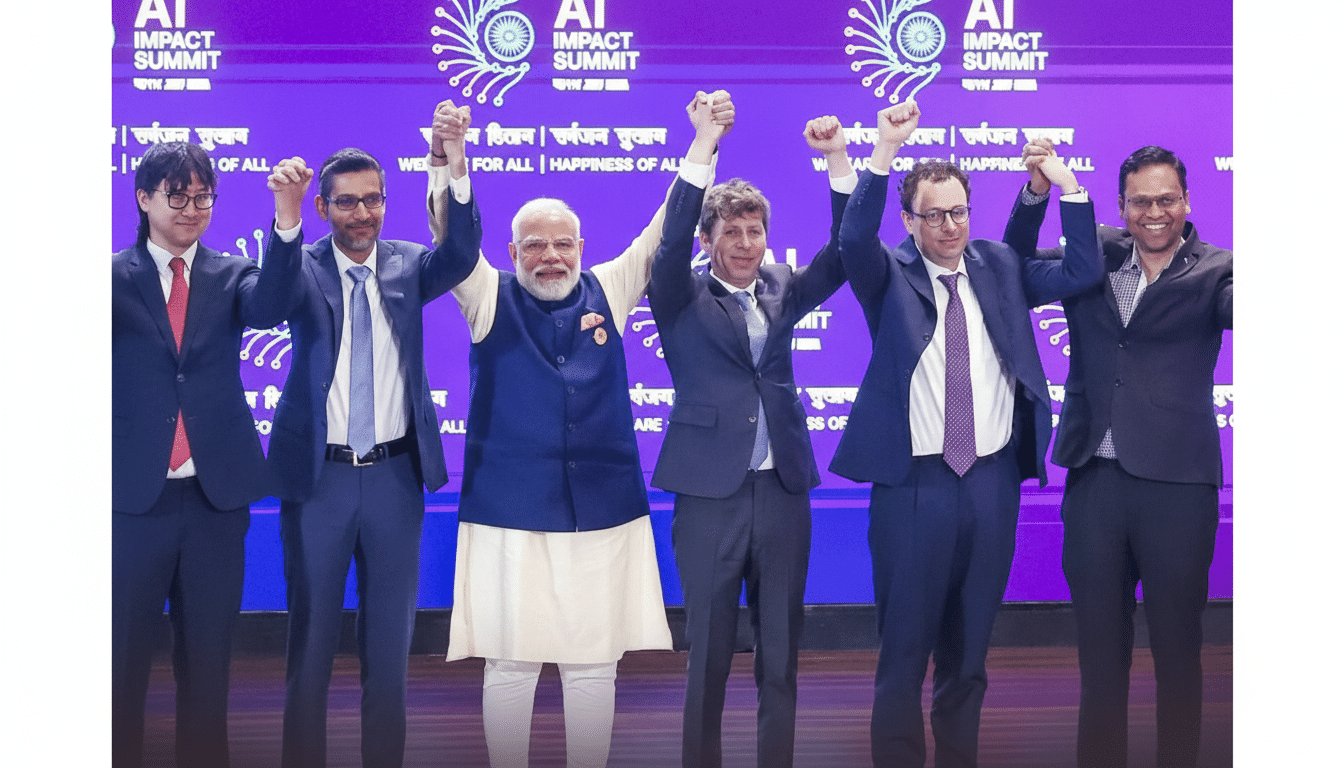
The split-second snub between OpenAI’s Sam Altman and Anthropic’s Dario Amodei at an AI summit in Delhi ricocheted across tech circles because it wasn’t just awkward—it was emblematic. A missed handhold in a photo-op line became a shorthand for years of competitive friction, diverging product bets, and a philosophical split over how frontier AI should be built and governed.
The Moment That Lit Up Social Media Worldwide
In a stage tableau designed for unity, most leaders linked hands. Altman and Amodei didn’t. Whether intentional or not, the clip spread fast because it neatly mapped to an existing narrative: two labs with overlapping DNA and outsized influence are now locked in a contest for technical leadership, enterprise dollars, and public trust.
- The Moment That Lit Up Social Media Worldwide
- A Rivalry Years in the Making Between AI Labs
- Product Strategies On A Collision Course
- Money and Momentum Are Reshaping the AI Race
- Politics Turns Up the Heat on AI Governance and Use
- Why the Snub Matters for Buyers, Developers, and Trust
- What to Watch Next in the Escalating AI Lab Rivalry
A Rivalry Years in the Making Between AI Labs
Anthropic’s founding is the original fault line. Amodei, alongside co-founders including his sister Daniela Amodei, left OpenAI in 2021 to build a lab rooted in safety-first methods like Constitutional AI and rigorous red-teaming. The spinout was more than a new company; it was a declaration that governance and guardrails could be core product features, not afterthoughts.
OpenAI, meanwhile, pursued a broad consumer-to-enterprise arc—turning ChatGPT into a household name with multimodal features spanning text, images, voice, and video. The two strategies shape everything from hiring pipelines to product roadmaps, and they inform how each CEO shows up onstage and online.
Product Strategies On A Collision Course
Anthropic narrowed its aperture: prioritize workplace reliability and coding-first use cases. Its Claude lineup notably foregoes native image generation in favor of tools like Claude Code and Claude Cowork, pitched to engineering teams and operations leaders looking for dependable assistants with large context windows and auditability.
OpenAI took the opposite path—build the broadest platform and let developers and consumers find the edges. ChatGPT’s multimodal stack and an expanding partner ecosystem aim to maximize reach, while coding tools sit within a larger suite. Industry studies from GitHub, McKinsey, and the Stanford HAI AI Index have consistently found code assistants among the fastest-adopted AI tools in the enterprise, with developers reporting double-digit gains in task completion speed and perceived productivity. That tailwind disproportionately benefits the team with the tighter, dev-first pitch.
Money and Momentum Are Reshaping the AI Race
Anthropic’s recent surge has sharpened nerves. It ran a buzzy Super Bowl ad jabbing at ChatGPT and followed with a new Claude release, Sonnet 4.6, emphasizing coding chops and heftier context length. PitchBook tallies indicate Anthropic closed a fresh funding round reportedly around $30 billion, with cumulative financing that now rivals—or even surpasses—OpenAI’s war chest, a striking reversal in a race that once looked lopsided.
The money maps to strategy. Large context windows and enterprise-grade reliability are compute-hungry and expensive to iterate. But they’re also sticky: once a Fortune 500 team integrates a model into CI/CD pipelines, compliance workflows, and knowledge bases, switching costs climb quickly.
Politics Turns Up the Heat on AI Governance and Use
Anthropic’s push for guardrails now intersects with geopolitics. According to reports, the company has sought limits on how militaries use its systems—eschewing mass surveillance of Americans and fully autonomous weapons. That stance has drawn sharp responses from defense officials, including threats to curtail contracts and even label the firm a federal “supply chain risk,” a designation that could ripple through government vendors and their partners.
It’s a high-stakes bet: concede and risk the brand’s trust premium; hold firm and risk federal revenue and second-order losses via integrators. For investors weighing durability, this is not just a PR fight but a distribution question.
Why the Snub Matters for Buyers, Developers, and Trust
Stagecraft reflects strategy. Enterprise buyers are testing not only benchmarks and pricing but also vendor posture on safety, legal exposure, and roadmap stability. Features like evaluation transparency, model cards, and security attestations (including SOC 2 Type II and ISO 27001) increasingly sit alongside context window size and token pricing in RFPs. A visible rift between the most-watched CEOs turns those soft factors into procurement talking points.
There’s also developer mindshare. Engineering leaders want assistants that are fast, accurate, and predictable across long files and large repos. Public spats can galvanize communities, but they can also distract teams when the advantage often comes from hundreds of small reliability wins rather than one splashy demo.
What to Watch Next in the Escalating AI Lab Rivalry
- Enterprise expansion: Which lab lands more standardized deployments across code, customer support, and knowledge workflows in highly regulated sectors.
- Pricing and context economics: Sustained 100K–1M token windows require smart caching, compression, and retrieval; watch how each vendor prices those capabilities without eroding margins.
- Governance-as-a-feature: Expect harder requirements from boards and regulators on evals, incident disclosure, and model provenance, areas where Anthropic has tried to lead and OpenAI has scaled rapidly.
- Strategic alliances: OpenAI’s deep partnership with Microsoft and Anthropic’s ties with cloud backers like Amazon and Google influence cost curves, go-to-market reach, and service-level guarantees.
In that light, the onstage snub was more than a meme. It was a snapshot of a rivalry defined by different answers to the same question: who can turn cutting-edge models into trusted, durable infrastructure for the world’s work?
