


Stuck on today’s Pips boards? You’re not alone. The latest daily logic challenge from New York Times Games subtracts the domino-style tiles and adds constraint areas with specifics for arithmetic and matching. If the in-game Reveal button feels like overkill, these targeted hints will help you nudge your way toward a solution when you’re ready for them, before resorting to full-on spoilers.
This walkthrough provides step-by-step support for progressing through Easy, Medium, and Hard level puzzles as positioned by tile values and orientation. All of this is in service of reducing over-revealing and safeguarding those precious a-ha moments that make Pips so addictive.
- Quick explanation of how the NYT Pips game works
- Easy hints for solving today’s NYT Pips boards
- Easy answers for today’s NYT Pips daily puzzle
- Medium hints for tackling today’s NYT Pips board
- Medium answers for today’s NYT Pips daily puzzle
- Hard hints for mastering today’s NYT Pips puzzles
- Hard answers for today’s NYT Pips daily challenge
- Strategy notes to help solve today’s NYT Pips board

Quick explanation of how the NYT Pips game works
You set domino-shaped tiles so their halves lie in or overlap color-coded zones. Number zones need the pips contained in them to add up to their value. A half that spans two regions must take the same face value in both zones, and adjacent halves must be distinct. Less Than and Greater Than zones compare the total inside the zone to a threshold value. A tile can span zones; only the half that is in a zone needs to follow that zone’s rules.
From the game-design literature on constraint satisfaction, we’re advised to solve “forced” spaces first: exact sums like 0 or 1, tight Less Than 2 areas, and small Equal zones. That cuts down on branching and yields cleaner placements at the end.
Easy hints for solving today’s NYT Pips boards
Begin with a zone of type 0 or 1. A 0 zone typically commits you to an entire 0-0 tile inside, or a half-zero through the border. For 1, you only need one 0-1, or you can settle it with 1-1.
Then try to hit a 3 or 6 if possible. The pairs 1-2 and 2-4 are the simplest, and they mitigate collisions with Equal zones. Prefer edges whenever you can; the fewer neighbors, the better, and the fewer rule conflicts there will be.
Use Less Than 2 to place 0-1 horizontally in spots where you want a low-sum path. If you see Greater Than 4, think 2-5, 3-4, or 4-4, and make the play that leaves the most mobile pips on your outer points.
Easy answers for today’s NYT Pips daily puzzle
Number 0 block: Set up a vertical 0-0 to lock the space clearly.
Equal 1 zone: Drop 1-1 vertically; if it stands against an edge, place a 1-2 next to it so only the “1” half sits in the zone.
Less Than 2 zone: 0-1 horizontally to keep both sides open.
Number 3 zone: Fit 1-2 vertically; avoid 0-3 here if it would overload neighbors.
Greater Than 4 zone: 2-5 horizontally to protect the 7 and bring a useful outside defender.
Not Equal zone: Satisfy it by having any two other zones anywhere from 2 to about 3 steps higher than the chosen half of the 4-5 zone (and at least one step-lower pair needs to touch the zone).
Medium hints for tackling today’s NYT Pips board
Work from the “strictest” out: your 0 and 5 zones will always give you high-certainty placements, since no face showing but a zero (or five) can touch here. Link zeros by keeping one half inside the zone and letting the other stretch into friendly territory.
Anchor the large sums. Can the number 8 work with either 3-5 or 2-6? For Greater Than 3, the 2-2 is often a neat play while not tying up a lot of pips at the high end.
Medium answers for today’s NYT Pips daily puzzle
Equal 0 chain: Put 0-0 vertically, then 0-3 horizontally, set a line of four blocks, and drop it just when the two zero halves are touching the zone.
Number 6 level: Put 2-4 horizontally to better distribute later connections than a layout in a 1-5 position.
Number 8 zone: Drop 3-5 deep to take the 3 vertical aimed at a Number 3 or Less Than 4 zone.
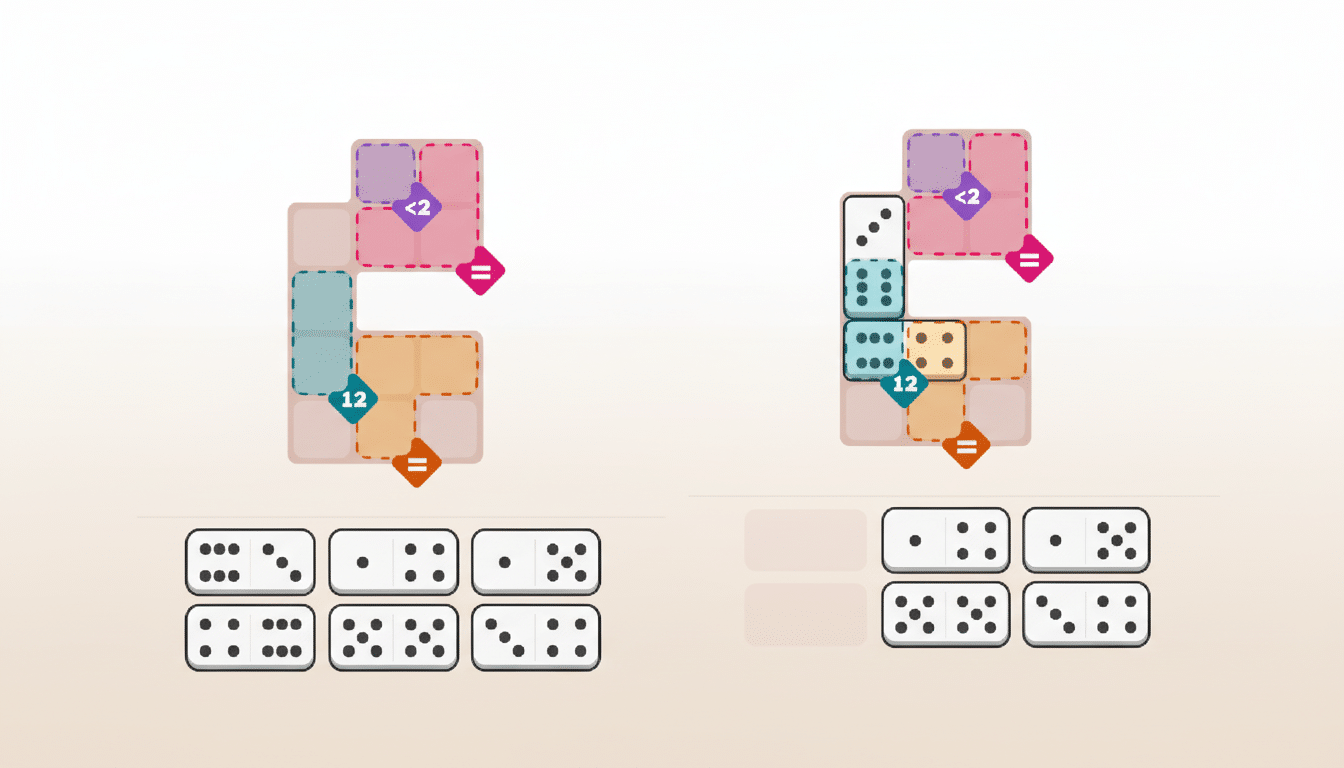
Less Than 4 zone: Play 0-3 across; you won’t want to play 1-2 here if it’s going to copy over somewhere into a Not Equal zone.
Greater Than 3 zone: Put down a 2-2 vertically for an easy sum of 4 that is more compact.
Equal 5 zone: Fill with 5-5 back and forth, then insert a vertical 5-1 so only the “5” half actually touches the zone.
Not Equal cluster: 6-5 vertical solved, 4-3 horizontal, then 2-1 vertically so that each half in the zone is unique.
Hard hints for mastering today’s NYT Pips puzzles
Switch to a boundary-first mindset. On Hard, many zones interlock, so seat doubles (such as 3-3, 6-6) where they can limit exposure. Address 2 and Less Than 2 as soon as possible to create safe paths through the crowded terrain.
If you are confronted with a large Not Equal zone, seed with the first three values and then backfill with tiles that have outward halves for neighboring sums. This prevents uncomfortable rewinding late in a solve.
Hard answers for today’s NYT Pips daily challenge
Equal 3 zone: Put 3-3 vertically and bridge a 3-1 horizontally across so that only the “three” half of the properties makes contact with the zone.
Zone 2: Fit 0-2 vertically to leave zero open for future Equal 0 interactions.
Number 9 box: Play 4-5 across to underexpose a nearby 6 paired near an edge.
Less Than 2 zone: Slot 0-1 horizontally; save 0-0 for an isolated corner still in need.
Greater Than 6 zone: Go 3-4 horizontally for a safe 7 that gets along well with surrounding sums.
Zone 7: Place 1-6 vertically with its “1” facing a bendy neighbor.
0 cluster: Stack 0-0, 0-5, and 0-1 vertically; only the zero half touches the zone.
Less Than 5 zone: Run 2-2 vertically to a clean-looking 4-man spacing and nothing to blow up nearby thresholds.
Not Equal block: Complete with 6-1 vertically, 5-4 horizontally, and finally 3-2 horizontally to keep all different halves inside the box.
Strategy notes to help solve today’s NYT Pips board
Constraint propagation’s your pal: do all of the strict stuff first, and recompute open sums after each placement. Puzzle researchers who work on combinatorial search often suggest “least-constraining value” next, which in Pips means favoring tiles that leave the greatest number of legal follow-ups. If one placement fixes a zone and starves two, it’s a bad trade — undo and find something to play that doesn’t screw you on today’s board.
If you get to the end of a section and something still doesn’t click, backtrack to your first Not Equal or Greater Than option. One reversible swap there generally gets the path back to a clean end.
