


Nvidia’s newest leap in AI scaling comes with DLSS 4.5, a big new update that claims to deliver up to six times more frames and visibly cleaner details on RTX hardware. The headline changes join a smarter Transformer-based image quality model with a new multi-frame generation mode capable of synthesizing five frames for every one the game actually renders, injecting fluidity far beyond what native rendering can sustain.
What DLSS 4.5 Changes in Image Quality and Performance
DLSS 4.5 advances the AI pipeline that had replaced previous convolutional networks with a Transformer-based architecture. Nvidia claims that although its second generation Transformer still trumps the competition in terms of edge preservation, sub-pixel detail and texture faithfulness, it does so while also combating remaining problems like shimmer and temporal instability. The company is positioning DLSS Performance mode as just under native and says Ultra Performance is finally now playable at 4K — that’s a statement that will probably be thrust under the magnifying glass by third-party testers.
- What DLSS 4.5 Changes in Image Quality and Performance
- Six-Times Frame Generation Explained and Trade-offs
- Image Quality and Stability Improvements in DLSS 4.5
- Compatibility and Requirements for RTX 40 and 50 GPUs
- Intelligent Controls for an Unstoppable Play
- Under-the-Hood Formats and Precision for DLSS 4.5
- In the Games: Where DLSS 4.5 Could Shine Most
- Part of a Wider AI Push Across the RTX Ecosystem
- Bottom Line: DLSS 4.5 Sets an Ambitious New Bar
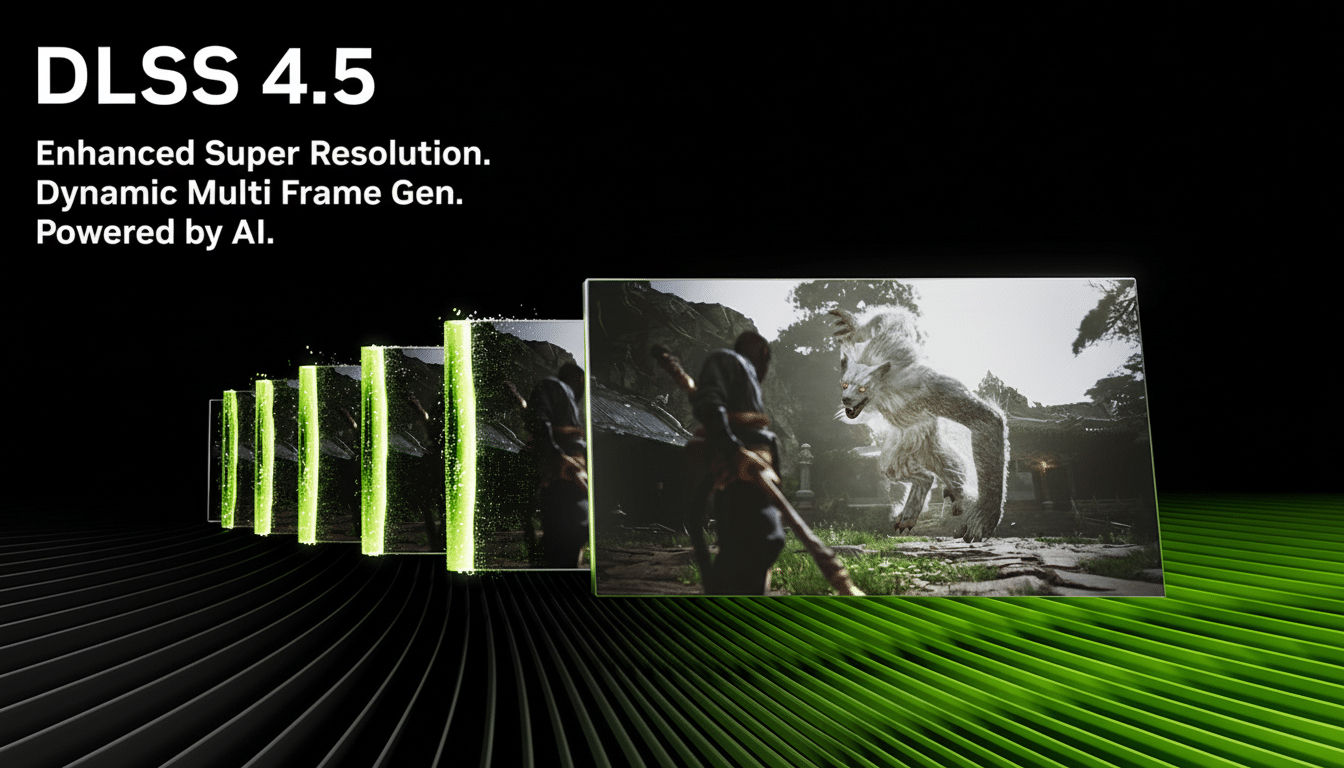
Six-Times Frame Generation Explained and Trade-offs
The 6x multi-frame generation effectively splices five AI-generated frames between every real one, boosting throughput massively over the earlier 4x option. That’s important in CPU-bound situations (think dense city builders or open-world games) where conventional upscaling can’t get the machine to produce more frames. Nvidia’s Reflex stays crucial in this regard, trimming the overall system latency so that high FPS fastness doesn’t start to feel floaty. The trade-off calculus is well-known: more fluid motion and better frame pacing, at the expense of artifacts in complex motion or transparency effects.
Image Quality and Stability Improvements in DLSS 4.5
Ghosting at high-speed objects and less-than-perfect anti-aliasing have been the complaints laid against previous DLSS implementations from enthusiasts and analysts like Digital Foundry.
Nvidia says 4.5 addresses both fronts with improved motion vector usage, training data and an optical flow pipeline. The idea is to preserve thin geometry such as wires, foliage or specular highlights sharp while also preserving temporal coherence, especially during fast camera pans and even when particles are moving.
Compatibility and Requirements for RTX 40 and 50 GPUs
Nvidia says the DLSS 4.5 system will be available across its RTX family, including desktop and laptop designs based on RTX 40- and 50-series GPUs. But the new second-gen Transformer model is only for RTX 50-series cards, which also mirrors the heavier AI workloads and memory formats that favor newer silicon. RTX 40-series hardware owners will still enjoy the expanded frame generation options, although the top-end image model is a 50-series exclusive.
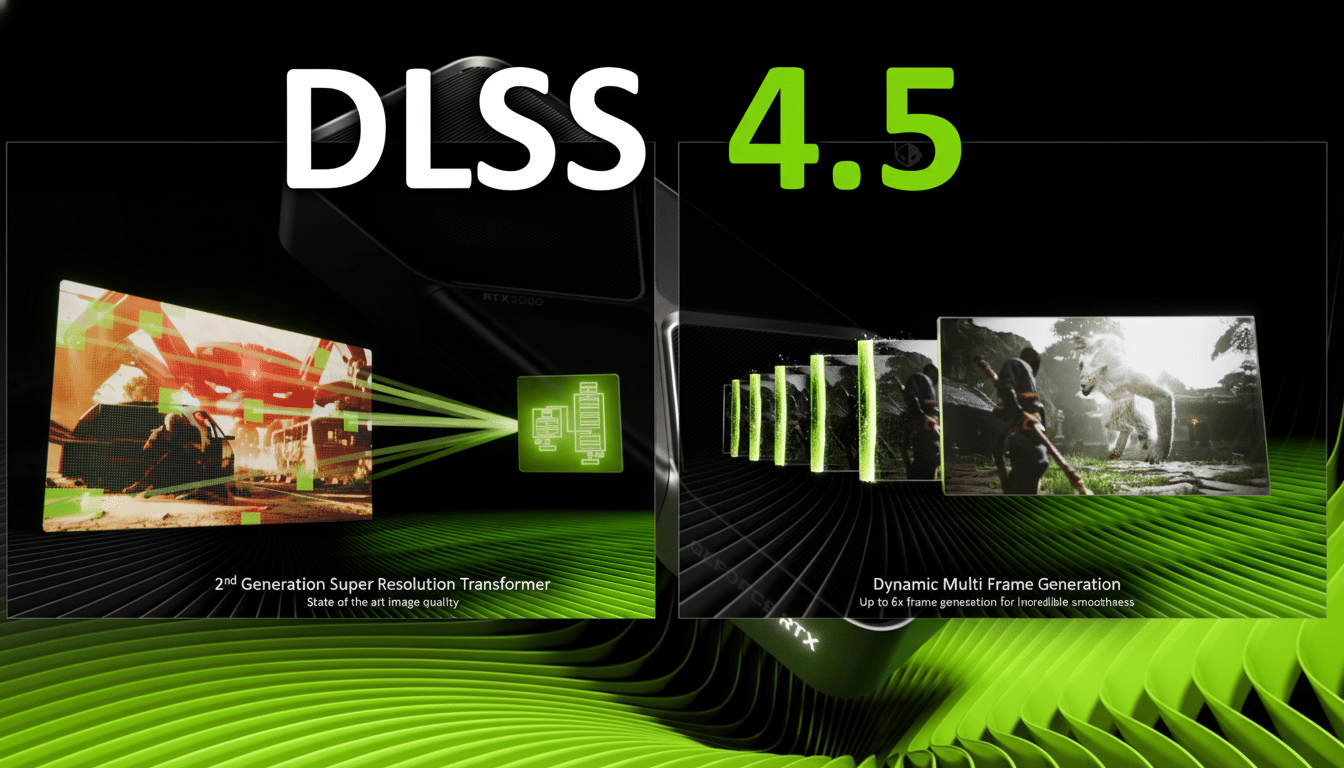
Intelligent Controls for an Unstoppable Play
In an effort to pare down the “set-and-pray” aspect of tuning that many players currently juggle, DLSS 4.5 introduces a dynamic frame-generation multiplier. It can turn synthesis up or down to meet a target frame rate, emphasizing image stability when there’s headroom. You can also expect features to be more tightly integrated with engines via Nvidia Streamline and popular toolchains — Unreal Engine plugins, that kind of common SDK path — so devs can tap into these controls without doing bespoke work for every title.
Under-the-Hood Formats and Precision for DLSS 4.5
Nvidia is also debuting alongside DLSS 4.5 NVFP8 and NVFP4 precision formats optimized for AI inference and training, which can reduce data footprints up to 60% versus higher-precision formats. Citing FP8-class math, the DLSS 4.5 Transformer was listed with FP8-class math, reflecting an industry-wide move toward lower-precision compute for more speed and efficiency. For DLSS, that means larger models or faster passes within the same thermal budget — which is a tangible gain for laptop GPUs and thermally constrained desktops.
In the Games: Where DLSS 4.5 Could Shine Most
Previous early-generation independent testing out of TechSpot and Digital Foundry consistently showed 2x–3x frame rate improvements from AI-generated frames in complex, heavy ray-traced scenes. A 6x multiplier assures that you’ll never be seeing linear scaling, but it at least gives devs some flexibility in their desire to ship high-end lighting and geometry at 4K while being able to control the game. CPU-bound games, memory-heavy racing sims with lots of AI and massive open-world RPGs stand to gain. Competitive gamers are the exception, at least — there’s still preference for lower generation settings among the mainstream audience in order to keep those latencies and artifacts low.
Part of a Wider AI Push Across the RTX Ecosystem
DLSS 4.5 is part of a growing RTX AI stack. RTX Remix Logic is an approach to current classic titles with work over assets and path-traced effects, while Nvidia ACE brings on-device assistants and NPC (non-playable character) logic for new games — Sega’s Total War series is one of the first out the door with an in-game advisor. For studios, they are compressing iteration cycles and opening up new design space; for players, they are a sign that AI-driven fidelity and performance improvements are being commoditized rather than bolted on.
Bottom Line: DLSS 4.5 Sets an Ambitious New Bar
The promise behind DLSS 4.5 is simple: more frames, clearer images and smarter control of both. The second-generation Transformer and the 6x frame generation strive to make 4K with advanced effects a natural choice, not a demo. As always, the proof will be in real-world testing across a variety of games and GPUs, but the general direction is clear — the future of PC graphics seems increasingly AI-shaped, and DLSS 4.5 marks Nvidia’s most assertive step in that direction yet.
