


NASA says the next crewed Artemis mission can launch without the massive deep space dish at Goldstone, California, which has been offline for months. Despite the loss of the 70-meter “Mars Antenna” known as DSS-14, agency planners maintain Artemis II will have robust communications and navigation support from the rest of the Deep Space Network and partner stations.
Why NASA Says It’s Still a Go for Artemis II
Mission integration teams at the Jet Propulsion Laboratory say Artemis II was never baselined to use DSS-14, so the outage does not change their coverage plan. Instead, Orion will rely on the agency’s two other 70-meter dishes in Madrid and Canberra and an array of 34-meter antennas across all three complexes. JPL routinely “arrays” multiple 34-meter dishes to match or exceed the link performance needed for voice, telemetry, and high-rate data—more than enough margin for a lunar-distance flight.
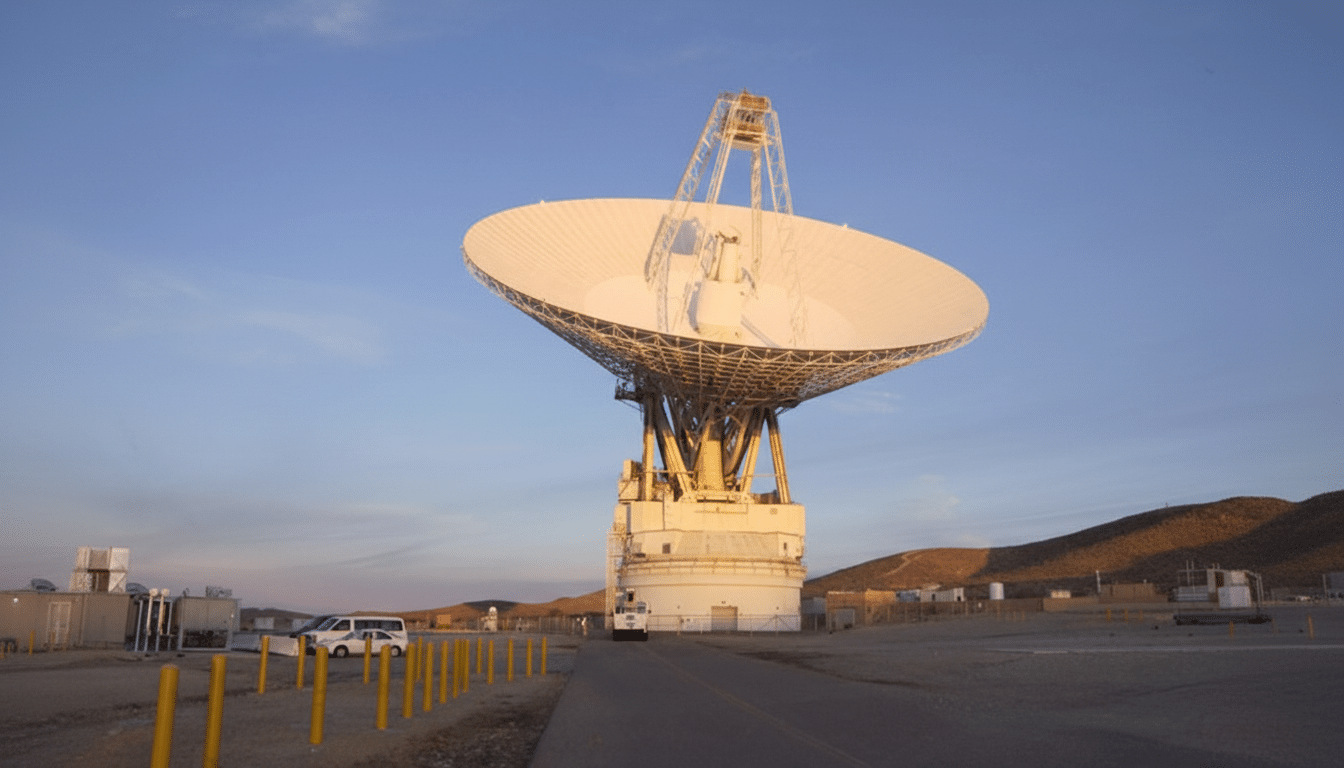
The decision reflects a broader strategy: spread critical passes across multiple sites and bands, and pre-book international backups, so a single-point failure does not threaten crew safety. According to NASA communications officials, those redundancies were built into Artemis II’s timeline and trajectory design.
What Happened at Goldstone’s DSS-14 Antenna
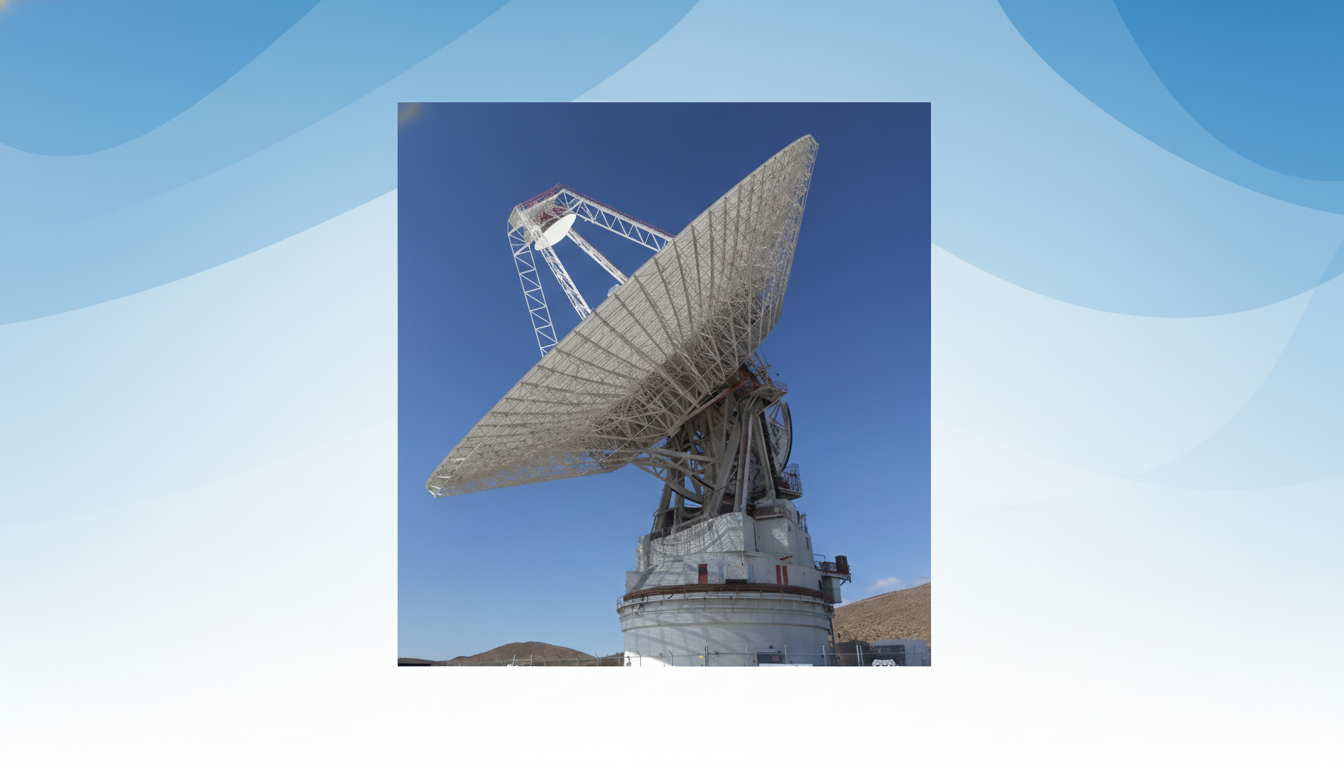
DSS-14, the largest antenna at the Goldstone complex, suffered a mechanical over-rotation during operations that damaged components near its central hub. Fire suppression plumbing also ruptured, causing localized flooding before technicians could secure the system. The venerable dish—roughly the size of a wide-body airliner—has survived mishaps and even a major earthquake in past decades, but this latest incident required a prolonged stand-down for assessment and repairs.
Goldstone’s importance is undeniable. During Artemis I, when a separate issue took a Goldstone station offline, NASA lost contact with Orion for several hours. Controllers later traced the blackout to aging storage hardware and software faults. That episode sharpened NASA’s focus on maintenance and real-time health monitoring across the network.
How Orion Will Stay Connected Without DSS-14
Artemis II will use S-band for command, voice, and low-rate telemetry, and Ka-band for higher-rate data and video. The Deep Space Network’s dishes support both, providing two-way Doppler and ranging for precise navigation. Even without DSS-14, the network can schedule passes through Madrid and Canberra, while Goldstone’s 34-meter antennas can be combined for additional gain when the geometry favors the U.S. site.
Onboard, Orion carries star trackers and inertial measurement units for autonomous navigation, giving the crew and flight controllers multiple ways to verify state vectors and execute burns. If DSN coverage ever dips, stored commands and onboard guidance keep the spacecraft within its planned corridor until the next pass restores full telemetry.
A Network Under Strain and Being Upgraded
NASA’s Deep Space Network manages more than 40 active missions from three sites—Goldstone in the Mojave Desert, Canberra in Australia, and Madrid in Spain—carefully orchestrated so at least one complex has line-of-sight to deep-space craft as Earth turns. Demand has ballooned as probes return higher volumes of science data, with traffic surpassing original capacity by roughly 40%.
NASA’s Inspector General has repeatedly cautioned that maintenance and modernization must keep pace. A recent audit on Artemis II readiness concluded that communications disruptions are increasingly likely without sustained investments. In response, NASA is expanding the network under the DSN Aperture Enhancement Program, adding six new dishes, including a 34-meter antenna at Goldstone slated to join operations soon.
International Backstops and Added Resilience
To guard against unexpected outages, NASA has strengthened agreements with international partners. Japan’s JAXA and European tracking networks can provide overflow coverage for critical phases, adding geographic diversity and freeing DSN antennas for the most demanding passes. The agency also replaced vulnerable hardware flagged after the Artemis I blackout and enhanced monitoring to catch faults before they cascade.
The calculus is straightforward: crewed missions require layered redundancy. With two 70-meter dishes still available globally, arrays of 34-meter antennas, upgraded ground systems, and partner support, Artemis II’s communications plan meets the program’s risk posture even while Goldstone’s flagship dish awaits a full return to service.
The Bottom Line on Artemis II Communications Readiness
NASA’s message is that Artemis II does not hinge on a single antenna. The DSN’s distributed architecture, recent corrective actions, and added international coverage give Orion multiple paths to stay in touch and on track. The Goldstone giant will be missed until repairs are finished, but it is not a blocker for the first crewed flight of the Artemis era.
