


Elon Musk has escalated his long-running dispute with OpenAI, asking a court to order OpenAI and its largest backer, Microsoft, to pay what his attorneys say is up to $134 billion in gains tied to his early role in building the AI lab. The filing argues OpenAI reaped between $65.5 billion and $109.4 billion due to Musk’s contributions, while Microsoft benefited by roughly $13.3 billion to $25.1 billion.
The latest claims sharpen a high-stakes fight over who deserves credit—financial and reputational—for OpenAI’s transformation from a nonprofit research collective into the most commercially influential AI startup of its generation.
- Inside Musk’s $134 billion restitution claim against OpenAI
- OpenAI pushes back, disputing Musk’s damages theory
- Where Microsoft fits into OpenAI’s partnership battle
- What Musk says he contributed to OpenAI’s early rise
- A long legal road ahead for Musk, OpenAI, and Microsoft
- Why this case matters for AI labs, investors, and courts
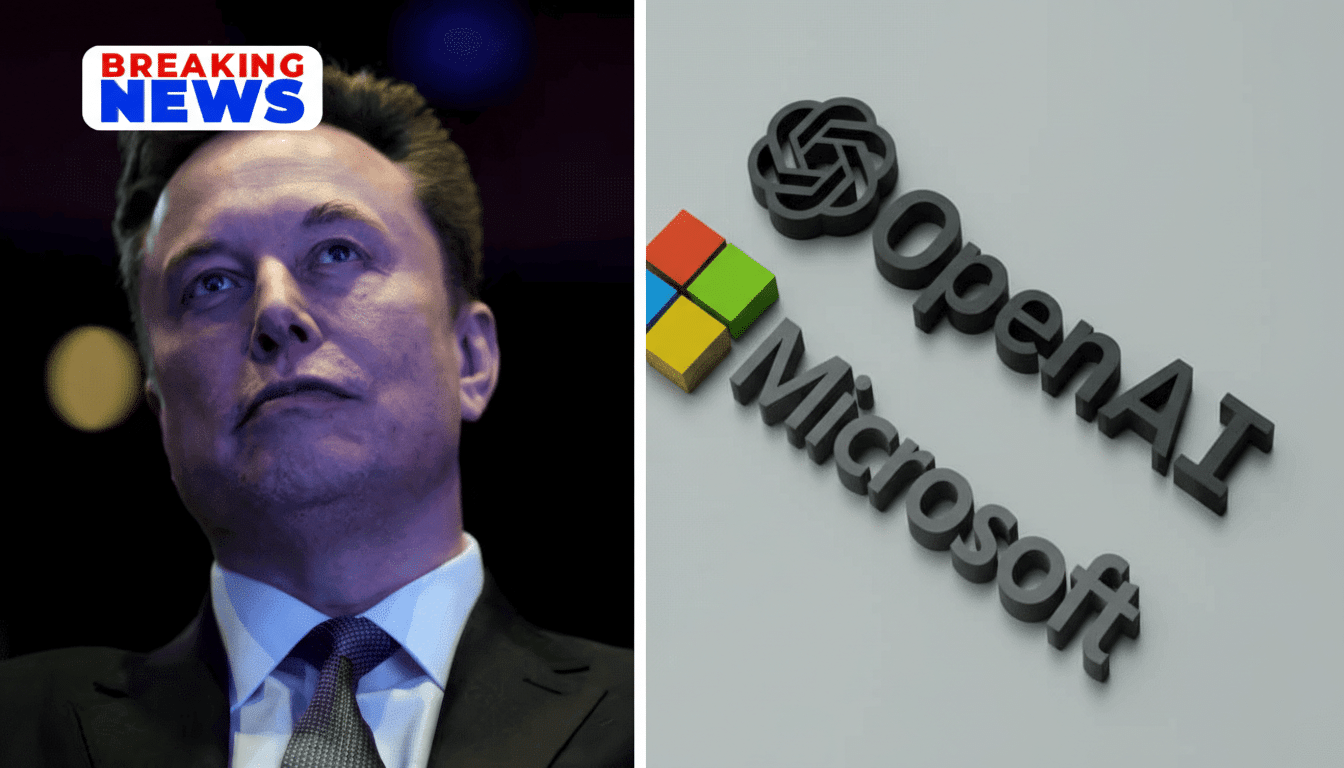
Inside Musk’s $134 billion restitution claim against OpenAI
Musk’s legal team frames the case as a straightforward restitution dispute: he allegedly supplied not only substantial early funding but also talent, contacts, product guidance, and public credibility that accelerated OpenAI’s trajectory and, by extension, Microsoft’s AI strategy. The filing cites $38 million in seed money—about 60% of the organization’s initial nonprofit funding—alongside nonfinancial contributions such as recruiting early technical leaders and securing industry relationships.
At the core is a counterfactual: absent Musk’s involvement, would OpenAI have achieved comparable scale or market impact? His attorneys argue no, and they model OpenAI’s and Microsoft’s purported gains accordingly. The figures are eye-popping and will face rigorous scrutiny, given that courts generally require a clear causal link between a contributor’s actions and another party’s enrichment.
OpenAI pushes back, disputing Musk’s damages theory
OpenAI rejects the damages theory and the premise behind it. In a public response, the company accused Musk of misrepresenting the record and pursuing a strategy intended to slow OpenAI while bolstering his rival startup, xAI. The lab also referenced private notes from its leadership to argue that Musk sought majority control and floated ideas about controlling Artificial General Intelligence, assertions OpenAI says undercut his current narrative.
The tension reflects a deeper disagreement about mission and governance. Musk has repeatedly said OpenAI strayed from its original nonprofit commitment. OpenAI counters that its hybrid structure—a nonprofit parent with a capped-profit subsidiary—was necessary to fund cutting-edge research at unprecedented scale, while still limiting investor returns to a multiple rather than an open-ended upside.
Where Microsoft fits into OpenAI’s partnership battle
Microsoft is not a bystander. Its multiyear partnership with OpenAI spans massive cloud compute commitments, product integrations across Windows, Azure, and Copilot, and joint safety research. The filing’s estimate of Microsoft’s gains likely reflects a mix of strategic advantages—faster AI adoption in enterprise software, cloud consumption growth, and differentiation against rivals—rather than a single revenue line.
Analysts have long noted that AI demand can be a flywheel for hyperscale clouds, where training and inference workloads drive infrastructure spending. By tying damages to perceived knock-on effects across Microsoft’s ecosystem, Musk’s case ventures into complex attribution territory that will test how courts weigh indirect benefits in fast-moving technology markets.
What Musk says he contributed to OpenAI’s early rise
Beyond funding, Musk’s team highlights several intangible inputs that are notoriously hard to price: recruiting foundational researchers, introducing critical partners, and lending the “prestige and reputation” that helped OpenAI attract talent and attention in its formative period. In startup land, these factors matter—top-tier people and early credibility often compress years of trial-and-error into months.
Still, translating intangibles into a dollar figure typically requires detailed contemporaneous records and expert testimony. Expect economists to debate counterfactual scenarios and to compare OpenAI’s path with peer organizations, from academic labs and consortia to commercial AI ventures that never secured comparable funding or distribution.
A long legal road ahead for Musk, OpenAI, and Microsoft
This dispute has already cycled through complaints, withdrawals, and fresh filings, with allegations expanding from mission drift to broader claims of misconduct. A prior takeover effort led by Musk and outside investors was rebuffed by OpenAI’s board, signaling that a negotiated settlement is far from guaranteed.
Legal scholars note that claims resembling unjust enrichment can succeed when contributions are clear and compensation is lacking, but the bar rises with time, complexity, and the number of intervening events. With OpenAI’s governance structure, Microsoft’s deep integration, and xAI’s emergence as a direct competitor, the factual record will be dense and hotly contested.
Why this case matters for AI labs, investors, and courts
However the court rules, the case spotlights unresolved questions in AI’s breakneck phase: how mission-driven labs balance openness with capital needs, how to value early-stage influence, and where to draw the line between personal brand capital and corporate ownership. It also underscores how quickly AI partnerships can reshape entire platforms—raising the stakes for anyone claiming to have set the flywheel in motion.
For OpenAI and Microsoft, the financial exposure may be less material than the strategic distraction. For Musk, the fight is as much about narrative control as dollars. And for the broader industry, the outcome could sketch new boundaries for credit and compensation in an era when reputation, research, and compute scale collide.
