


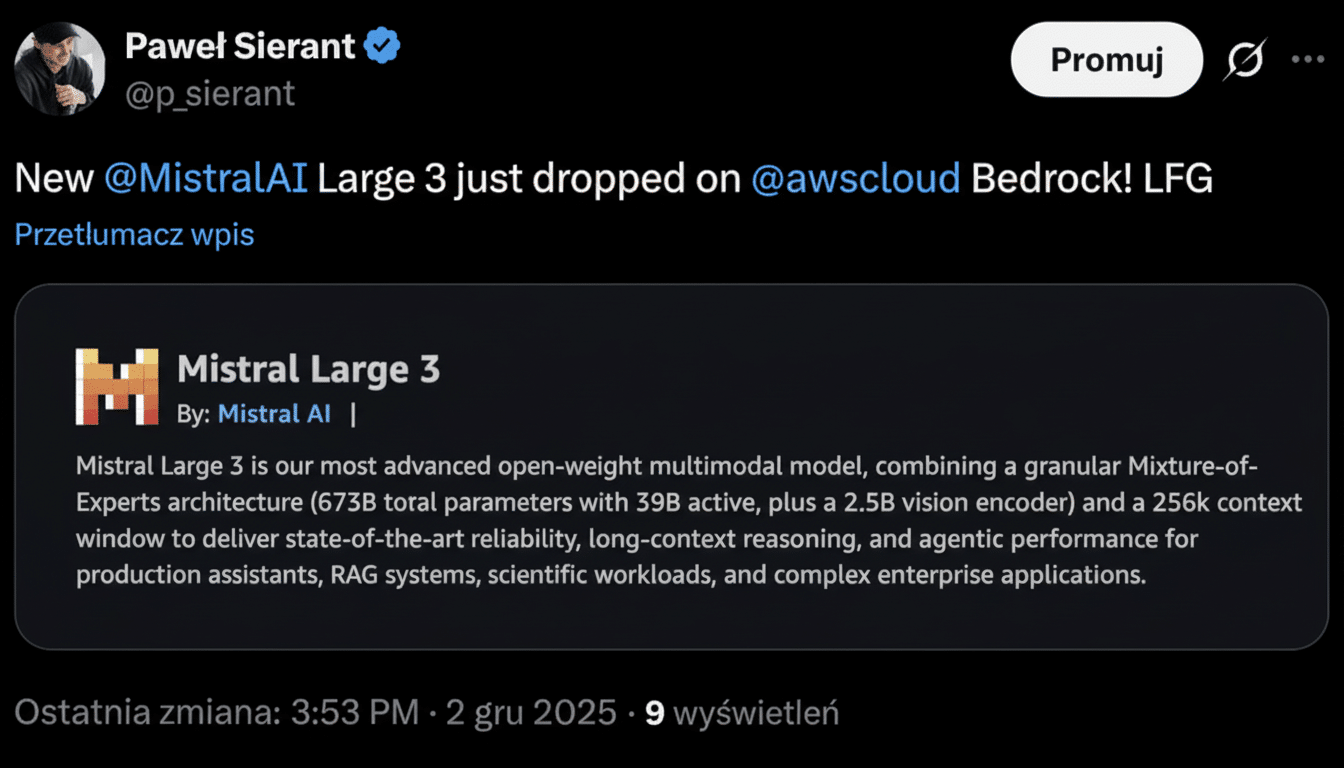
French AI startup Mistral has announced its flagship, high-performance computing product family – the Mistral 3 – featuring a frontier large-scale open-weight model combined with an array of smaller infrastructure and customizable systems focused primarily on enterprise workloads.
The combination packs enough multimodal capacity and long-context reasoning to bring companies into closer competition with larger rivals, while also offering practical deployment options that run on relatively modest hardware.

A Frontier Model That Checks All the Big Boxes
“The new flagship, Mistral Large 3, has both multimodal and multilingual capabilities in a single open-weight frontier model—a space that used to be dominated by closed systems like GPT-4o and Gemini.” It also sits alongside top open-weight contemporaries like Llama 3 and Qwen3-Omni, and succeeds previous Mistral pairings that saw vision and language spread across different models.
Large 3 is built on top of Large and employs a fine-grained Mixture-of-Experts architecture with 41B active (about 675B total) parameters, allowing for better routing and throughput across the broader context window of 256K tokens. That combo is designed for big jobs: long-document understanding, complex coding and multilanguage assistants; agentic workflows that knit together tools and retrieval.
Mistral posits that the open-weight model makes for a strong and cost-sensitive choice, suggesting that by using such models teams can self-host or optimize more tightly around domain data space while controlling latencies without losing their data asset to third-party APIs. It’s a practical stance in a market where benchmark leadership counts, but boring cost and integration profundity often close the deal.
Ministral 3 Makes Its Bet On Smaller, Faster, Cheaper
Nine compact Ministral 3 models were introduced, corresponding to the flagship version and available in Base, Instruct & Reasoning varieties across sizes of 14B, 8B and 3B.
All support vision, handle a context window of 128K–256K, and are tailored to multilingual scenarios. The pitch: Choose the precise amount of capacity and behavior you want, with fine-grained tuning for your domain.
These tiddlers are, Mistral believes, capable of competing with closed systems on real-world workloads after customization and kick off fewer tokens for equivalent tasks — an underappreciated lever in controlling your inference bills. It’s also important to point out that many configurations run on a single GPU, freeing up offline edge deployment from the on-prem racks down to laptops, robots and vehicles.
Licensing also signals accessibility. Mistral has specified friendly terms for certain small models, leaving the frontier model unrestricted in weight when self-hosted only under… business-friendly conditions. The approach reflects a larger trend in the market for open-weight releases that support intimate tuning without losing IP or data governance.
Enterprises And The Importance Of Open Weight
Open weights grant enterprises control on security boundaries, cost structure and performance tuning. For regulated verticals and EU-based companies trying to comply with data residency and the AI Act, hosting models in-region as well as auditing behavior is typically a need, not a nice-to-have.
There is also a dimension of reliability. Self-hosted models ensure teams are protected from third-party API outages, throughput limits or sudden policy changes. This is especially true with mission-critical applications where any downtime could be expensive.
Adoption tailwinds are real. According to McKinsey’s 2024 State of AI survey, 65% of companies employ generative AI at scale, yet many claim escalating inference costs and integration hurdles have held them back. Both pain points are directly targeted by smaller, fine-tuned models, especially those that can fit on commodity GPUs.
Robotics And Edge Deals Point To A Strategy
Mistral is doubling down on physical AI, in which devices are required to implement small models to overcome constraints of latency, bandwidth and reliability. The company is partnering with Singapore’s HTX in areas including robotics, cybersecurity and fire safety systems; with Helsing on vision-language-action stacks for drones; and with Stellantis on in-car assistants. These are textbook edge cases where single-GPU usage is a feature, not a concession.
Others are exploring similar trade-offs. Cohere’s Command A is designed for two-GPU footprints and its foundation platform can operate on one GPU. The market, in turn, is coalescing around a compelling thesis: specialization and focus on proximity to the data often trump generic cloud-only giants when it comes to production-grade workloads.
The Competitive Picture for Mistral’s Open-Weight Strategy
Mistral’s war chest — some $2.7 billion raised at a valuation of $13.7 billion — is puny compared to Big AI players that have hoovered up tens of billions and rest on valuations many times bigger. But the company is charting a different course: open-weight access, aggressive efficiency and models built for tweaking rather than leaderboard theater.
This time around, benchmark headlines will continue to play in favor of the very biggest closed models when using them straight out of the box. But companies are increasingly valuing their time, with how quickly a model can be adapted to proprietary data and tools among the key new benchmarks. On those fronts, Mistral’s frontier-plus-small-models combo is built to chip away.
What to watch for next:
- Independent evaluations assessing Large 3’s multimodal and long-context performance
- Ministral 3 in the wild at scales of 3B–14B
- Licensing terms influencing how widely these models roam
Even if Mistral’s promises pan out in pilots, the company doesn’t have to be the largest to be a major player.
