


Microsoft said Exchange Online mailbox connectivity was returning late Aug. 31 after an outage disrupted Outlook email, sign-ins and mailbox operations for some business and enterprise customers. The recovery did not mean every affected function was immediately normal: Microsoft reported that it was still restoring search and working through email that had accumulated in queues.
The incident is a reminder that cloud email failures are not confined to an inbox application. Exchange Online underpins corporate mail delivery and access, and Microsoft’s reported service-health updates ultimately described degradation across Teams, OneDrive for Business, SharePoint Online, Purview and Defender XDR as well. Organizations may regain access to mailboxes before delayed messages and connected services fully catch up.

Authentication deployment was Microsoft’s reported cause
Microsoft initially said it was examining telemetry and diagnostic data as reports of Exchange Online trouble rose on Aug. 31. TechCrunch reported that the company had identified an issue involving an authentication component and was testing a remediation on part of the affected infrastructure before a wider deployment.
A later Mashable report provided the most specific public account of Microsoft’s assessment: a misconfiguration had prevented authentication components from deploying correctly to a portion of its infrastructure. That is Microsoft’s explanation, relayed through reporting rather than a directly accessible Microsoft incident report, so it should not be read as an independently established postmortem.
Authentication is the process that confirms a user or service is permitted to connect. If the components handling that task are not deployed properly, the visible symptoms can extend beyond an Outlook client failing to open: users can have trouble signing in, connecting to a mailbox, sending messages or receiving them. Microsoft said users could experience degraded functionality across Exchange Online while it reviewed the incident.
Recovery was gradual, not a single all-clear
Microsoft’s updates described a staged restoration. According to a service notice reproduced by Santa Fe College, Microsoft reapplied authentication components and progressively restarted targeted parts of the affected infrastructure. The college said its users began receiving Outlook email again by 8:30 p.m. local time, while warning that delivery could remain delayed and that residual effects were possible.
Late that day, Microsoft said mailbox connectivity should have returned to normal, according to Mashable. But it separately said search functionality was still being restored and that messages queued during the disruption could take time to clear. Those are materially different recovery states: a user may be able to open a mailbox while a message sent during the outage has not yet arrived, or while search remains incomplete.
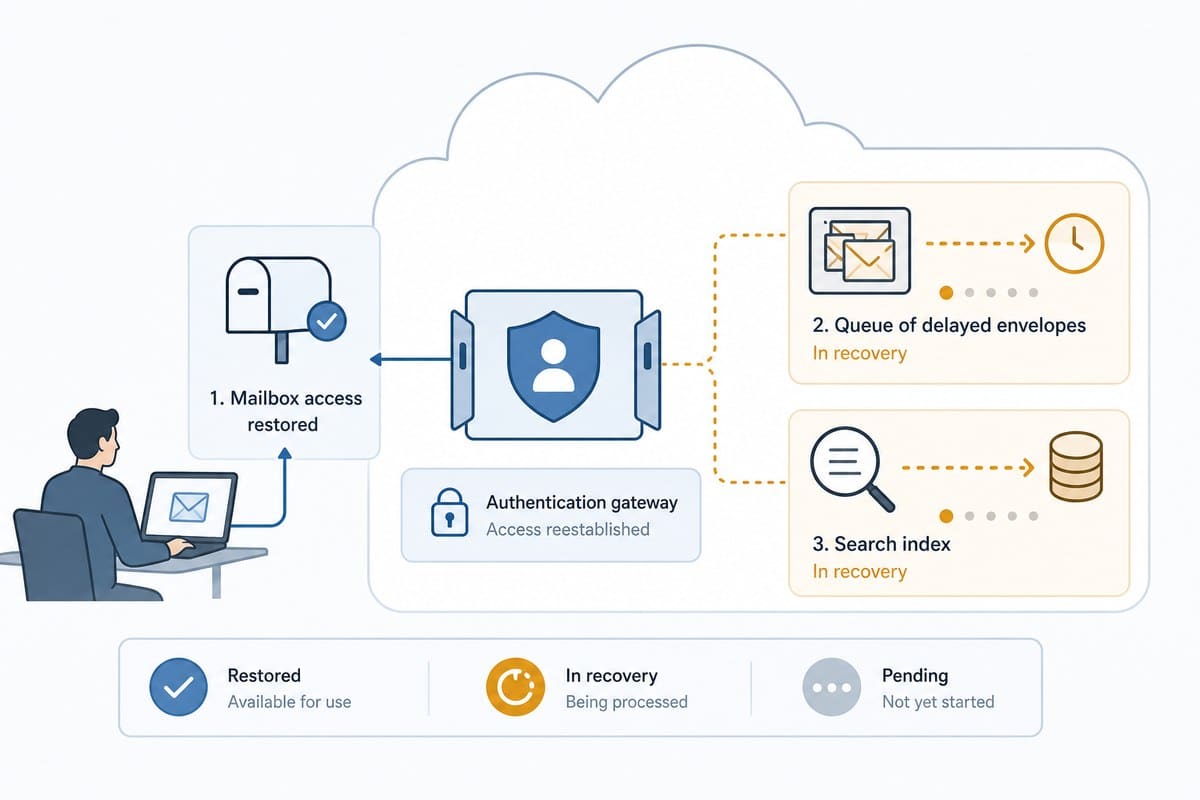
The available accounts therefore do not support treating the return of mailbox access as a declaration that every Microsoft 365 function, customer or region had fully recovered. A report in Australia the following morning noted continuing user complaints, but The Nightly’s account relied on a limited number of Downdetector reports and did not establish an official regional outage. The differing reports are consistent with a phased recovery and crowdsourced reporting, rather than proof that Microsoft’s status statement was wrong.
Outage reports show scale signals, not customer totals
Public reports rose sharply around midday on Aug. 31. USA Today reported that Outlook-related reports on Downdetector peaked at nearly 6,000 around 12:24 p.m. Eastern time; Mashable cited a rise above 6,000 shortly after 11:16 a.m. Eastern. The variation reflects snapshots taken at different times, not necessarily competing counts.
Neither figure represents 6,000 affected people, mailboxes or companies. Downdetector collects voluntary problem reports, which are useful for detecting a sudden surge but cannot measure total impact. The evidence does establish that the disruption was broad enough to produce a pronounced public reporting spike and to affect at least one institution that publicly documented its operational response.
It also exposed a gap in public visibility during the event. Mashable reported that Microsoft’s public service-status page initially showed products operating normally even after the company had acknowledged an Exchange Online problem, before broader degradation was later listed. The available reporting does not explain whether this reflected a delay in updating the public page or a difference between public information and the notices available to tenant administrators.
For affected organizations, the practical status at the end of Aug. 31 was more qualified than a simple “up” or “down” label: Microsoft reported restored mailbox connectivity, while queued mail and search were still being restored.

