


MediaTek has introduced the Dimensity 9500s and Dimensity 8500, chips positioned to ride the current “flagship” wave stirred up by Qualcomm’s Snapdragon 8 Gen 5 lineup. On paper, they look fresh. In practice, they are mostly last-generation designs with modest tweaks, aimed at giving phone makers a cheaper path to premium branding rather than pushing the envelope on performance or features.
Dimensity 9500s Targets the Flagship Lite Segment
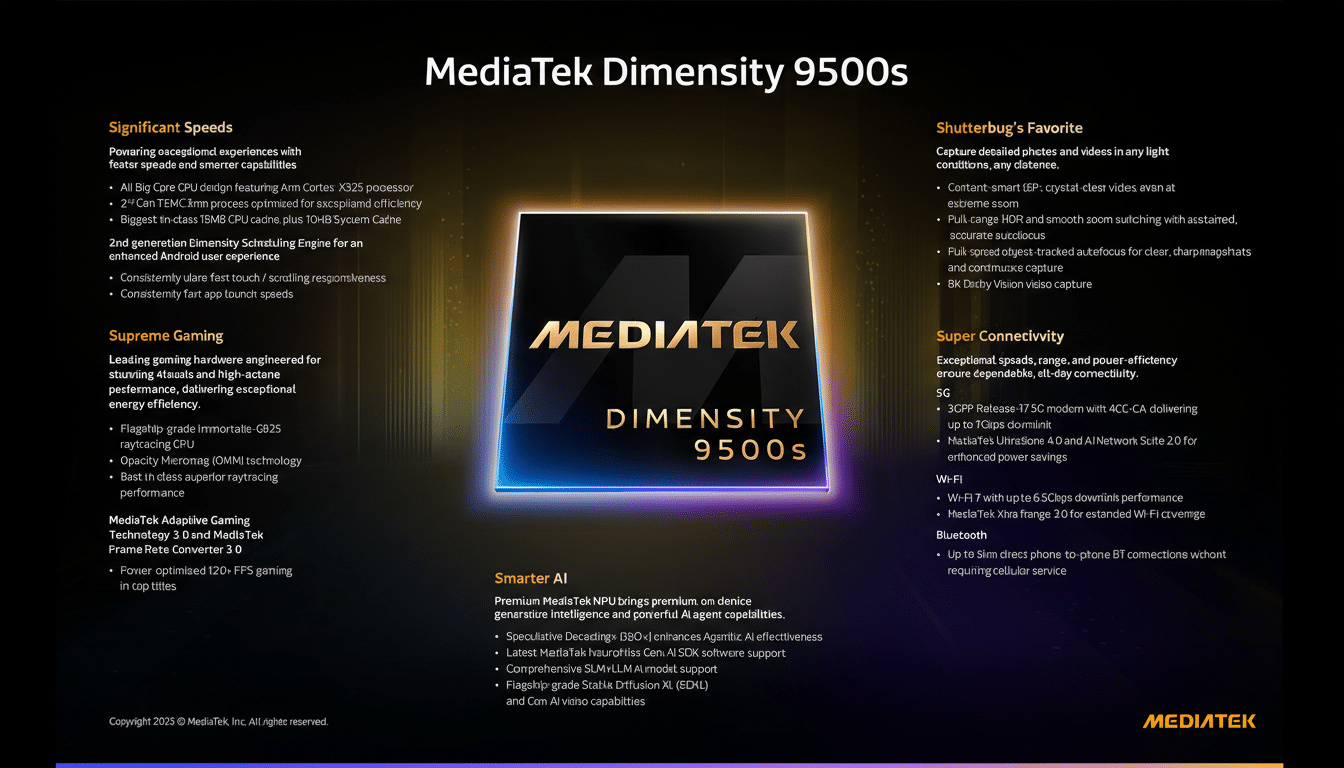
Built on TSMC’s 3nm N3E process, the Dimensity 9500s adopts a big-only CPU cluster but stops short of Arm’s newest cores. Its prime core is the older Cortex-X925 clocked at 3.73GHz, joined by three Cortex-X4 and four Cortex-A720 cores. That layout closely mirrors the Dimensity 9400 family rather than the latest silicon MediaTek showcased in its full-fat 9500. It’s a pragmatic bin, not a bold step.
The graphics side tells a similar story. MediaTek keeps the Immortalis-G925 GPU, a capable unit with hardware ray tracing and variable rate shading, but again not truly new. An eighth-generation NPU—expected to be the NPU 890—handles on-device generative AI tasks and multimodal features. For creators, the integrated Imagiq ISP supports 8K capture with Dolby Vision and focus tracking at up to 30fps, plus standard 8K recording at up to 60fps.
In short, the 9500s looks like a speed-bin and branding play: maintain the 3nm advantages of N3E (better density and power than 4nm) while reusing proven CPU and GPU blocks. Expect strong burst performance and decent efficiency, but not the leap you’d associate with a true new flagship core architecture.
A Counter To Qualcomm’s Split Flagship Strategy
Qualcomm’s recent split between Snapdragon 8 Elite Gen 5 and Snapdragon 8 Gen 5 gives OEMs two “flagship” tiers to hit different price points. MediaTek’s 9500 and 9500s now mirror that strategy—one for halo devices, one for affordable flagships that still carry premier branding. The timing isn’t accidental.
There’s a business logic here. Component costs have risen and memory prices have been volatile, a trend highlighted by firms like TrendForce. Reusing mature core IP on the same advanced node helps control die size, yields, and certification overhead. It also lets brands market “Gen AI,” “ray tracing,” and “8K” without paying top-shelf silicon premiums. But for enthusiasts comparing benchmarks and sustained performance, this round of “new” chips may feel more like a shuffle than a sprint.
Dimensity 8500 Refreshes The Upper Midrange
Positioned a rung below, the Dimensity 8500 is essentially a tuned version of MediaTek’s recent mid-premium platforms. It sticks to TSMC’s 4nm node and a CPU cluster of eight Arm Cortex-A725 cores with a peak frequency lifted to 3.4GHz from earlier 3.25GHz designs. The GPU remains Mali-G720, reportedly with higher clocks and improved drivers.
MediaTek claims the 8500 delivers a 25% performance bump and 20% better power efficiency versus its immediate predecessors. Expect smoother gaming via frame stabilization features and upgraded computational photography, including AI-assisted telephoto enhancements. These gains are likely rooted in frequency headroom, firmware, and scheduler tuning rather than architectural overhauls.
Devices and Early Outlook for Availability and Performance
The Dimensity 8500 is already inside the Honor Power 2 in China, a device notable for its massive 10,080mAh battery and endurance-first pitch. The Dimensity 9500s is rumored to headline an upcoming Redmi Turbo 5 series in China. Broader global availability remains unclear, and that will heavily influence how these chips shape the mainstream flagship and upper midrange segments.
Against Qualcomm’s roster, the 9500s should land near the Snapdragon 8 Gen 5 in many everyday tasks but trail the 8 Elite Gen 5 in sustained workloads, GPU compute, and peak AI throughput. As always, implementation matters: cooling design, storage speeds, and camera pipelines can swing real-world results more than a few hundred MHz on paper.
Bottom Line: Smart positioning without a true leap forward
The Dimensity 9500s and 8500 broaden MediaTek’s coverage rather than break new ground. They’re smart for partners chasing margins and marketing claims, less compelling for anyone expecting a generational leap. If you’re shopping, look past the badge—watch sustained performance metrics, thermal behavior, and image quality tests from independent labs like AnandTech and DxOMark. The true innovation push will come with the next wave of cores and GPUs, not this measured reshuffle.
