


LG has been getting ready to introduce a new home robot called CLOiD at CES 2026, and the announcement represents its most ambitious leap yet into consumer robotics. Marketed as an indoor assistant, CLOiD combines advanced manipulation, multimodal perception, and on-device AI to help people with its services round the clock.
Full details are still under wraps, but LG is painting a picture of a system designed for practical help instead of frivolous novelty: a mobile base equipped with dexterous arms, a sensor-rich “head” that can understand and communicate, and software that learns from your routine over time. No pricing or availability has been announced, re-emphasizing that this is an early glance at a flagship concept.
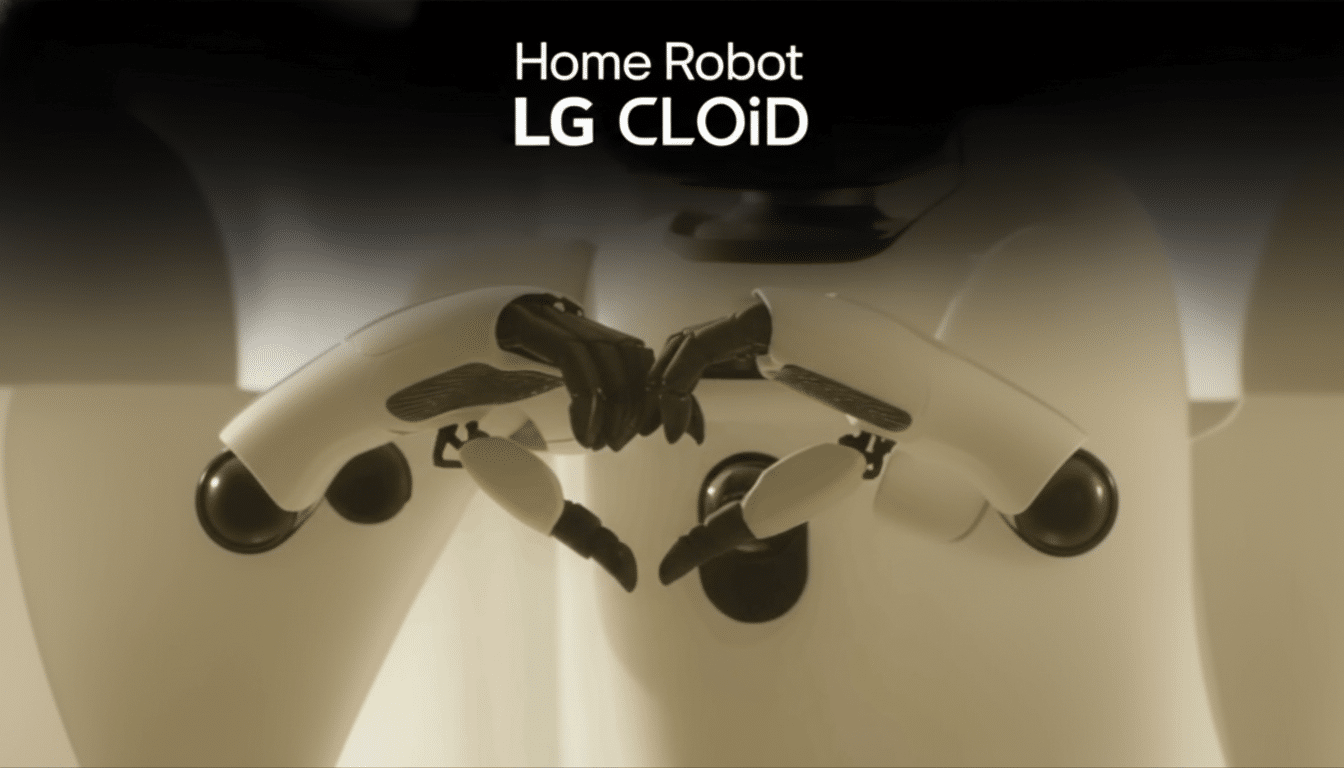
What LG Says About CLOiD’s Design, Arms, and AI
According to LG, CLOiD has two articulating arms with a five-finger gripper at the end of each for gentle manipulation—be it picking up delicate objects, manipulating or pressing appliance controls, or removing container lids. Each arm has seven degrees of freedom, a standard for industrial cobots and many research labs that allows it to reach like humans and orient its wrist like ours.
The head of the robot houses computing for on-board AI, a camera for vision, a display for expressive feedback to occupants of the home or workers at the job site, and a speaker that allows it to talk with them.
On top of that are environmental sensors in addition to the camera and two sets of eyes, as well as ways to safely navigate familiar environments by avoiding people or obstacles without walking into walls or furniture between its starting point and eventual destination. LG says the platform is powered by its own LG AI stack and will personalize over time, adjusting responses and routines based on repeat engagement with a household.
LG hasn’t shared any imagery, a shipping window, or a price range. As with many CES announcements, the initial reveal is likely to feature live demos and carefully controlled stunts rather than detailed specs. Real-world performance—battery life, noise, reliability, and safety thresholds—will still need to be tested.
How It Fits LG’s Robotics Playbook and Strategy
LG is no stranger to the CLOi brand. The company has deployed the ServeBot platform in standalone restaurants and GuideBot systems in airports and malls as it focuses on mobility, automatability, and interaction with consumers so they are served within public spaces. A robot for the home with hands ups the ante: Manipulation is the most difficult part of domestic robots, particularly around clutter, changeable light, animals, and people.
It also speaks to LG’s notion of the “zero-labor home,” wherein devices work in concert so you can minimize drudgery. CLOiD is likely to be pitched as the front-end for LG’s growing ThinQ ecosystem, a cooperative effort that not only sees data but thinks and then acts on that information across various Internet of Things–enabled appliances. The company teased some of this approach when it unveiled the LG Smart Home AI roving facial-recognizing agent in the past, focusing on both multi-sensor perception and intention as indispensable to in-home help.
The industry-wide picture is sobering. Household robots have found it tough to advance beyond light cleaning and surveillance. Amazon’s Astro has continued as an experiment in limited release, and Samsung’s photogenic Ballie has emphasized projection and companionship over outright manipulation. If CLOiD could consistently pick up, carry, and operate home-based interfaces, LG would be addressing the very bottleneck responsible for stalling the category.

The Current State of Home Robots and Devices
Domestic service robots—the overwhelming majority of them being vacuum cleaners and lawn mowers—now dominate among units shipped, according to data from the International Federation of Robotics. The devices work well because they automate a small, repeatable job in a controlled setting. A helper that must take care of dishes, laundry, or pantry items must not only perceive mess and variation, but it also has to reason about a safe motion plan in confined spaces—tasks that require solid perception, compliant control, and robust gripping.
Industry research, done by others and in academic labs, has pointed toward consistent incremental progress not just on cheap depth cameras, but also on tactile sensing and AI-based grasp planning. But the last mile—reliability in the typical, flawed home—is still a struggle. CLOiD’s seven-DOF arms and five-finger grippers indicate LG is wagering manipulation is now finally ready for public demos, at least, if not immediate mass deployment.
What To Watch At The Show: Demos, Safety, and Specs
Dexterity demonstrations will be the tell. Seek out meaningful tasks:
- Loading and unloading items
- Sorting groceries
- Serving drinks
- Opening doors or drawers
- Pressing appliance controls
- Light tidying up
Repeatable, reproducible performance across many runs is even more important than one orchestrated flourish.
The focus should be safety and the interaction between humans and robots. These include:
- Whether the robot has force limits and collision detection when working around children and pets
- How it recovers from errors
- How it conveys intentions
- Battery life and how often the device needs to be charged
- Operational noise in typical home settings
Integration and openness matter too. Will CLOiD be a walled-off assistant, or will it provide APIs for developers to create skills? Will core AI be on-device (for privacy) or in the cloud? And, importantly, will LG present a believable timeline and target price story—or paint this as a long-horizon concept?
If LG can deliver reliable handling along with a realistic timeline, CLOiD may liberate home robotics from its vacuum-sealed past. If not, it could go the way of many dazzling CES prototypes that never leave the show floor. Either way, the reveal will provide a snapshot of where household robotics is today—and how far it is from being widespread.
