


Lenovo is betting big on the all-in-one desktop, launching two Panther Lake-powered systems that dare — yes, we said dare! — to slash away at both design and workflow barriers. The Yoga AIO I Aura Edition gets an adaptive light bar across the front, as well as a touch of transparency to let its visuals sync up with yours, while the ThinkCentre X AIO Aura Edition goes nearly square with a 16:18 display ready for vertical-heavy work. Both are for shooters who build their own targets and for professionals who prefer fewer boxes on the desk and more smarts on the screen.
All-in-one desktops don’t come along as often as laptops, but when they do arrive, they usually set themselves apart. A pair from Lenovo does just that: one goes in on immersion and studio polish, the other rethinks screen shape to suit modern document-first work. Beneath the surface, both rely on Intel’s new Panther Lake silicon and Copilot+ PC functionality to usher on-device AI into everyday experiences.
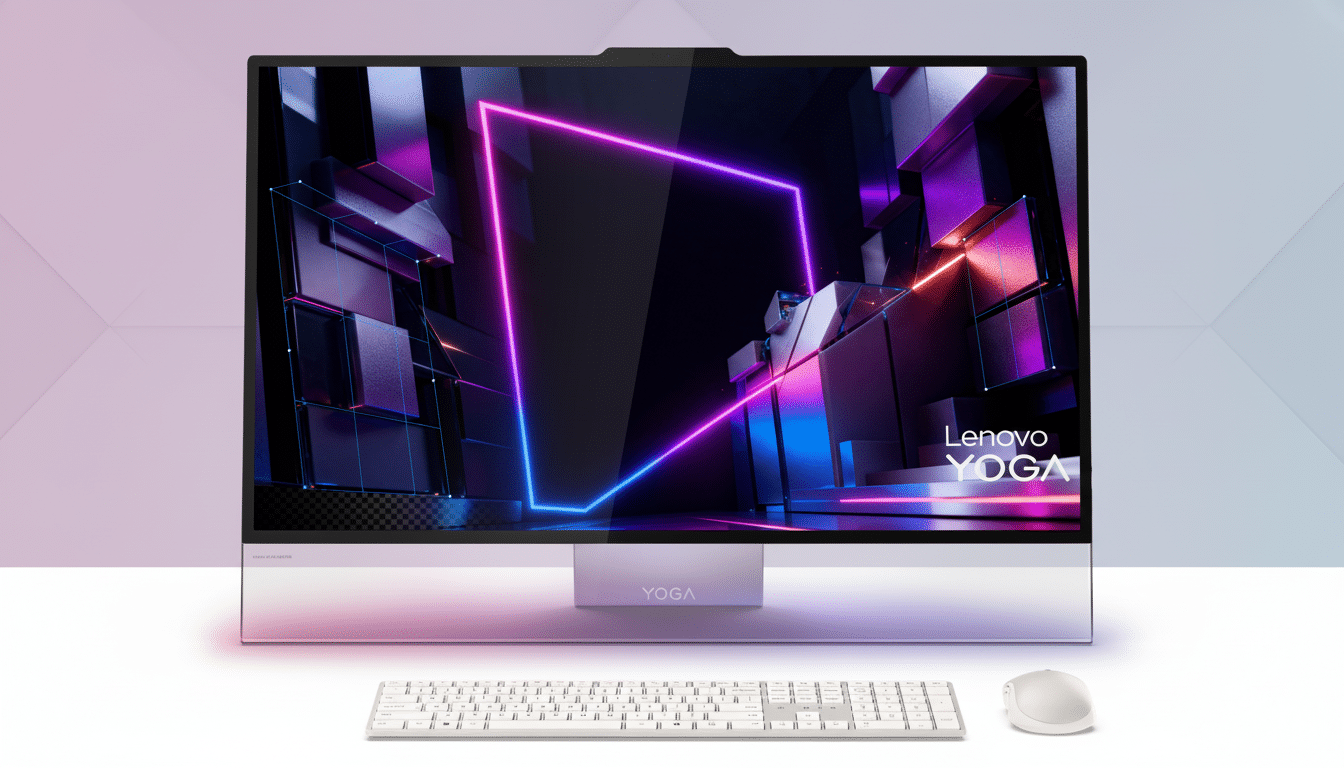
Yoga AIO I Aura Edition with Dynamic Adaptive Lighting
The Yoga AIO I Aura Edition boasts a 31.5-inch 4K OLED panel at 165Hz for vibrant color and smooth movement. At 3,840 by 2,160 pixels (approximately 8.3 million pixels), it offers clear detail at around 140 pixels per inch while making text and UI elements sharp without any scaling headaches.
Its most notable flourish is a see-through light bar that runs along the bottom edge of the body. Think of it as a desktop version of ambient TV lighting, à la Philips’ Ambilight — here, though, it’s part and parcel of the system “foot.” And the bar synchronizes with on-screen action to carry color into the room without blasting it in your eyes, also serving as a gentle notification system for messages or alerts. For creators, ambient bias lighting isn’t just a party trick; professionals have long recommended soft, indirect light behind a display to mitigate eye strain and equalize perceived contrast.
Performance and connectivity are on par with the high-minded panel. It’s powered by an Intel Core Ultra X7 358H processor, and supports up to a whopping 32GB of LPDDR5x memory as well as up to 2TB of PCIe SSD storage. Wireless is managed via Wi‑Fi 7, providing quick and flexible networking. Ports include a headphone jack, HDMI, two USB‑A, and three USB‑C (one being Thunderbolt 4 for high-speed peripherals). Up top is a 16-megapixel camera with facial recognition, protected by an electronic shutter. A concealed USB adapter tucks into the mouse and keyboard for all-in-one convenience — these details matter when your PC exists in plain view. The system will start at $2,399.99.
ThinkCentre X AIO Goes Almost Square For Productivity
And speaking of business, the ThinkCentre X AIO Aura Edition features an almost square 16:18 aspect ratio on its 27.6-inch display, with a resolution of 2,560 pixels by 2,880 pixels. That’s about 7.37 million pixels — again, about 140 pixels per inch or so — so text clarity would be consistent if you switch between Lenovo’s two AIOs. Extra vertical real estate is the point: 2,880 pixels high provides you with 33 percent more height than 4K’s 2,160; that means you can see more code, or rows or paragraphs at once.
Those who have pivoted a monitor for dashboards or development purposes will understand the allure. Enter the 20-inch (16:10 in mode) Lenovo G2022-1G, which adopts this same DualUp concept for a standalone monitor and turns it into an all-in-one PC. For a lot of roles — developers, analysts, editors — it’s close enough to optional that a second monitor won’t cost you any visibility.
A function called Share Zone illuminates the screen in a split configuration, showing the desktop from the AIO on one side and an attached laptop or other device next to it (think of picture-by-picture mode here, without having to give up control over your all-in-one). It’s a clever alternative to managing a KVM switch and several panels, particularly for those with limited desk space.
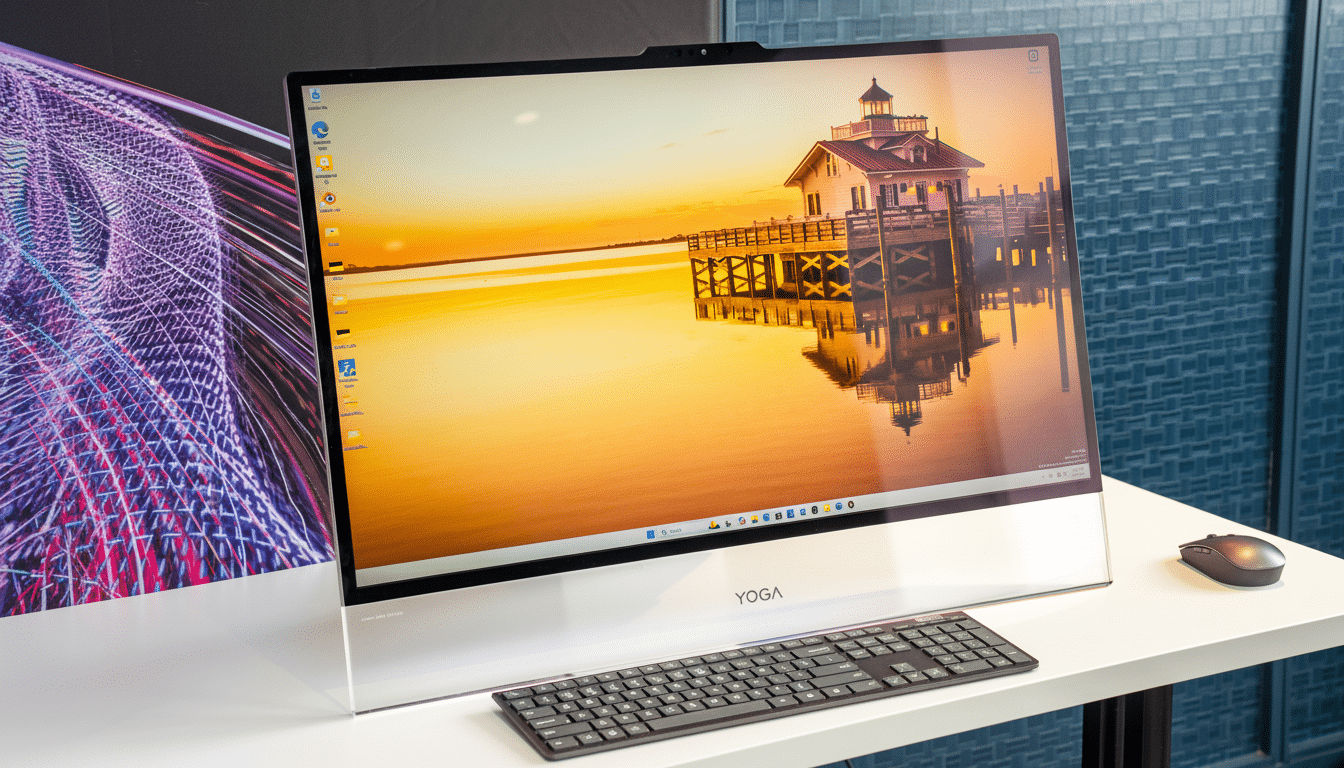
Inside, the ThinkCentre X AIO operates on Intel Core Ultra X7 Series 3 processors with up to 64GB of memory. It has speakers, Wi‑Fi 7, three USB‑C ports (one capable of Thunderbolt), three USB‑A ports and HDMI. An optional “smart AI” camera scans paper documents and digitizes them directly into your workspace — a useful feature for those in finance, education and front office positions.
Panther Lake And Copilot+ Land On The Desk
Both AIOs are described as Copilot+ PCs, a term that is consistent with Microsoft’s emphasis on local AI acceleration. Intel’s Panther Lake platform combines CPU, GPU and NPU to process operations such as noise reduction, background blur, live captions and creative assistants on-device for lower latency and improved privacy. Industry observers at IDC have flagged AI-capable PCs as a major catalyst for the next refresh cycle, and these desktops fit right into that story with lots of capacity for memory, storage, and I/O.
Thunderbolt 4 means headroom for fast external SSDs and more displays, while Wi‑Fi 7’s multi-link operation aids throughput at busy office locations. In other words, the plumbing lines up with the promise.
Why These All-in-One Designs Matter for Modern Workflows
The Yoga’s lights aren’t just eye candy. Bias lighting can help reduce eye strain during long edits or late-night sessions, and contextual prompts free you from pesky pop-ups. At the same time, the ThinkCentre’s 16:18 canvas accommodates stacked windows quite naturally: think code on logs, brief on spreadsheet, or timeline on bins. Photographers and social teams win here, too — near-square layouts preview 1:1 crops without wasted margins.
There’s a quiet practicality here. Through pixel density parity between the 31.5-inch 4K OLED and the 27.6-inch 2.5K-by-2,061px iMac screen, there isn’t an immediate tangible difference in sharpness between a monitor and the Mac I use daily (mid-2011). Lenovo reduces UI scaling foibles if your team of professionals uses mix-and-match models. And with split-screen collaboration and high-bandwidth ports to dock your MacBook, the company is treating the AIO as a hub, not a trade-off.
Early Outlook on Lenovo’s New Panther Lake AIO Lineup
Lenovo’s new AIOs offer two very different responses to modern desktop work: immersive, mood-aware creation with OLED and glow, and laser-focus productivity on a near-square canvas.
Both are indicative of a broader transition to AI-tuned, single-footprint machines that appear as considered as they compute. If you dismissed all-in-ones as boring, these Panther Lake machines are another reason to revisit the form factor.
