


Apple’s ultra-skinny iPhone Air could be more than a new look — it appears to be a tease for how Apple plans to design its first foldable iPhone. According to multiple well-placed industry watchers, including Bloomberg’s Mark Gurman, the first foldable iPhone might be a design that looks like two iPhone Airs attached at a hinge, with the Air’s aggressive slimming approach as the model.
The iPhone Air and the Idea of a Foldable
The iPhone Air’s crowning feature is its thinness: a sloping profile that descends to around 5.6mm at one end of the device. Apple achieved that by moving some of the largest components — processor, power management and the camera modules themselves — into a raised “plateau” around the camera system to essentially use vertical space to offload horizontal thickness elsewhere.
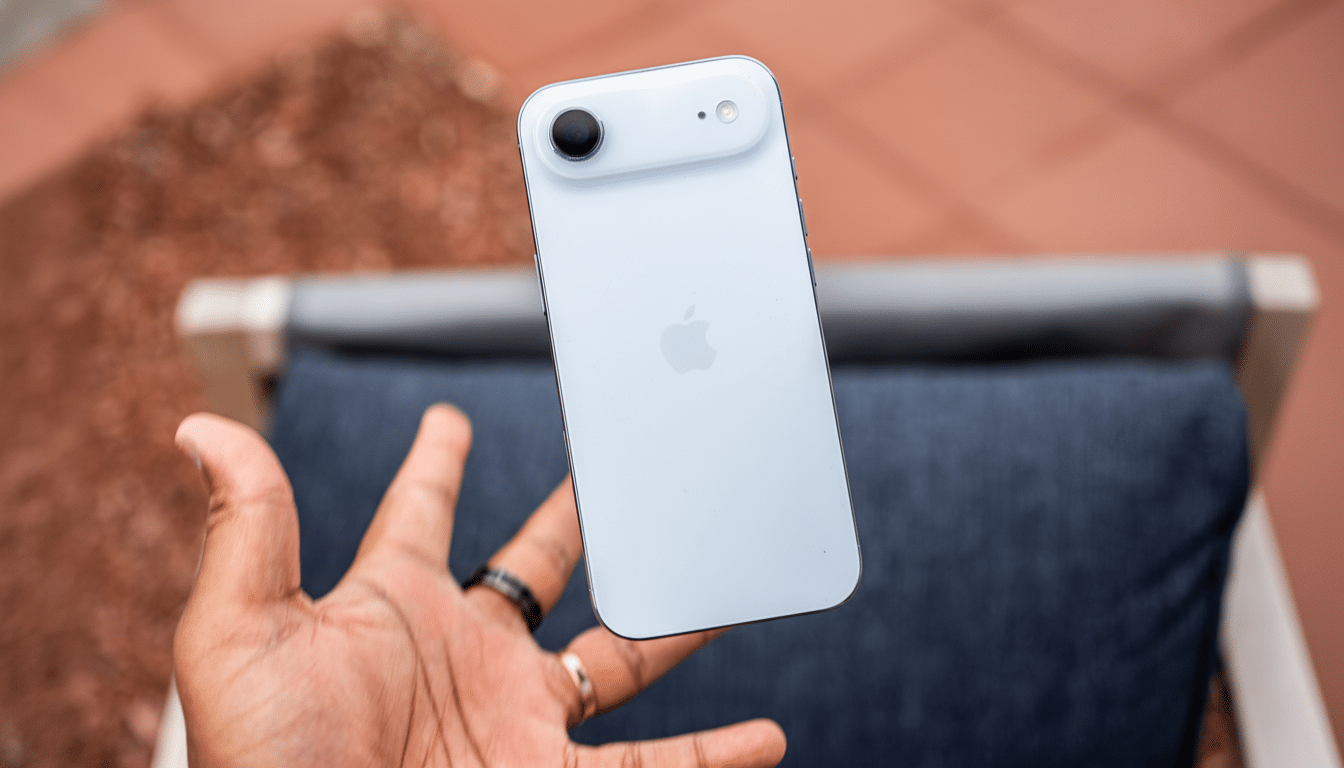
That redistribution is the precise manner of board-level engineering a book-style foldable requires. On a foldable, every millimeter counts times two, and cramming dense components into localized “islands” near the spine or camera bump can reduce stack height with no loss of thermal headroom or battery volume.
Two Airs Together: What the Thickness Math Means
Take two iPhone Air-class halves, put them back to back, and do some elementary math: a creased chassis just north of 11mm before factoring in the hinge hardware, display cover layers, or adhesives. Gurman’s reporting lines up in that ballpark. It wouldn’t be the thinnest foldable anyone’s ever dreamed up, but it would be competitive, and substantially less bulky than many first-gen book-style designs.
Context matters. Middle-ground foldable launches from industry leaders have clocked in around 12–14mm closed, and outliers like Honor’s Magic V2 slither under the 10mm mark by pushing aggressive materials and battery packing. Apple’s edge is not just in sheer thinness; it is perceived thinness, weight distribution, symmetry—areas where the company has historically perspired the details.
Engineering the Fold: Hinge, Glass and Battery
But beyond thickness, there will be three hard problems for any credible Apple foldable: crease control, cover durability and battery density. Display Supply Chain Consultants has charted the push in the industry towards thinner stacks of ultra-thin glass (UTG) that can more gracefully fold and bend without making creases more visible. Apple has patented hinge geometries that spread the stress over a larger radius—a strategy meant to help flatten the crease and safeguard the stack of OLEDs in use.
Battery packaging is equally gnarly. To help keep a folded device in balance, vendors often divide its cells between both halves. The iPhone Air suggests Apple is comfortable changing internal volumes to fit industrial design targets, and that philosophy ought to be transferred over to a foldable. Look for a packed logic board, multi-piece battery system and a hinge cavity that reduces dead space while still containing cabling and antenna pass-throughs.
Materials will also be in question. A foldable cover has to navigate scratch resistance, drop performance and bend tolerance. Apple’s history with custom glass chemistries, and ceramic-infused coatings, could be a separator when combined with UTG and an external display that doesn’t feel like a concession.
Supply Chain Signals and Price Expectation
Analyst Ming-Chi Kuo tips that Apple’s foldable ambitions sit at the premium end of the specs and pricing scale, with estimates going north of $2,000. It would put the foldable at the high end of the segment, along with book-style maxed-out models. Assembly is expected to come from Apple’s main partners, with Foxconn a frequent mention for the final stages of integration, and panel supply also split among top flexible OLED makers already responsible for the iPhone.
Apple’s packaging strides in the iPhone Air (move silicon under the “plateau,” slim down the mid-frame, get thermals right) are precisely what a supply chain does before scaling something more intricate. In other words, the Air sounds like a doorstep experiment in the component placement Apple needs to turn a foldable from “an iPhone that also unfolds” to an “experiment.”
Why Wait? A Market Reality Check for Foldables
Foldables are still very much an up-and-coming niche. Research firms including IDC and Counterpoint estimate global shipments in the mid- to tens of millions a year, with double-digit growth and greater momentum in China and South Korea. Apple generally waits until components are mature and the trade-offs in user experience have shrunk to almost zero before it seeks to enter a new category. The iPhone Air demonstrates Apple has solved for thinness; the foldable challenge is one of proving durability and everyday utility at scale.
Pricing is another lever. Flagship foldables typically cost several hundred dollars more than their slab brethren. If Apple prices high, it’s going to have to earn that price with battery life parity, top of the line cameras on both halves and software that does more than treat the inner display as just a larger canvas — think adaptive multitasking, continuity across screens and pro-grade creation workflows.
What to Watch Next as Apple Tests Foldable Concepts
Watch for:
- Rumors about panel supply from display-tech analysts
- Leaks of specific hinge components in import databases
- Evidence within Apple’s software betas suggesting fold-friendly layouts or continuity features
Of equal importance: keep an eye on whether Apple replicates the Air’s packaging playbook for more models of device — a sign that it’s in the process of standardizing any internal architecture it will need to use in a foldable iPhone.
Assuming everything is true, the iPhone Air isn’t simply a thinner iPhone. It’s one half of a larger concept — it’s physically half the story, and strategically, we’ve only seen what amounts to this device’s body with a faceplate covering its secrets — but it says something important about how Apple wants to combine the future with the iPhone without bending its core values of design.
