


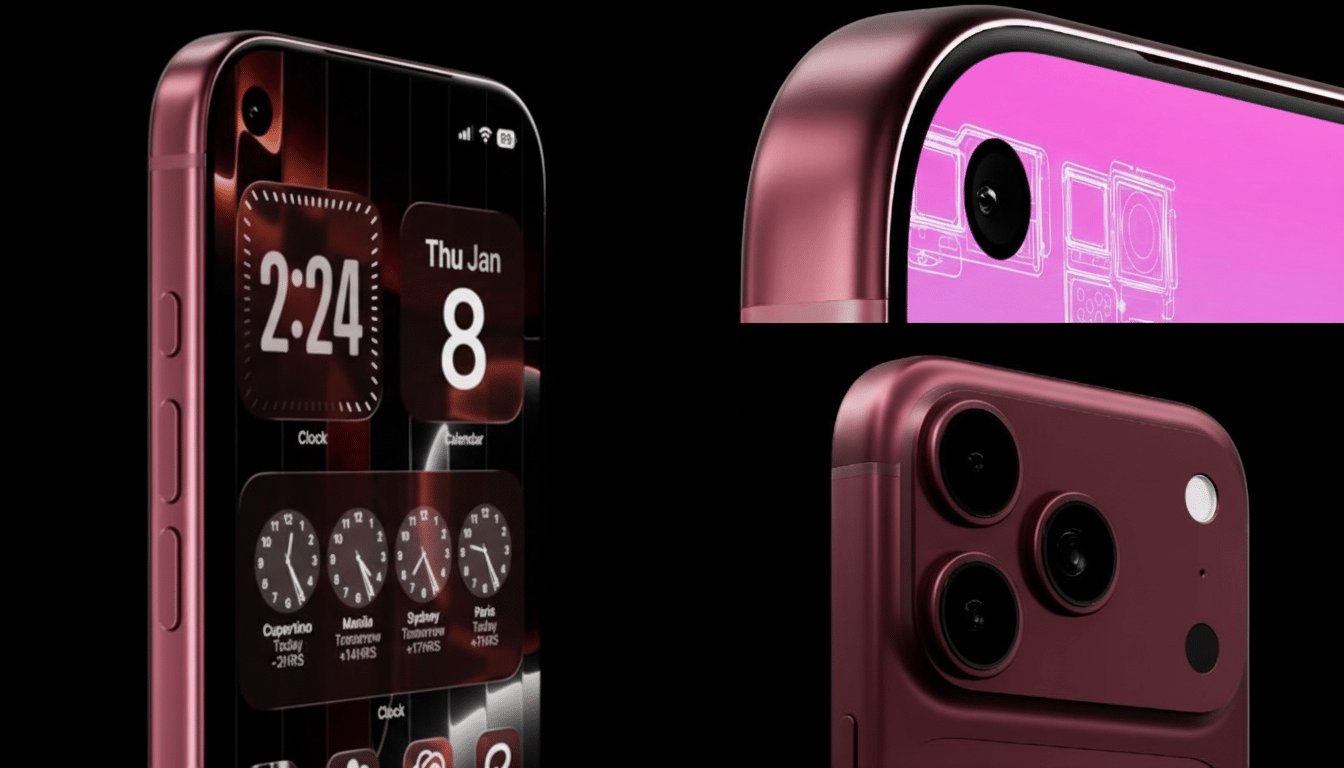
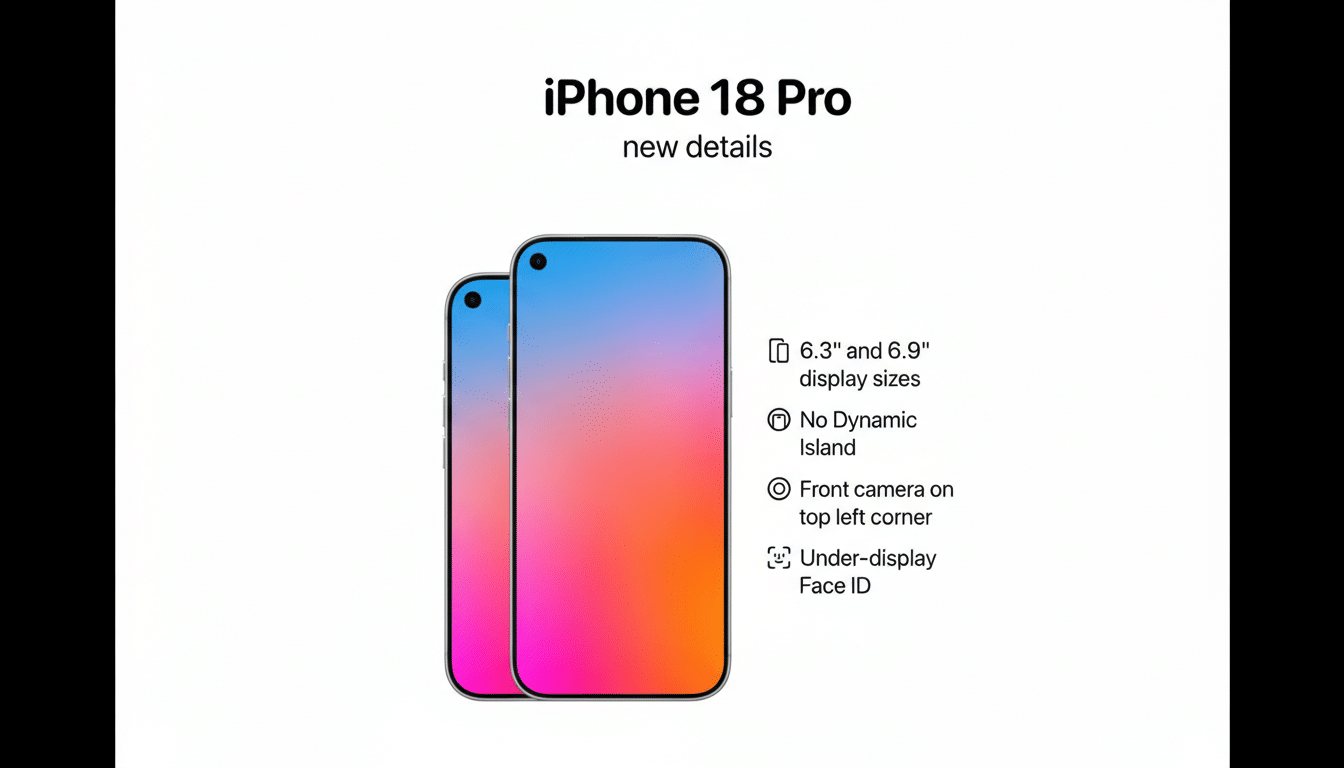
Apple is reportedly preparing its first iPhone with a punch-hole selfie camera, pairing the change with an under‑display Face ID system and a redesigned Dynamic Island on the iPhone 18 Pro. Multiple reports from The Information and ETNews, echoed by well-known leakers, suggest the cutout will shrink to a single hole while the Face ID sensors move beneath the screen. The display itself is said to be a new “LTPO+” panel co-developed by LG Display and Samsung Display.
Why A Punch‑Hole And Under‑Panel Face ID Matters
Moving Face ID components under the OLED solves the biggest obstacle to a truly immersive iPhone screen: the large pill-shaped cutout. Industry groups have demoed under-panel solutions for years, but Apple’s biometric bar is unusually high. Placing the IR illuminator and dot projector behind a specially engineered transparent region allows Face ID to keep working while freeing more usable pixels, and a punch-hole selfie camera preserves full image quality where under-display cameras still lag.
Under-panel regions introduce optical challenges—reduced luminance, scattering, and potential color shift—documented by display makers at SID Display Week. Vendors mitigate these with microlens arrays, compensation algorithms, and carefully patterned subpixels. For an IR-driven system like Face ID, throughput and uniformity matter more than perfect visible transparency, which makes this path technically feasible. Apple patents have outlined similar approaches, and supply chain chatter lines up with that trajectory.
Dynamic Island Gets A New Home And Slimmer Footprint
Rumors point to the Dynamic Island shifting from the center toward the top-left, with a slimmer footprint. That tweak would be more than cosmetic. By relocating system alerts and Live Activities, Apple could clear the visual centerline for video, maps, and games, while still surfacing glanceable info like timers, music controls, or rideshare status. Expect Apple’s Human Interface Guidelines to evolve so developers can target the new anchor position without rewriting the core experience.
Even with a punch-hole, the Island isn’t going away, according to leakers who’ve previewed prototypes. Instead, think of it as a smarter status surface that adapts to a less intrusive cutout. On large Pro displays, top-left placement may also aid one‑hand reachability for quick interactions, a small but meaningful ergonomics win.
Inside The LTPO+ Display Rumor And Efficiency Gains
ETNews reports the iPhone 18 Pro’s panel will use an LTPO+ stack jointly advanced by LG Display and Samsung Display. While “LTPO+” isn’t an industry standard label, it signals iterative gains: wider adaptive refresh windows, lower backplane leakage, and better power efficiency at always-on and low-refresh states. Display Supply Chain Consultants has long forecast incremental OLED efficiency improvements via new material sets and driver ICs; a dual-supplier strategy would help Apple secure yield and scale.
Practically, a more efficient backplane offsets the power tax of brighter peak HDR and the overhead of under-panel sensing regions. The result should be a cleaner look with similar or better battery life, rather than a beauty upgrade that costs endurance.
What Changes On The Front Of The Phone’s Display
Switching from a pill to a hole increases the effective canvas at the top of the display, opening space for status icons and giving full-screen apps a more symmetrical view. It won’t radically alter the screen-to-body ratio—which is already high on Pro models—but even a modest reduction in visual interruption is noticeable, especially in landscape video and gaming.
Expect Apple to calibrate the punch-hole’s placement to minimize conflict with UI chrome and to keep the selfie camera away from common gesture paths. Past flagship phones from Samsung, Google, and OnePlus show that a well-placed hole quickly disappears in daily use; Apple will aim to combine that familiarity with its own dynamic UI layer.
The Other iPhone 18 Pro Rumors Taking Shape
Bloomberg has reported Apple is exploring expanded satellite features beyond Emergency SOS, such as basic navigation assistance or sending low-resolution photos when you’re off the grid. It would build on the satellite system introduced with iPhone 14 and the ongoing investment in partner networks. Color options are also said to be in testing—burgundy, brown, and purple have been floated—but finishes are historically among the last decisions to lock.
Read The Signals But Keep Perspective On Leaks
Front-panel changes this substantial require long lead times, so the convergence of supplier reporting and leaker imagery lends credibility. Still, Apple prototypes multiple hardware paths each cycle. Watch for breadcrumbs in iOS betas, component analyst notes from firms like DSCC, and supplier briefings ahead of mass production. If the reports hold, the iPhone 18 Pro’s front could be Apple’s cleanest yet—less notch, more screen, and a Dynamic Island that evolves rather than disappears.
