


New images of the interstellar comet 3I/ATLAS show that it has developed a diffuse greenish coma as it has traveled inward from its earlier pass through the solar system, and an animation shows how this color change develops over time.
The change provides a timely chemistry lesson unfolding in real time: various ices are vaporizing and fluorescing in sunlight as the comet changes during its outward leg.
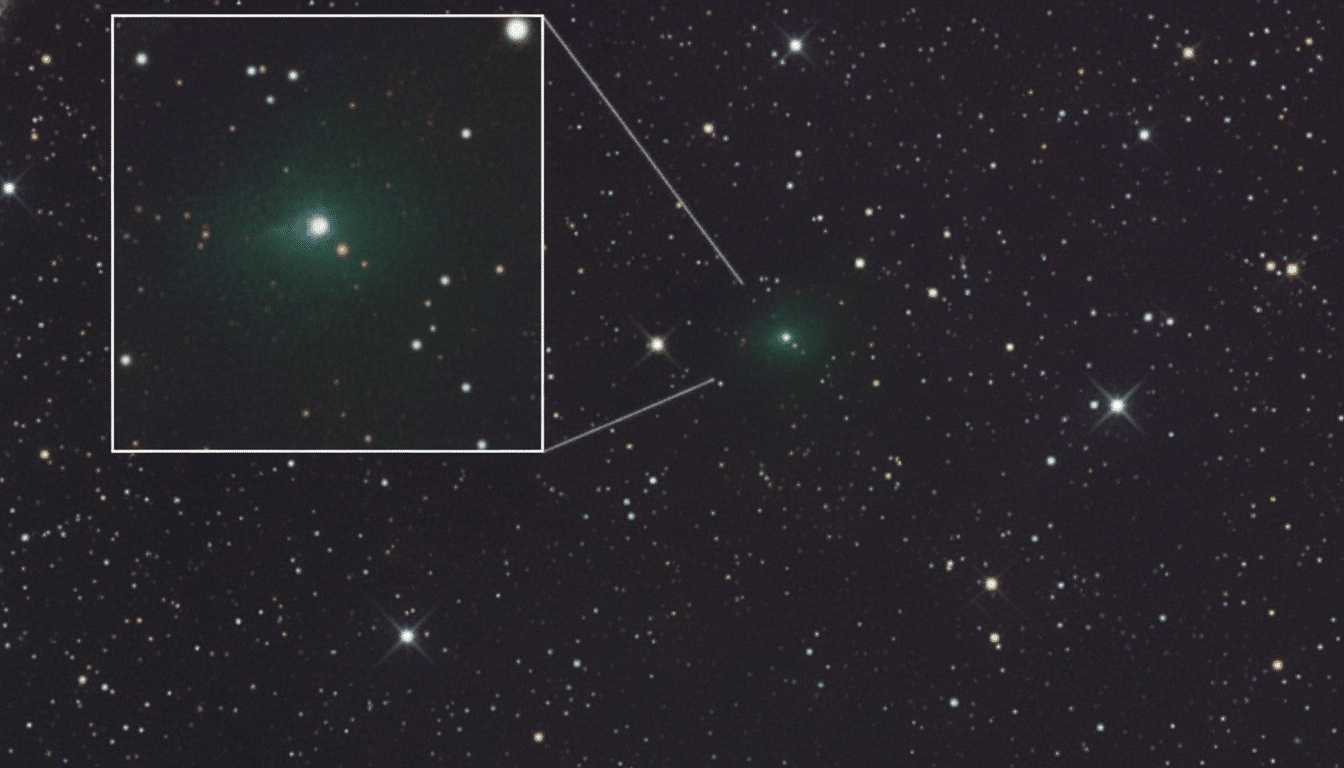
3I/ATLAS is just the third confirmed interstellar visitor ever spotted, after 1I/‘Oumuamua and 2I/Borisov. It is streaking through the solar system on a hyperbolic trajectory at about 137,000 miles per hour, too fast to be captured by the Sun’s gravity — so it will shoot back out into interstellar space after this one visit.
Why the Comet’s Color Changes as It Nears the Sun
A comet’s color is due to a blend of sunlight reflected by dust and light emitted by the gas molecules in the coma. The green we observe today is characteristic of fluorescing diatomic carbon (C2) in the Swan bands near 516 nm. Toward perihelion, the C2 is ejected away from the nucleus in roughly a symmetric configuration with respect to its orientation before approaching close to the Sun, and sunlit regions (nearest approach) may or may not produce all of the dissociated carbon cometary emissions.
The previously reddish appearance probably reflects a coma dominated by dust and stronger red-emitting species. Ices sublimate, and chemistry changes; green-light emitters spike, especially near the nucleus where short-lived C2 is most abundant. This is typical comet behavior, but the timing and strength of the outburst can differ — especially for a never-before-seen visitor from another star system.
How Astronomers Caught the Change in Color
Astronomers making use of the Gemini North telescope on Maunakea, Hawai‘i (powered by NSF’s NOIRLab), have captured high-resolution images in new color bands that depict this green emission from the growing coma as 3I/ATLAS receded from the Sun; earlier observations from Gemini South in Chile had revealed a redder shift — illustrating how filter selection and changes in outgassing rates can display different chemical regimes with time.
The observing run doubled as an exercise in public engagement via the program Shadow the Scientists, which puts viewers mentally inside control rooms as data stream in. Keeping 3I/ATLAS sharp while background stars streaked in multicolored trails, this was a graceful demonstration of both the comet’s path on the sky and how its coma’s spectrum changed.
X-ray Clues from a Solar Wind Clash with Gas
To investigate a different aspect of the coma, the European Space Agency’s XMM-Newton space telescope followed up with nearly 20 hours of X-ray observations. Comets emit X-rays when neutral gas streaming away from the nucleus encounters the solar wind; highly charged ions steal electrons in a process known as charge exchange, producing soft X-rays that allow us to map out where the gas is most dense.
This information can be used to calculate the total gas production rates and, when combined with optical spectra, will tell which species dominate at different axial distances from the nucleus. NASA and ESA have organized a wide-spectrum program — on Hubble, the James Webb Space Telescope, Mars Reconnaissance Orbiter, Lucy, and Psyche — that cross-checks composition from ultraviolet to infrared to X-rays while the comet is still visible.
What Makes 3I/ATLAS Different from Local Comets
Interstellar comets are frozen time capsules from other planetary nurseries. Kicked out by gravitational nudges from giant planets or sailing stars, they spend eons adrift in the cold before a serendipitous encounter brings them through our neck of the woods. That background can create chemistry that might not quite match the comets in our own solar system.
Preliminary analyses reported by NASA and its international partners suggest a carbon dioxide–to–water ratio that would fall outside the middle range measured in local comets, as well as dust and metal signatures that appear atypical. These, as one small-bodies scientist at NASA has described them, are flavor rather than category differences: The object is still clearly cometary; it just has a distinct set of notes molded by its native system.
What to Watch Next as 3I/ATLAS Fades from View
Comets are well known for being laggy when it comes to sunlight. Even as heat is carried to the interior by diffusion, new vents can form, eruptions can be sporadic and the mix of gases can alter. For 3I/ATLAS, that would mean fluctuations in the green glow as C2 production drops or begins to regulate dust again. Probing those transitions requires observing at various wavelengths.
For researchers at NOIRLab, ESA, and NASA, what’s at stake is a compositional fingerprint of material forged around another star. For the rest of us, the spectacle represents a rare opportunity to literally see science in action: a tiny, fast interloper zipping across our skies that changes color as it exhales its ices into space after having carried them with it from interstellar realms.
