


Intel is moving into GPU production, positioning itself against Nvidia’s commanding lead in the accelerators that power modern AI and high-performance computing. The company framed the effort as a customer-driven push to build graphics processors tuned for training and inference workloads, a notable pivot for a firm best known for CPUs.
The initiative will be led inside Intel’s data center organization, with oversight attributed to executive vice president Kevork Kechichian, according to reporting from Reuters. Intel has also brought in veteran graphics architect Eric Demers, whose résumé spans senior roles in GPU and mobile graphics engineering, including a long tenure at Qualcomm and earlier leadership at AMD.
Why GPUs Matter For AI And Modern Data Centers
GPUs have become the backbone of AI because their massively parallel cores accelerate linear algebra operations at the heart of neural networks. In practical terms, that translates to faster model training, higher throughput for inference, and better utilization of high-bandwidth memory. This is why cloud providers, national labs, and startups alike are building clusters around GPU nodes instead of general-purpose CPUs.
Analysts widely agree Nvidia dominates this market. Estimates from Omdia and Mercury Research have put Nvidia’s share of data center GPUs and AI accelerators well above 80%, buoyed by hardware like H100 and a software ecosystem that took years to mature. MLCommons’ MLPerf results routinely show Nvidia at the top of training and inference rankings, underscoring the performance gap Intel will need to close.
Intel’s Angle: Hardware Experience Meets Manufacturing Scale
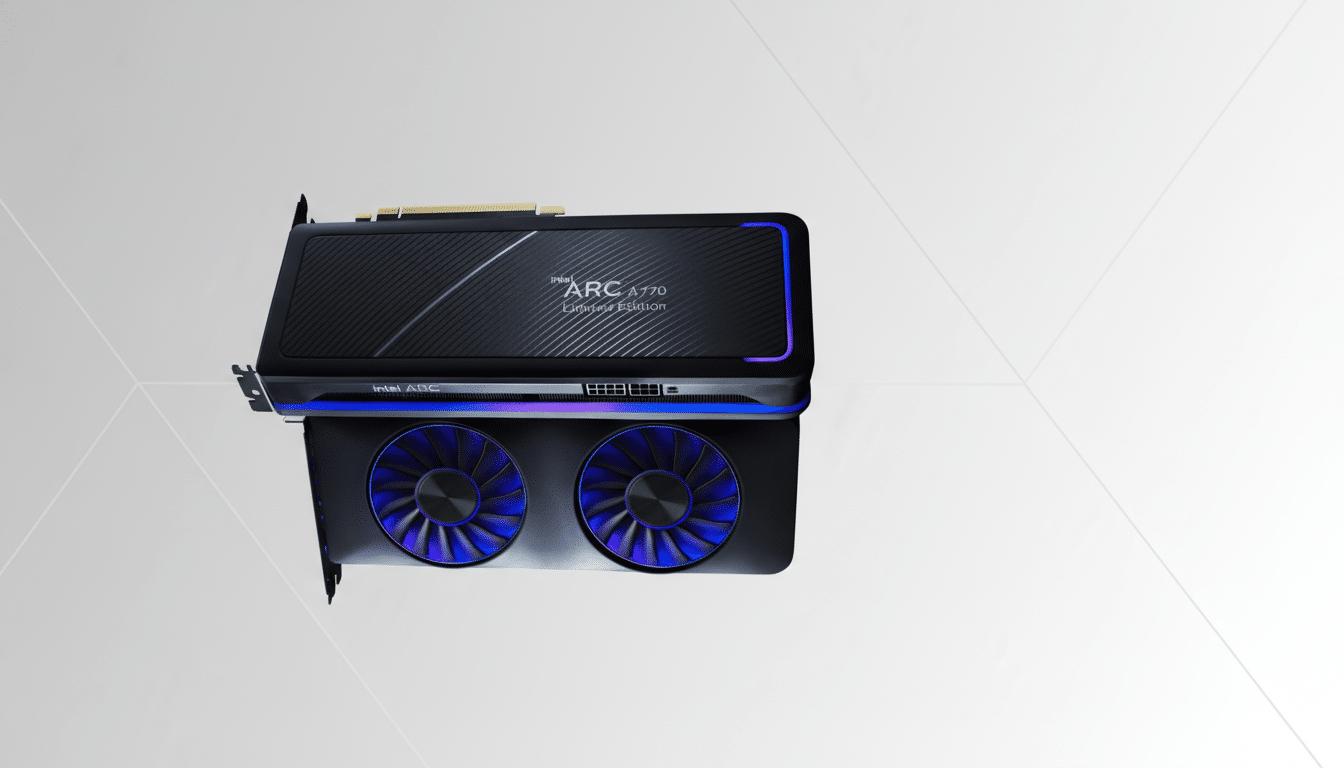
Intel isn’t starting from zero. The company has shipped discrete graphics under its Arc brand and built data center accelerators such as the Gaudi lineup, which has posted competitive price-performance in recent MLPerf inference submissions. That experience gives Intel a base of software tools, compiler work, and board design know-how that can feed a GPU program focused on AI workloads.
Where Intel can differentiate is manufacturing and packaging. Advanced accelerators depend on high-bandwidth memory and complex multi-die packaging. Intel has poured billions into technologies like EMIB and Foveros, and it has expanded advanced packaging capacity in the U.S. These capabilities could help address industry bottlenecks—particularly HBM integration and substrate availability—that have constrained accelerator supply.
Sourcing HBM remains a gating factor for any GPU roadmap. SK hynix leads shipments of HBM3, with Micron and Samsung ramping HBM3E. If Intel secures dependable HBM supply and couples it with its packaging stack, it can reduce wait times that have stretched to quarters for some AI customers and bring competitive total cost of ownership to cloud deployments.
The Nvidia Moat: Software And Developer Ecosystem
Hardware alone won’t unseat Nvidia. CUDA, cuDNN, and an ecosystem nurtured over a decade have become the default for developers, with millions using Nvidia’s stack across PyTorch and TensorFlow. That lock-in is as much about libraries, kernels, and tooling as silicon.
Intel will need to accelerate its software strategy—oneAPI and SYCL are the obvious pillars—and court framework maintainers to ensure first-class performance on day one. Deep partnerships with hyperscalers and independent software vendors will be essential, as will turnkey solutions that make cluster operators confident about reliability, observability, and fleet management.
Talent And Timeline: What To Watch For Intel’s GPU Push
The leadership hires are a signal that Intel intends to build a GPU group with serious graphics DNA. Demers brings decades of architecture and execution experience, while Kechichian’s remit suggests a tight alignment with data center customers rather than a purely consumer play.
Key milestones to watch include early silicon tape-outs, developer preview toolchains, and MLPerf submissions that validate performance at scale. Equally important will be OEM and cloud design wins, HBM supply agreements, and proof that Intel can deliver consistent batches at volume—a challenge that has tripped up even established vendors in the current AI investment cycle.
Market Impact And Competitive Dynamics Ahead
For buyers, credible alternatives to Nvidia could expand supply and put price pressure on premium accelerators that often sell above $25,000 per unit through resellers. For AMD, which has gained traction with its Instinct line and ROCm software, Intel’s entry raises the stakes—and could also help normalize a multi-vendor software world that reduces CUDA’s gravitational pull.
If Intel executes, its manufacturing scale and packaging know-how could become a lever to rebalance a market that has been constrained by supply chain frictions as much as by raw performance. If it stumbles on software or ecosystem, the effort risks becoming just another capable chip without the developer mindshare to matter.
The signal today is clear: Intel is aiming at the GPU heart of AI infrastructure. The question that will define the next phase of the accelerator race is whether it can marry silicon and software quickly enough to chip away at Nvidia’s lead.
