


iFixit has launched a new mobile app for Android and iOS that puts its extensive repair database in your pocket, along with AI assistant FixBot. The move represents iFixit’s first full-featured return to Android in years, with step-by-step guides to guide you through repairs, along with parts ordering, tool tips, and on-device battery health checks. For anyone who has gazed at a shattered screen or dying battery and thought, “Um, where do I start?” this is the bandage to peel away that guesswork and add some confidence.
What FixBot Actually Does: device ID and guided repairs
FixBot is an AI repair assistant that can recognize hardware from images and send you to relevant instructions. Point your lens at a controller, earbuds case, or phone backplate and the app will attempt to identify the model and offer up applicable teardown or repair instructions. Once you know the device in question, typing can get you to what you need help with — say a battery swap or joystick replacement — and FixBot will surface the corresponding steps.
- What FixBot Actually Does: device ID and guided repairs
- A Repair Hub Above and Beyond AI: guides, parts, diagnostics
- Right to Repair Tailwinds: laws and consumer repair momentum
- Early Limits And Realities of the Practical
- Why This Could Be Cost-Saving: DIY versus paid service
- Availability and What to Watch: features on the roadmap

Early testing is promising with typical consumer tech: it can discern close variants — think right- versus left-hand game controller modules — without dumping you into generic instructions. Image processing is not instantaneous; photo-based IDs can take several seconds, sometimes longer, and coverage is most complete for items already in iFixit’s catalog. For specialty gear without a guide, FixBot relies on higher-level problem-solving rather than step-by-step disassembly instructions.
A Repair Hub Above and Beyond AI: guides, parts, diagnostics
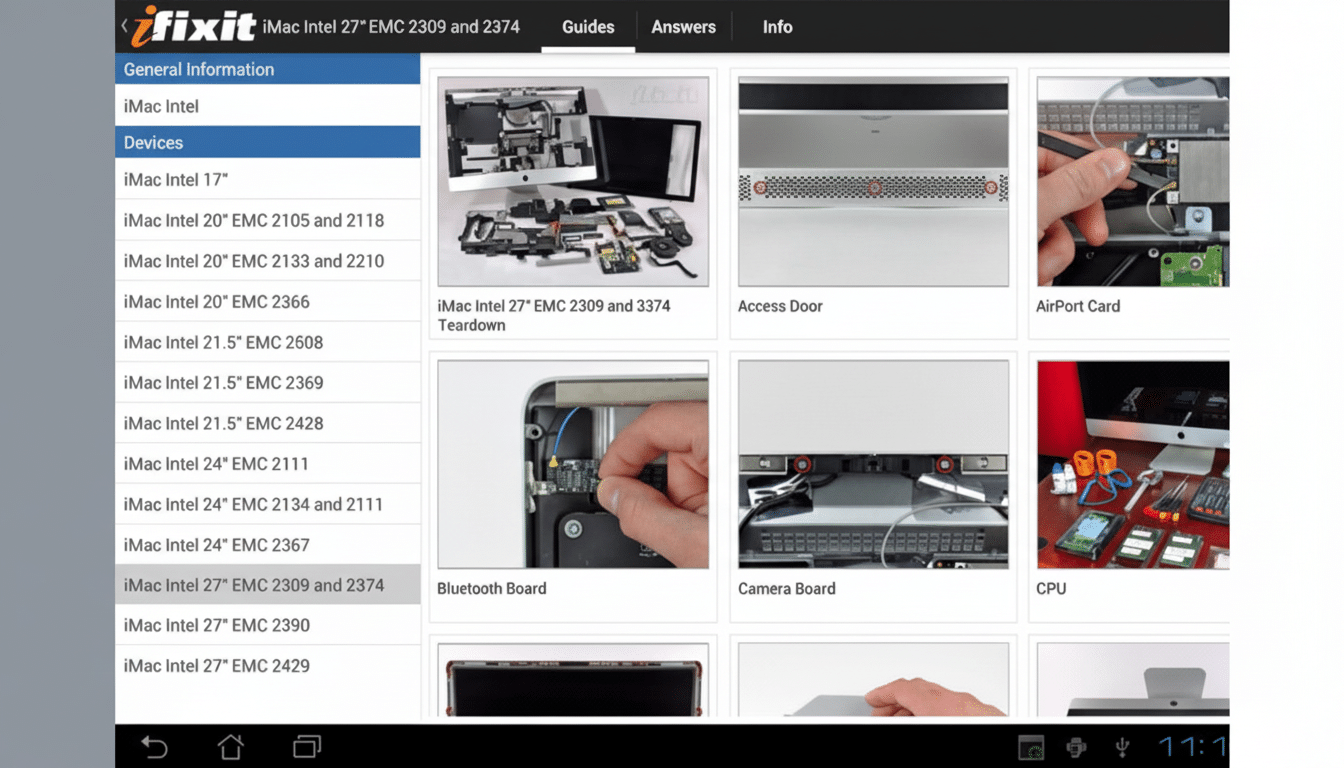
The app is far more than a chatbot. It anchors iFixit’s massive archive — more than 100,000 free repair guides across thousands of devices — in an app that lets you follow the steps, order parts, and find out how to properly wield the correct spudger, bit set, or thermal tool. Battery diagnostics access your phone’s built-in data, where it exists, to estimate both capacity and wear, allowing you to determine when you need to replace one of a gadget’s cells before it turns into a safety problem or causes devices to stop working.
That final feature is important because batteries are the Achilles’ heel of modern phones. Many lithium-ion pack manufacturers estimate that their packs will still have about 80 percent of capacity after around 500 full charge cycles. To be able to spot those health dips and dive right into a vetted replacement guide — plus an accompanying battery kit — cuts down on what used to involve a multi-site scavenger hunt.
Right to Repair Tailwinds: laws and consumer repair momentum
The timing coincides with a larger global movement toward repairability. States including California, Minnesota, and New York have passed digital Right to Repair laws that require access to parts, tools, and documentation; the European Commission’s Right to Repair initiative is nudging manufacturers toward making products easier for consumers and recycling centers to fix after the warranty runs out. US PIRG has calculated keeping each average smartphone in use for just one year longer could result in a meaningful reduction in CO2e — hundreds of thousands of cars’ worth of annual emissions reductions — spotlighting repair as a climate lever.
iFixit has for years collaborated with hardware manufacturers and communities to stock parts and post instructions for widely used products like Pixel phones, Motorola handsets, and the Steam Deck. Layering an AI assistant over that corpus, the company is betting, will move more people to attempt some of those repairs that once seemed intimidating.
Early Limits And Realities of the Practical
Like all AI, FixBot can seem quite sure about things that are wrong. If one device does not have a given guide, your assistant will give you generic advice and not tell you about things like hidden clips or screws that may be the wrong type, or safety cautions. That’s not exclusive to this app; it pretty much sums up most consumer AI today. The smart way to use FixBot is as a knowledgeable triage nurse, not the surgeon — check your steps against the full guide and take things slow.
There are also practical considerations. Photo analysis may introduce significant delay on some queries, and accuracy depends on illumination and angles, or model versions. Users who are wary of sharing images and questions will be interested in details about how the processing is done; though it’s an app oriented around iFixit’s sphere, AI tends to require cloud inference to enable capabilities such as learning. Look for policies and on-device processing options to mature.
Why This Could Be Cost-Saving: DIY versus paid service
DIY repairs can cost pennies on the dollar compared with storefront service. A standard battery replacement kit for a popular phone can cost much less than even the most affordable full-service appointment, and controllers impacted by joystick drift can frequently be rebuilt for the price of a module plus minimal tools. Consumer Reports and independent repair advocates consistently find that proficient DIY with good instructions is safe and reliable, as long as you have the right tools and adhere to ESD- and battery-safety protocols.
For beginners, the value of FixBot is in its ability to cut through the uncertainty: what type of device you have, whether parts are interchangeable, and where exactly it wants you to go next. Even if you do wind up hiring a professional, walking in with the correct diagnosis and an ordered part list can save time and money.
Availability and What to Watch: features on the roadmap
The new iFixit app is free and can be downloaded on the major mobile app stores. Expect faster image recognition, and support for more devices, in the future as well as further integration with repairability scores. If the assistant continues to accrue knowledge from real-world fixes and scales beyond hot devices like phones and consoles, it could become a first port of call for issues with anything from kitchen gizmos to niche peripherals.
For now, it’s an impressive first step: a centralized repair hub with AI that speeds the process from “what am I looking at” to “let’s fix this,” which is good for your wallet, good for the reduction of e-waste, and a potential shot in the arm to the right-to-repair movement.
