


Now Google is testing a new AI agent named CC, which delivers a tailored morning briefing directly to your inbox with the promise of helping get you organized before your coffee has gone cold and calm the daily swirl of follow-ups, meetings, and files. Based on Gemini and available as a Labs experiment, CC creates a focused summary from Calendar, Gmail, and Drive to help you start your day instead of scrambling to find it.
What CC Does Each Morning in Your Daily Inbox
CC reads your schedule, the latest emails from colleagues, and documents shared with you to construct a single email that shows what needs attention now and what can wait.
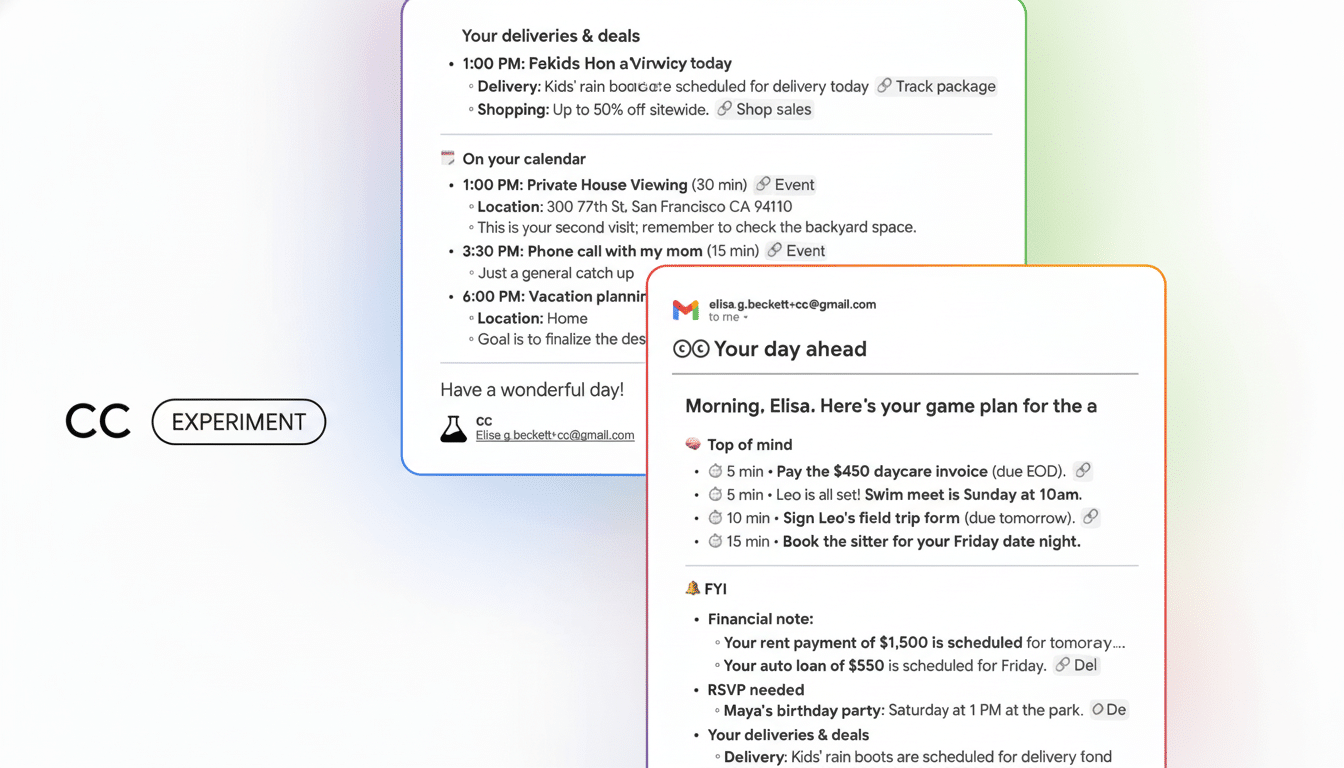
The briefing packages timely meetings, action items pulled out of threads, and relevant files — then throws in AI-generated quick actions: calendar links and email responses from you, so you can accept, schedule, or nudge seconds after processing.
In practice, that could be a 9:30 a.m. budget update with Drive attachments, a reminder to approve yesterday’s vendor quote in the thread, and a draft email ready to send your team for a change of plans.
The aim is not only summary but orchestration — nudging you toward the next best action with as few clicks.
You can train CC to get smarter; it’s like coaching a bot. Email it preferences (like “Group all recruiting items on Fridays”) or just drop in any ad hoc to-dos and ideas, and it will do its best to include them in the next briefing. To comment, send email to an address in the format your-username+cc@google.com.
Privacy And Control for Your AI Morning Briefings
Google says that data pulled in from Calendar, Drive, and Gmail are used to generate your briefings but aren’t used to train its underlying generative AI models. The company also notes that CC can get things wrong — useful context for anyone thinking of forwarding AI-drafted emails without a rapid sanity check. The human-in-the-loop, as with any agentic tool, comes into play.
The wager is that email is the lowest-friction interface for most workers. Asana’s Anatomy of Work report shows knowledge workers spend most of their day on “work about work,” which includes email and scheduling. Putting the assistant where people already live minimizes tool switching and increases the chances of daily use.
How It Compares With ChatGPT Pulse and Others
(CC comes just as competitors tout similar routines. OpenAI’s Pulse provides a comprehensive morning update, based on past chats and memory of the future; a sneak preview of what it plans to surface tomorrow; with an invite for edits. Google’s take is more of a utilitarian one: a bullet-style email with embedded actions, not a dashboard full of cards and descriptions.)
More important than aesthetics is the receiving surface. With a native read on Calendar, Gmail, and Drive, CC can extract context and construct replies on the fly — no connectors required. The latter fact is in stark contrast to other assistants, which tend to depend on third-party integrations or extensions. Microsoft’s Copilot in Outlook and Teams, for example, relies much more on threads and meeting recaps, but I feel it keeps a larger portion of the action happening inside their apps rather than email-first.
Who Can Try It and How to Get Early Access
CC is offered on a waitlist to users 18 and older in the US and Canada. Once in, you will automatically receive the Morning email. Google also says that priority for early access will go to those who are paying subscribers on Google AI Ultra and other paid levels.
Setup is intentionally minimal: no new app to learn, no onboarding gauntlet. If it lives up to its billing, that simplicity could be the project’s point of differentiation — particularly in enterprises concerned about deploying yet one more tool.
Why Morning Briefings Matter for Productivity
Morning digests are successful in part because they reduce the cost of coordinating action. Asana has documented that the time its workers spend “on work coordination” versus “skilled labor,” if you will, is well over half, and Microsoft’s Work Trend Index concluded early users of generative AI feel more productive and less overwhelmed by email and meetings. A briefing that sells the next action and writes the first response turns those gains into ten minutes saved before 10 a.m.
The danger is alert fatigue — too many nudges become noise. CC’s promise is predicated on precision: exposing only what really matters, learning from individual preferences, and remaining transparent about what it did and why. Google’s commitment to continuing CC for email, and including explicit links and drafts you can accept or reject, is a pragmatic hedge against over-automation.
Agentic AI is going from demos to habits. If CC can show that it’s capable of shaving down the burdens of modern labor without foisting new bullshit upon its users, a single morning email could end up being the most important AI feature Google ships this year.
