


Newly revealed court filings suggest Google is mapping a long runway to replace Chrome OS with a new platform called Aluminium OS, with a limited tester program potentially starting in late 2026, broader availability in 2028, and a full Chrome OS sunset not before 2034. The phased plan underscores how carefully Google must navigate education, enterprise, and regulatory obligations while it attempts its biggest PC software transition to date.
Court Filings Point To 2028 Launch Window
Documents filed in the ongoing U.S. search antitrust case indicate Aluminium OS could be offered to “commercial trusted testers” in late 2026, with general release targeted for 2028. The same materials note that 2028 is also the earliest practical window for an enterprise and education rollout, reflecting the lengthy qualification cycles typical in those sectors.
The filings contrast with earlier public comments that framed 2026 as an aspiration, not a guarantee. Internally, the two-year gap between pilot access and general availability appears designed to stabilize features, gather feedback from OEMs and IT administrators, and build a robust app and driver ecosystem ahead of a wide launch.
Why a Long Runway for Aluminium OS Makes Sense
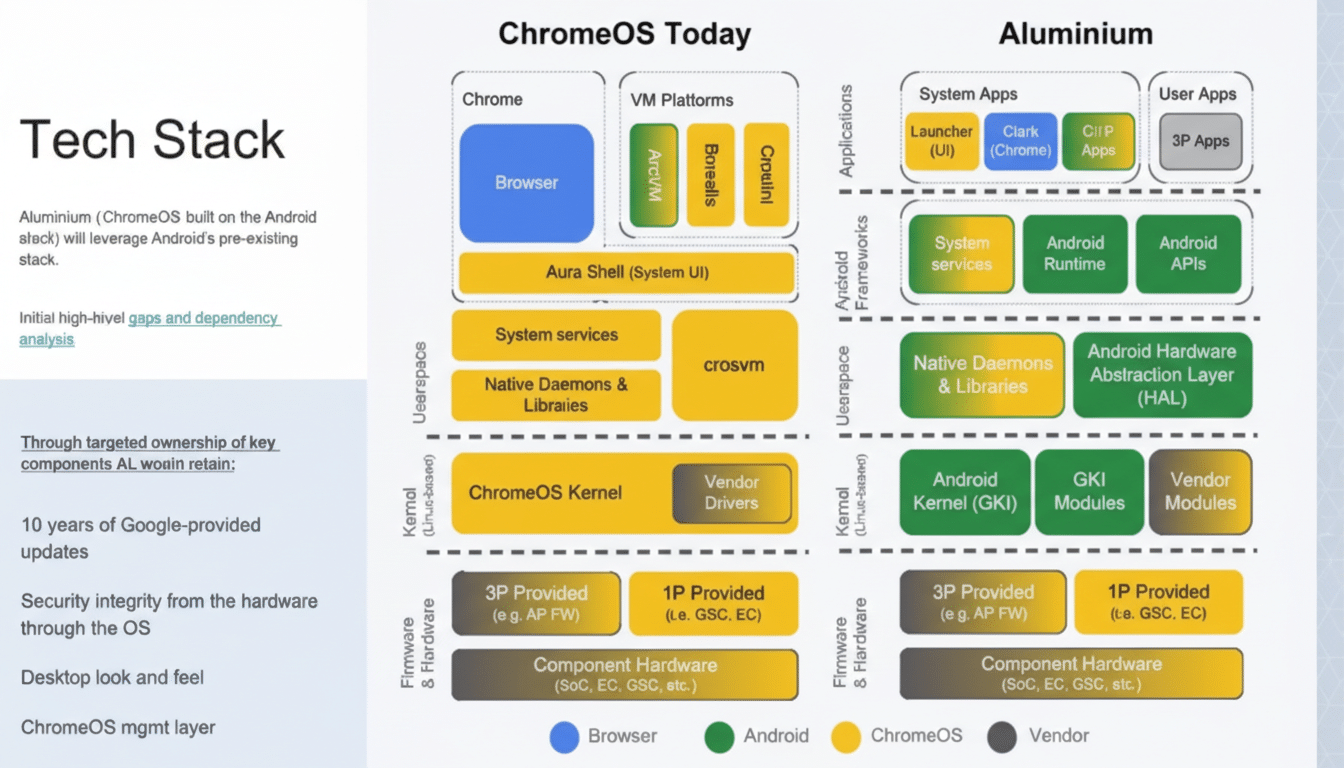
Aluminium OS is pitched as a convergence of Android and Chrome OS—an operating system that can power laptops and desktops while running mobile apps natively and delivering the manageability Chrome OS is known for. Unifying app models, security postures, and update mechanisms across device categories is a large technical lift, especially if Google aims to optimize for new PC-class ARM silicon showcased at recent chipset summits.
To succeed, Google must align Android frameworks, Chrome OS-style verified boot and sandboxing, and seamless background updates into a single, IT-friendly stack. That means rebuilding core subsystems, hardening enterprise features like identity and policy management, and ensuring compatibility with the Android app universe without sacrificing the fast, low-maintenance ethos that won Chrome OS traction in schools.
Chrome OS Support Is Promised Through 2034
The same court materials reportedly set the “timeline to phase out Chrome OS” at 2034, which aligns with Google’s public promise to provide up to 10 years of automatic updates for Chromebooks. In many jurisdictions, consumer protection and public-sector procurement rules mandate multi-year support windows; honoring those obligations effectively sets a hard floor under any retirement date.
Google executives have reiterated that existing devices will continue to receive updates for their full term. For education buyers who refresh hardware in waves, that matters: schools can standardize on Chrome OS today, plan for Aluminium OS pilots in the second half of the decade, and transition fleets during normal replacement cycles without stranding devices.
What Changes for Users and IT During the Shift
Near-term, nothing. Chromebooks will keep getting security patches and feature updates on a predictable cadence. Over time, expect Google to outline a migration path—identity providers, admin console continuity, and app management that bridge Chrome OS and Aluminium OS. A job listing late last year hinted at a formal transition strategy, suggesting Google aims to minimize disruption for classrooms and enterprises.
For developers, the roadmap implies new tooling and compatibility targets. A unified platform could simplify building apps that scale from phones to PCs, but it will require guidance on APIs, windowing, input methods, and performance tuning for laptop-class CPUs and NPUs.
Competitive Stakes in the Evolving PC Market
The timing intersects with a broader industry shift. Apple’s M-series has reset expectations for performance-per-watt, Microsoft is pushing Windows on ARM with AI acceleration, and Qualcomm and others are touting PC-focused chipsets. A Google OS that marries Android’s app catalog with Chrome OS manageability could give OEMs a third option against Windows and macOS—especially in lower-cost, always-connected devices.
Chrome OS today commands a dominant share of U.S. K–12 mobile PC deployments according to education market trackers, even as its global desktop share remains in the low single digits. Aluminium OS represents an attempt to extend that beachhead beyond the classroom and into mainstream consumer and commercial PCs, while preserving the simplicity that made Chromebooks appealing.
What to Watch Next in Google’s OS Transition
Key milestones to track: announcements of “commercial trusted tester” programs, SDKs and developer previews, OEM partnerships, and clarity on support lifecycles for mixed fleets. If Google hits a 2026 pilot and 2028 general release, the 2034 Chrome OS phaseout would give customers roughly six years of overlap to plan and execute an orderly transition.
The headline here is patience: the documents outline a methodical, decade-spanning pivot rather than a sudden switch. For users and IT teams, that’s likely good news—time to evaluate, test, and migrate without sacrificing security or support along the way.
