


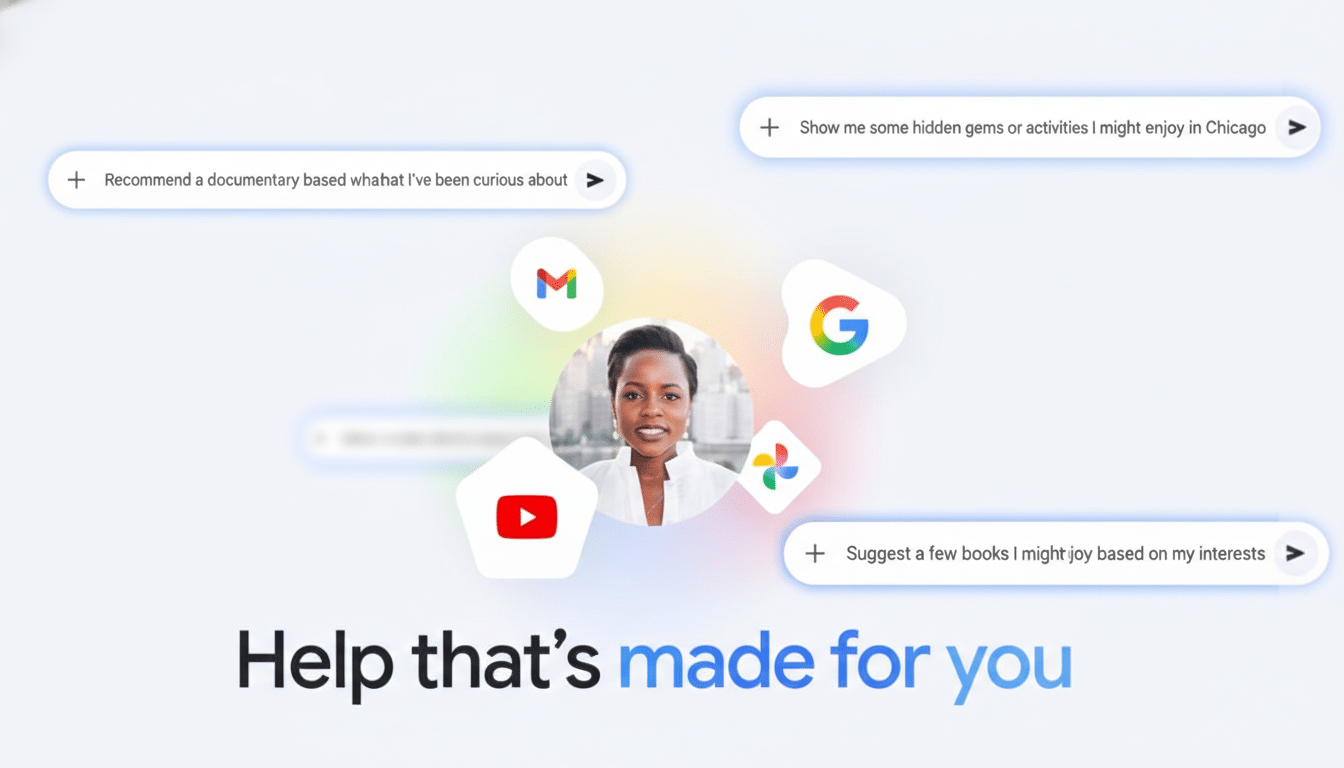
Google is giving its AI a powerful memory boost. A new mode called Personal Intelligence lets Gemini draw on your Gmail, Photos, Maps, YouTube, and other Google apps—if you opt in—so it can answer with context about your life rather than generic suggestions. The feature is debuting in beta for US subscribers to Google’s AI Pro and AI Ultra plans, with broader availability promised.
Instead of retrieving a single email or image on command, Gemini can now reason across your data and pull the most relevant snippets at the right moment. The system is built on Gemini 3 and its one-million-token context window, but it doesn’t try to shove your entire inbox into the model. Google’s approach selectively surfaces a small set of items, addressing what the company calls the “context packing” problem.
What Personal Intelligence Actually Does for You
Think of it as a personalized retrieval layer. Ask about new tires and Gemini can infer your exact vehicle from a receipt in Gmail, confirm trim details from a photo, and factor in your typical driving patterns before making recommendations. Plan a weekend trip and it may weigh past travel emails, starred places in Maps, and the kinds of photos you take to produce an itinerary that reflects your habits, not a one-size-fits-all list.
Crucially, this works across modalities. Gemini can combine text, images, and even video context—like reading a license plate in a photo, cross-checking purchase history, and layering in current search results—within a single response. That multimodal reasoning is where large models often struggle; by shrinking the input to only what’s relevant, Google is trying to preserve accuracy while keeping responses personal.
This selective memory also acknowledges scale. Google services hold staggering volumes of data—trillions of photos live in Google Photos alone—far beyond what even a million-token context can ingest. The design choice to stage information retrieval rather than brute-force context loading is consistent with research trends in retrieval-augmented generation, where smaller, timely snippets typically outperform monolithic dumps.
Privacy Controls and Data Handling Explained
Personal Intelligence is off by default. You choose which apps to connect and can disconnect at any time. Google says Gemini will show or cite where specific details came from so you can see why it made a suggestion. You can also ask for non-personalized answers when you don’t want your data involved.
Google states that Gemini does not train on the contents of your Gmail or Photos libraries. Those sources are referenced to answer your question, not absorbed into the model’s parameters. The company says training is limited to prompts and responses, with personal information filtered or obfuscated. Expect scrutiny: privacy advocates have cautioned that “memory” features can over-collect, and Microsoft paused its Windows Recall rollout in 2024 following watchdog concerns. By making Personal Intelligence opt-in with per-app permissions, Google is aiming to avoid similar missteps.
There will be rough edges. Google acknowledges the AI may over-personalize or misinterpret relationships—confusing a parent’s interests with a child’s, for example. Correcting these assumptions is part of the feedback loop, and users can review or reset what Gemini remembers.
Availability and Where Personal Intelligence Works
The beta is rolling out first to US customers on AI Pro and AI Ultra across the web, Android, and iOS. Google says Personal Intelligence will also appear in Search’s AI Mode in the near future. Business and education accounts are not supported at launch, so Workspace users will have to wait.
Why This Matters for the Future of AI Assistants
AI assistants have long struggled with amnesia. Without situational awareness, they produce decent summaries but mediocre help. Personal Intelligence moves the category toward true assistance—where the system understands your context, reduces the back-and-forth, and offers proactive guidance rooted in your data.
Competitively, this raises the bar. OpenAI has experimented with persistent memory for ChatGPT, and Apple’s recent on-device features emphasize private context, but Google’s strength is its deep integration across the apps people already use every day. If the company can balance utility with trust—transparent sourcing, strict controls, and clear off-switches—Gemini could become the first mainstream AI that genuinely “remembers” without overreaching.
