


Google’s motion sickness solution for Android is getting a new name, before it has even shipped. Motion Cues — now known as Motion Assist, according to our APK teardown of the most recent Google Play services beta (25.49.31 beta) — will reportedly launch as a Pixel-first feature sooner rather than later.
What the teardown shows in the latest Google Play services beta
Motion Cues-related strings are replaced with Motion Assist across settings text and feature flags in the Play services build. Though the code doesn’t yet surface a complete settings screen, the renaming is uniform and implemented in numerous components so that Google appears to have decided on branding, instead of simply experimenting with this rebrand for a while.
- What the teardown shows in the latest Google Play services beta
- Why the new Motion Assist name matters for Android
- How Motion Assist Will Most Likely Function
- Transiting Mode Hints at Smarter Automatic Enablement
- What to Look for on Pixels as Motion Assist Approaches Launch
- The Bigger Picture for Motion Assist and Mobile Comfort
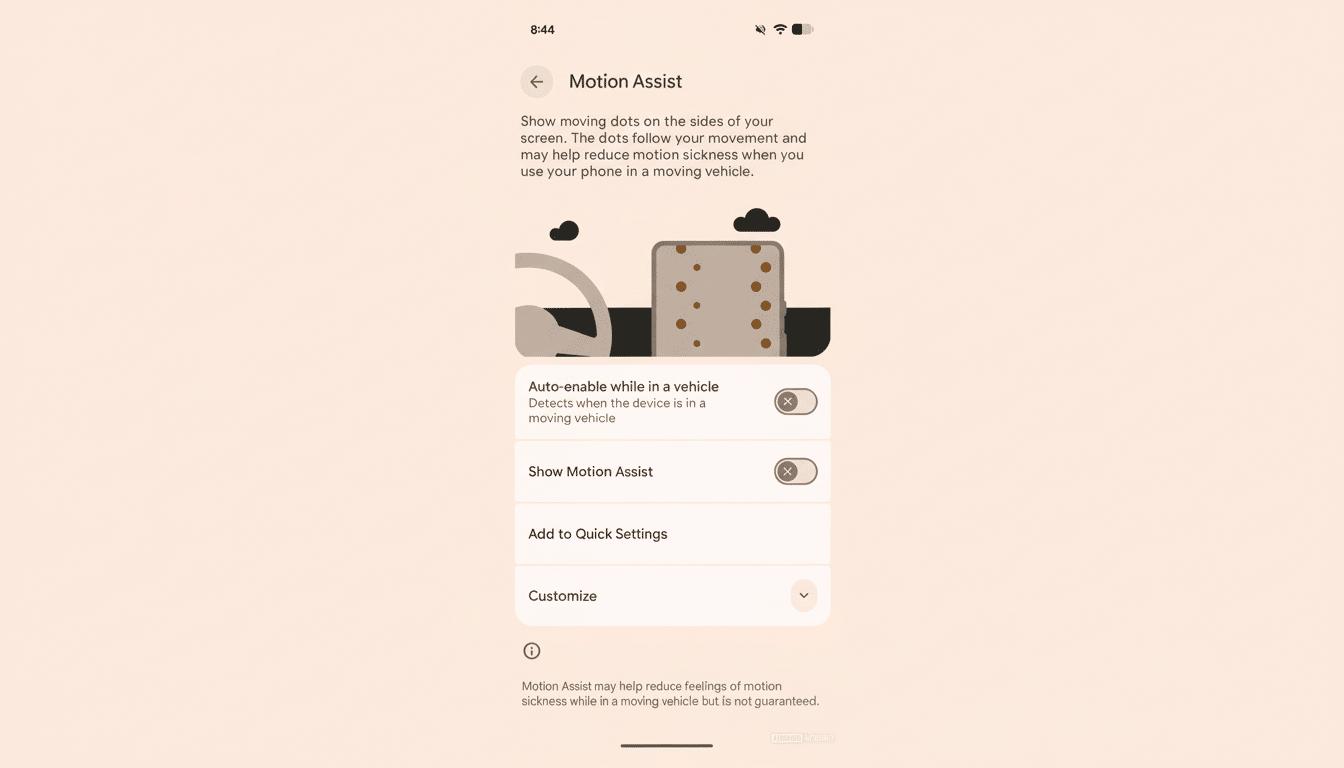
The feature is intended to minimize motion sickness while using the phone in a moving vehicle by adding small on-screen movements that correspond with real-world motion. This is similar to what Apple has with Vehicle Motion Cues in iOS, where animated dots visually indicate acceleration and deceleration as a way to reconcile the difference between what your eyes perceive and what your inner ear tells you.
Why the new Motion Assist name matters for Android
The step from Motion Cues to Motion Assist is also more than skin deep. The new name mitigates confusion with Apple’s Vehicle Motion Cues at the same time it falls in line with Google’s larger “assistive” naming trend for context-aware features. This also plays a role in casting this ability as a behind-the-scenes helper, rather than as an effect on the table that users must repeatedly manage.
There’s practical urgency here. The National Library of Medicine cites studies that show up to 30% of the population are extremely susceptible to motion sickness, especially when they read or use a screen while they’re in a moving car or bus. In an age where in-car screen time is on the rise, that may very well change and serve as a real quality-of-life improvement for commuters and families.
How Motion Assist Will Most Likely Function
Google hasn’t shared a spec sheet, but the building blocks are known. The accelerometer and gyroscope are bound to provide some hilarious sensor fusion to generate a lightweight visual overlay (hopefully something like little dots or slight gradients) that changes as the vehicle does. The goal is to minimize this sensory mismatch without causing distraction, or distorting content.
Several such tools are already pre-installed by Android OEMs. The likes of OnePlus 15, vivo X300 Pro, and OPPO Find X9 Pro offer a screen animation suppression overlay by default. A Google-driven, platform-wide strategy could normalize behavior and give devs unified APIs, so the effect would be available throughout every app without bespoke integration.
Transiting Mode Hints at Smarter Automatic Enablement
Code references discovered in connection with Motion Assist allude to a dedicated Transiting Mode for buses and trains. String descriptions say there are automatic settings and adjustments for an easier ride. Though details are slim, the duo points to Google’s apparent hope to cleverly switch Motion Assist on and off when it recognizes that you’re in motion and have actually used the display — this should minimize unnecessary battery drain and visual hopping about.
Android’s existing Activity Recognition framework and location signals could accompany this detection to automatically switch Motion Assist off and on as needed. That fits neatly with Google’s drive towards ambient intelligence: tools that anticipate needs and quietly change on the user’s behalf.
What to Look for on Pixels as Motion Assist Approaches Launch
Google hasn’t shared any details about a release, but the existence of that finalized branding in Play services usually indicates that its big day is coming soon. This will mean it is liable to launch first on Pixel, possibly as part of a Feature Drop, with Android more broadly after devices and driver support have all been signed off.
Key questions remain:
- Will users receive intensity controls?
- Is the overlay able to apply to specific apps such as browsers or e-readers only?
- Will they need per-vehicle profiles for cars versus trains?
- How will Google thread the needle between responsive and power-drawing OLED technology without “burn-in” safeguards?
The responses, he said, will be necessary to uncover whether Motion Assist feels “invisible” in use — which is the goal — or just another setting that users can switch off.
The Bigger Picture for Motion Assist and Mobile Comfort
Motion Assist is at the crossroads of human factors and mobile UX. For years, organizations such as NASA’s Human Research Program have documented how visual-vestibular conflicts induce motion sickness; the smartphone magnifies this conflict because the eyes are fixated on a static screen while the body feels that it is moving. If Google nails it, Pixels could come with a measurable comfort advantage for the millions who read, chat, and navigate on the go.
For now, the conclusion is straightforward: Google is putting the branding and plumbing in place. Motion Assist appears to be ready to move out of the lab and into commuters’ hands, and the rename is the latest (and clearest) hint that it’s going to be up to Google’s Pixel line to show them how it’s done.
