


Google is rolling out a beta called Personal Intelligence for its Gemini app, a new capability that proactively tailors answers by drawing context from your Google world—starting with Gmail, Photos, Search, and YouTube history. The goal is simple and ambitious: move from reactive chatbot replies to timely, personalized assistance that understands what you need without being told where to look.
How Gemini’s Personal Intelligence Works Across Sources
Unlike basic retrieval tools, Personal Intelligence can reason across multiple sources. If you ask about upcoming travel plans, for example, Gemini can scan your Gmail itinerary, recall a YouTube documentary you watched on the destination, and tap your Search history for saved places—then offer a route, packing tips, and neighborhood recommendations in one go.
The system is multimodal. It can pull specific details from photos, like a Wi-Fi password snapped on a router label or the tread rating on a tire you photographed last fall, and combine that with text from emails and browsing. Google says Gemini only activates this “connective tissue” when it expects the added context will materially improve the answer.
Internally, the company frames the feature around two strengths: cross-source reasoning and precision recall. That means Gemini can fuse signals—text, images, and video—and still fetch a single detail on demand, such as an invoice total from a receipt in Gmail or a model number visible in a photo.
Privacy Controls, Data Use, and User Choices Explained
Personal Intelligence is off by default. Users can choose whether to connect Gmail, Photos, Search, and YouTube history, and can turn connections on or off at any time. Google adds that the assistant avoids proactive assumptions about sensitive categories—like health—unless you explicitly ask about them.
Crucially, Google says the feature does not train the core Gemini models on your Gmail inbox or Photos library. Instead, your content is referenced at inference time to generate an answer, while model training is based on user prompts and the model’s own responses. That distinction—contextual use versus corpus-level training—aims to address a long-standing consumer concern about data repurposing. Surveys from organizations like the Pew Research Center show most people remain wary of how companies use personal information, making clear consent and data boundaries essential.
The company’s approach also arrives in a climate shaped by recent industry missteps. Features that over-collect or surface private information have triggered public backlash and policy reviews across the sector. By making Personal Intelligence opt-in and scoping how sensitive data is handled, Google is trying to thread the needle between helpful personalization and responsible boundaries.
What Personal Intelligence Can Do for You Today
Early demos suggest a practical bent. Ask “What size tires should I buy?” and Gemini can pull the exact size from a photo of your car’s sidewall, then recommend options suited to your driving patterns inferred from past trip photos in your library. At the DMV and forgot your plate number? If there’s a clear shot in Photos, the assistant can surface it instantly.
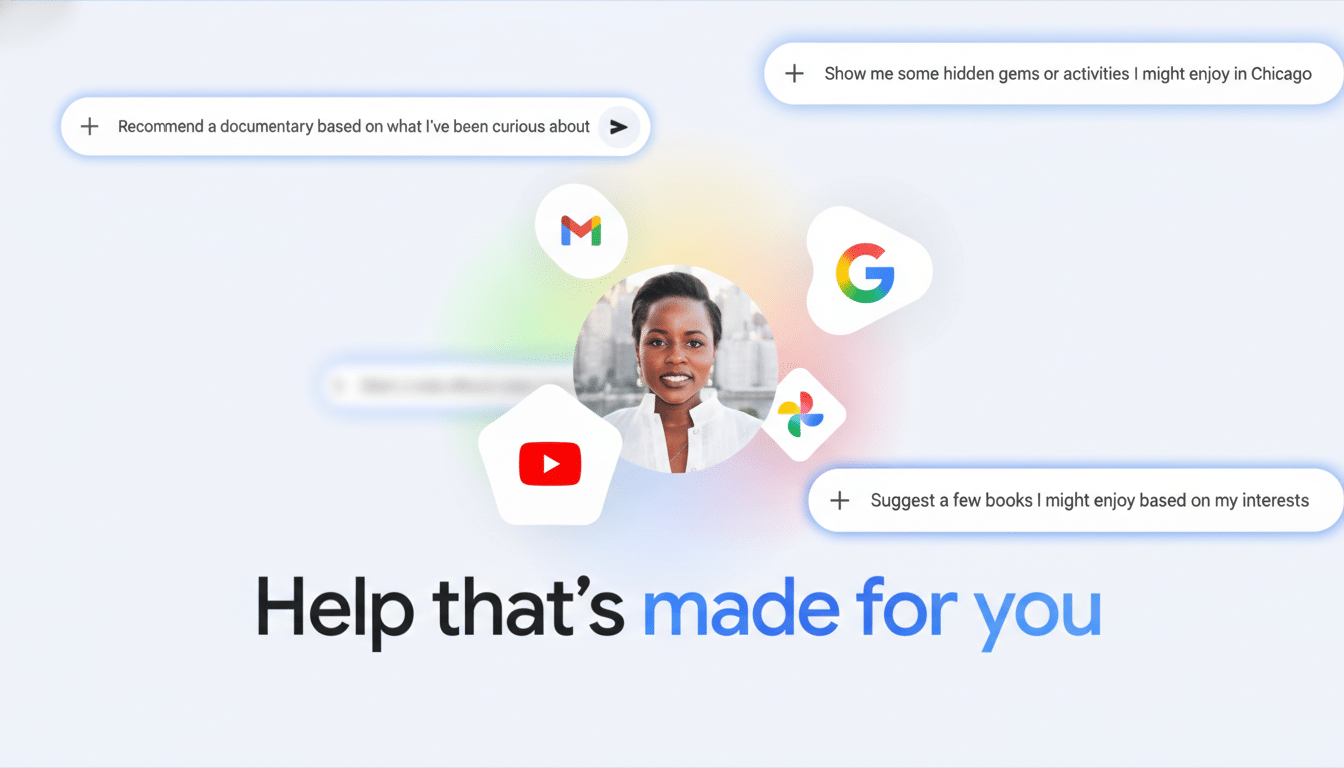
For planning, you can ask it to “Design a weekend in Chicago based on what I like,” and it will weigh your past emails, saved places, and viewing history to avoid tourist traps in favor of museums, cafés, and neighborhoods you’re more likely to enjoy. Content discovery also gets sharper: the prompt “Suggest documentaries aligned with what I’ve been curious about lately” blends your Search and YouTube signals to produce a tailored watchlist.
These use cases fit where Google has massive signal density. Gmail has more than a billion and a half users, YouTube counts over two billion logged-in monthly visitors, and Google Photos serves well over a billion people. With that scale, even small improvements in relevance can feel like a step change in usefulness.
Availability, Regional Rollout, and the Product Roadmap
Personal Intelligence is launching in beta for Google’s AI Pro and AI Ultra subscribers in the U.S., with expansion to additional countries planned. Google says it intends to broaden access to the free Gemini tier after it gathers feedback and tunes safeguards.
Expect more services to join the roster over time. The company is signaling a careful, staged rollout—adding data sources gradually, measuring accuracy and safety impacts, and tightening controls before widening the funnel.
Why This Beta Matters for Everyday AI Assistants
Personalization is the next competitive front for consumer AI. OpenAI has tested “memory” for preferences, Apple is pushing on-device context with its latest assistant efforts, and Microsoft has been refining how its assistants index personal content. Google’s advantage is breadth: few companies can legally and technically connect as many personal signals under a single account.
The risk is overreach. Users want convenience, not surveillance. Success will hinge on transparency, consent flows that people actually understand, and the model’s ability to be confidently helpful without hallucinating or exposing sensitive details. If Google can strike that balance, Personal Intelligence could shift assistants from clever chat companions to dependable, everyday copilots.
