


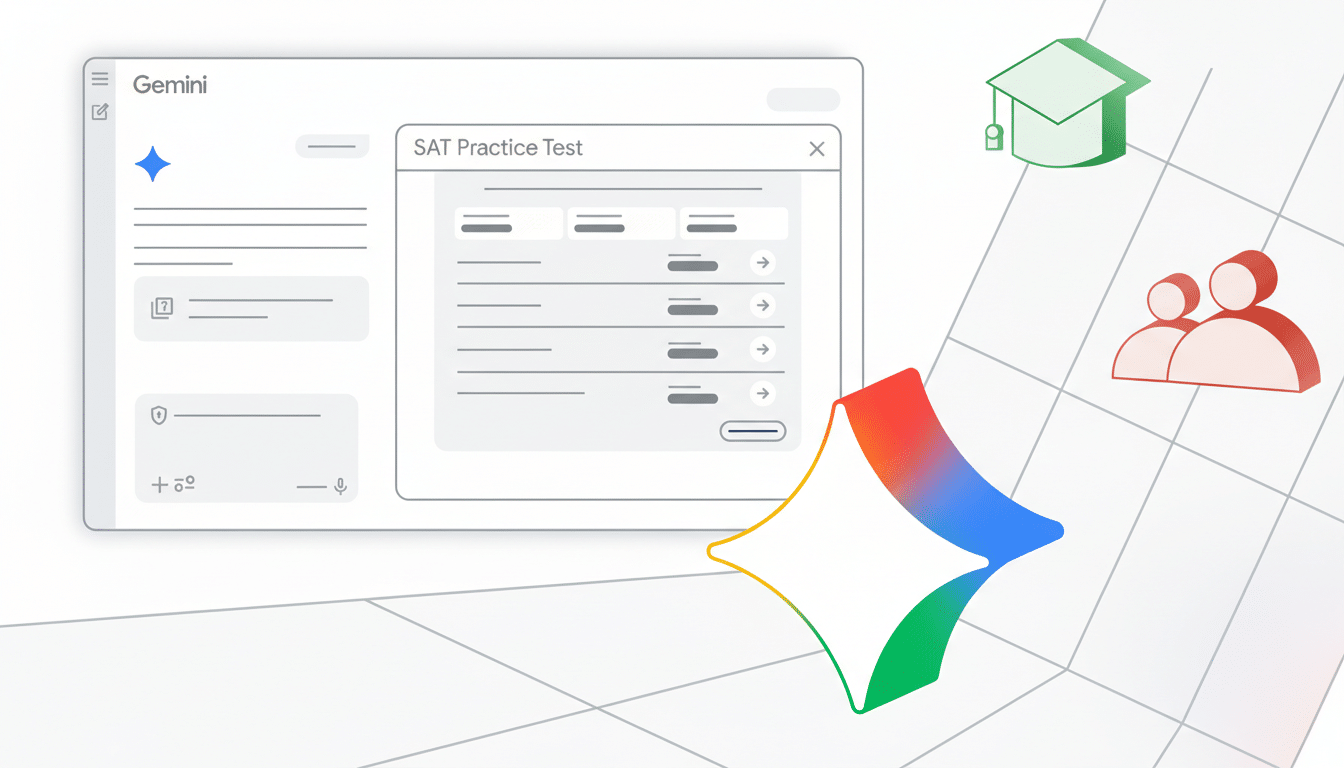
Google is rolling out free SAT practice exams powered by Gemini, its generative AI model, aiming to lower the cost of test prep and boost access for college-bound students. Ask Gemini for a practice SAT and it generates a full-length exam, scores your responses, and walks through the logic behind each answer.
To ensure quality, Google says it worked with established education providers, including The Princeton Review, so questions resemble the digital SAT’s style and difficulty. The result is an AI-driven study companion that tries to replicate the realism of official practice while adding personalized feedback that updates as you go.
- How The AI Practice For The SAT Actually Works
- Why This Move Matters For Students And Test Preparation
- How It Compares To Existing SAT Practice Options Today
- The Benefits And Risks Of Using AI For SAT Preparation
- Quality, Equity, And Privacy Questions Around AI SAT Prep
- What Comes Next For Google's Free AI-Powered SAT Practice
How The AI Practice For The SAT Actually Works
Students initiate a session by prompting Gemini to start a practice test. The system assembles reading and writing passages, math problems, and grid-ins that mirror the exam’s format. When you submit, Gemini highlights strengths, flags weak spots, and offers detailed explanations for incorrect choices.
Crucially, the model doesn’t just reveal the right answer; it deconstructs why distractors are tempting and how to avoid common traps. That kind of immediate, granular feedback aligns with findings from cognitive science research showing that timely explanations and retrieval practice help consolidate learning.
The SAT is now fully digital and uses a multistage adaptive design. Google hasn’t said whether Gemini replicates the exam’s module-level adaptivity, but the company positions the tool as an on-demand simulator with targeted follow-up drills generated from your performance.
Why This Move Matters For Students And Test Preparation
According to College Board, roughly 1.9 million students take the SAT annually—many without access to high-cost tutoring. Traditional courses from big brands can run into the thousands, and one-on-one tutoring often adds significant hourly fees. A free alternative that personalizes explanations could narrow long-standing gaps in prep access.
The broader context is shifting, too. The SAT went digital, universities continue to recalibrate test-optional policies, and students are navigating a crowded prep landscape. An AI that can simulate tests on demand and adapt to your mistakes fits the moment—especially for learners who prefer chat-based, just-in-time help.
How It Compares To Existing SAT Practice Options Today
Official practice through College Board’s Bluebook app remains the gold standard for exact format and timing. Khan Academy, which has long offered free SAT practice in partnership with College Board, provides structured lessons, videos, and progress dashboards.
Gemini’s differentiator is conversational tutoring at scale. Instead of reading a static explanation, students can ask follow-up questions, request alternate solution paths, or generate similar practice items on the fly. For self-directed learners, that dialogue can feel closer to a live tutor than a problem bank.
The Benefits And Risks Of Using AI For SAT Preparation
Done well, AI can accelerate deliberate practice. Research summarized by educational psychologists, including work by Dunlosky and colleagues, underscores that retrieval practice, spaced repetition, and explanatory feedback meaningfully improve outcomes—precisely the routines a responsive model can support.
But overreliance is a real concern. Teachers worry that constant hints can short-circuit productive struggle. Analyses from organizations like Brookings and OECD have noted that heavy, unguided tech use can correlate with weaker learning gains. The best use of Gemini is likely as a coach, not a crutch—prompting students to show their work before revealing solutions.
There’s also the human impact. Free AI prep puts pressure on a multibillion-dollar tutoring sector. While many tutors will adapt by integrating AI into their practice, some families may shift away from paid services if Gemini covers most needs, reserving human support for high-scorers or targeted remediation.
Quality, Equity, And Privacy Questions Around AI SAT Prep
Content fidelity matters. If Gemini’s items consistently match the digital SAT’s emphasis—data literacy in reading and writing, calculator-enabled math with real-world contexts—students benefit. Google’s use of vetted partners is a positive sign, but ongoing calibration against official guidance from College Board will be key.
Equity will hinge on device access and language support. Free prep narrows one barrier, yet students still need reliable connectivity and quiet time. Schools could help by offering supervised practice blocks and pairing AI feedback with teacher check-ins, an approach early pilots of AI in classrooms have found promising.
Privacy and data use deserve scrutiny. High schoolers are generating sensitive performance profiles. Families and districts will want clarity on how study data are stored, whether it trains future models, and what controls students and educators have over retention and sharing.
What Comes Next For Google's Free AI-Powered SAT Practice
Google has already been leaning into classroom tools, including Gemini features that help teachers draft lesson plans or convert materials into podcast-style audio. Expect deeper integrations with learning platforms and, potentially, a school-facing mode that lets educators assign practice sets and monitor progress.
For students, the playbook is simple: combine Gemini’s free practice with official materials, time yourself under digital conditions, and treat AI explanations as a springboard to your own reasoning. If Google can keep the content aligned and the feedback trustworthy, free AI practice could become a staple of SAT prep—and a new baseline for what “personalized” really means.
