


Google is getting ready to release a small but suggestive upgrade to its sticky‑note app: automated note titles generated by machine learning. Code strings found in the most recent Google Keep build indicate an upcoming ability where the app will read a note and suggest a short headline, thus simplifying the way you organize your notes and discover them later.
What the latest Google Keep APK teardown reveals
An APK teardown of Google Keep version 5.25.382.03.90 reveals mention of a “generate title” option that is linked to the note header field.
- What the latest Google Keep APK teardown reveals
- Why clear titles matter so much in a notes app like Keep
- Is AI‑generated titling overkill or genuinely useful polish?
- On‑device versus cloud processing, performance and privacy
- Part of Google’s wider AI productivity and writing push
- What to watch for as Google tests auto‑generated titles
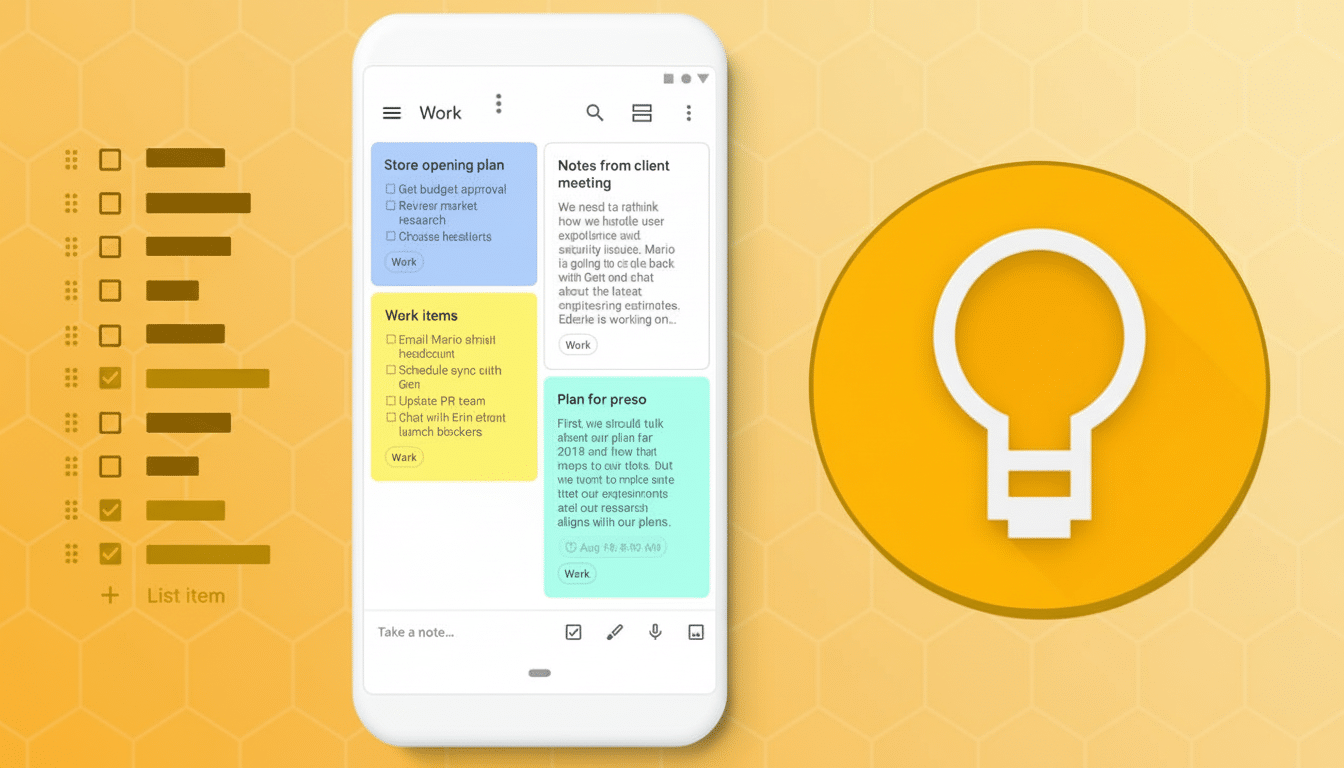
A new button shows up where you would typically type a title, with an icon that looks similar to the writing tools on Gboard. In its current form, it’s inert — probably gated by server flags or not yet fully implemented logic — so we can’t view the actual prompts and outputs just yet.
The most likely behavior is simple: Scrape the body of a note, and then propose a brief, scannable title — say “Weekend camping groceries” for a checklist or “Q3 launch talking points” for a meeting dump. It’s a lightweight sort of assistance that fits into Google’s history of sprinkling text-generation features across its productivity apps rather than reorganizing the core UI.
Why clear titles matter so much in a notes app like Keep
Titles are the first thing your eye jumps to when scanning a grid of notes, and they heavily influence search and sorting. Keep already has labels, colors, and strong search; stronger titles can help reduce the friction of plunging through your list of 40 “Untitled note” entries. This is particularly important at Keep’s scale (just on Android, the app has crossed one billion installs on the Play Store and many users have hundreds of notes across personal and work contexts).
Also, semantically meaningful headings are useful when you export notes to other tools or if sharing them with others. A one-tap auto-title could be a time-saving concept following pasting research or voice-dictating thoughts on the hoof, or for dropping in multi-paragraph text from another app.
Is AI‑generated titling overkill or genuinely useful polish?
It might sound like overkill to have AI name a note. Titles are quick to type, and too many assistive buttons run the risk of making a minimalist app feel cluttered. And if the feature takes several taps, long pauses, or awkward edits to use, it may well bog down the exact kinds of people who need its assistance.
But there’s a pragmatic upside. More than a few notes begin life without a title, and this is how they die. For long, messy posts, an AI that condenses the salient points to a pithy headline could potentially be useful — especially if it functions as a single inline action with immediate output available for editing. The ultimate litmus test will be when we get to the point where the suggestion feels instant and correct rather than obtrusive.
On‑device versus cloud processing, performance and privacy
It is not yet clear if the title generator will be entirely on-device through Gemini Nano, or through cloud models. On-device processing would deliver two obvious wins: faster response times and better privacy, as the content remains on the device. The cloud approach could offer more specific recommendations, but also introduces the familiar concerns of data handling and connectivity.
Google has previously gated some Keep improvements behind its paid AI wares; for example, anyone with access to higher-tier Gemini packages can create checklists from prompts. Where the title generation lands — free, paid, or available only by ecosystem-friendly subscription on specific devices — will determine how widely it’s adopted.
Part of Google’s wider AI productivity and writing push
The experiment in Dona Ana County has dovetailed amiably with Google’s broader ambitions. In addition to SwiftKey’s new engine, Gboard supplies rewrite and proofread tools, Gmail and Docs offer “help me write” suggestions, and Google Photos can auto-title Memories using artificial intelligence. Separate code hints have also referred to AI-generated sketches in Keep, but this feature hasn’t arrived either. Title generation is yet another small brick in an expanding wall of assistive features that will help with the grunt work of tidying and formatting.
What to watch for as Google tests auto‑generated titles
Since the feature is inactive in the current build, it may come out slowly with a server-side switch or land on specific devices first, as well as be tested by only some users. The key differentiators will be speed, editability, and control — perhaps a simple toggle to opt out, clear labeling, and the ability to regenerate.
If Google gets those basics right and continues to keep as much processing local as possible, auto-generated titles could be more of a nice-to-have feature than AI for AI’s sake. If not, it could become just another button no one’s reading.
