


Changing cellphones between platforms is still like moving house without boxes. That could soon change. And fresh clues in Google’s Switch to Android app and rare cross-company cooperation both indicate a real expansion of what can move between Android and iPhone, as well as how it gets there — evidence, perhaps, that tomorrow could be a better day for bringing more of your digital life along wherever you go.
What the new code shows about migration features
New migration payloads were already linked to the “vnd.os-migration” schema, suggesting support for migrating accessibility settings, music playlists, passwords and passkeys, wallet passes, and complete Wi‑Fi credentials. Today, users get to keep photos, contacts, and messages but have to retype logins, set new preferences, and reorganize media. The new data types are designed to address these pain points.
- What the new code shows about migration features
- Make credentials and passkeys truly portable
- Wallets and eSIMs need a smarter cross-platform handshake
- Respect accessibility right from the first boot
- Media and messages, no mess during cross-platform moves
- One migration flow that works securely in two directions
- The bottom line on cross-platform phone migration
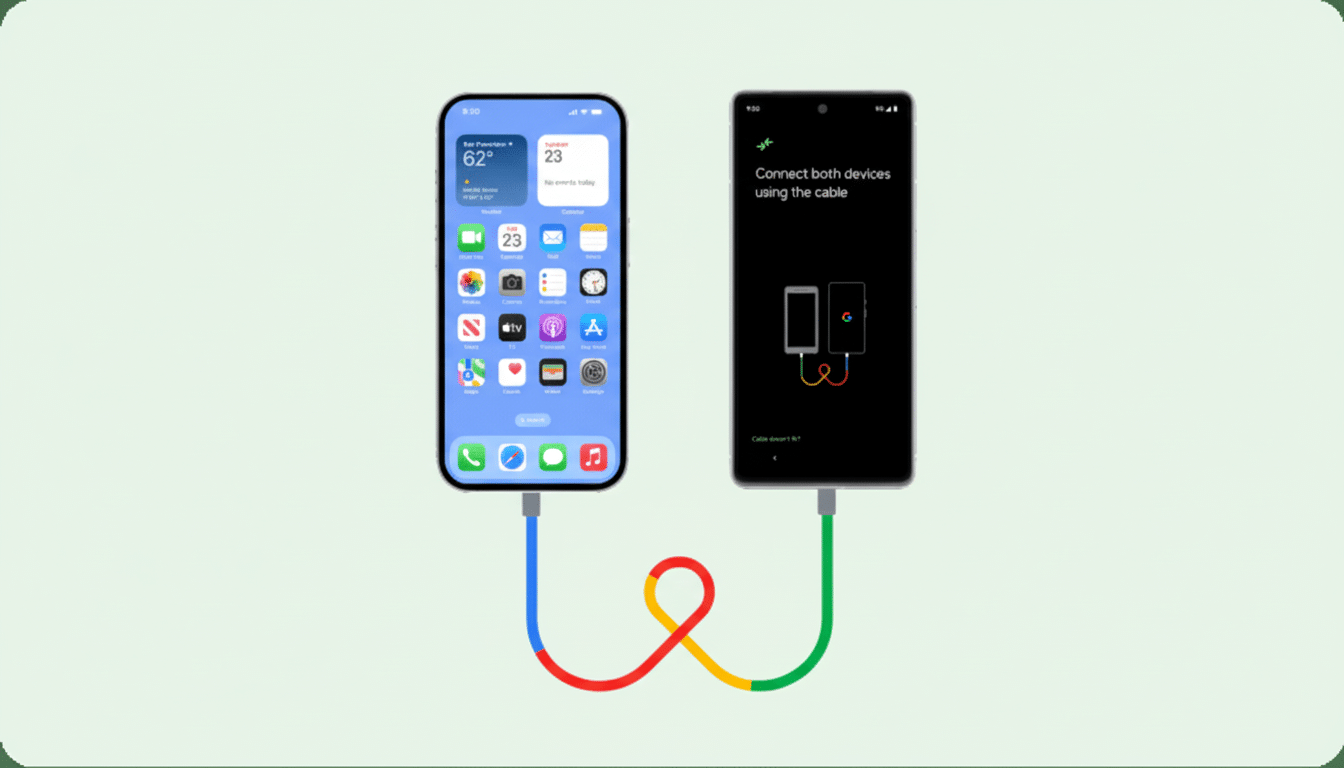
Although it’s the Android side that contains coded evidence of this feature, people familiar with its development say it may not ultimately make an appearance in the final product.
UPDATE: While code appears on the Android side, there is a lot of two-way communication here, so some or all of it will likely show up in Apple’s Move to iOS app as well. What works from iPhone can also work to iPhone from Android.
Neither company has given precise time frames or indicated whether the transfers will be done via cable or wirelessly, but the move is clear: more categories, less setup friction.
Make credentials and passkeys truly portable
Ditto with passwords and passkeys; they either make or break day-one usability. One possible tactic for a seamless handoff would be to employ the FIDO Alliance’s multi-device passkey model, with an encrypted, peer‑to‑peer exchange delivered through QR code or cable. That would safely ferry passkeys between iCloud Keychain and Google Password Manager without the shared secrets ever being exposed to the servers of either platform.
Two-factor codes deserve to be first-class as well. System-level migration APIs should allow authenticator apps to export TOTP secrets into the new device’s Secure Enclave or Titan M–backed storage with clear user opt‑in. For Wi‑Fi, moving not only from one SSID to another but also pushing pre-shared keys or WPA3 credentials would eliminate the first-day dance of collecting passwords room by room.
Wallets and eSIMs need a smarter cross-platform handshake
Wallet passes are commonly built around the .pkpass format for both ecosystems to interpret. The majority of non-payment items that users care about could be included in a guided import that maps loyalty cards, transit passes, and event tickets. It gets more complicated when it comes to payment cards: tokens are generated by networks like Visa and Mastercard and are device-specific for security purposes. It’s possible a cross-platform “re‑provisioning” flow — facilitated by the card networks, not Apple or Google — could allow users to re-add cards without manually re-entering numbers, while still enabling bank-grade checks.
eSIM is the elephant in the room. Android’s recent adoption of GSMA‑standard eSIM transfer mechanisms on certain devices, and Apple’s eSIM Quick Transfer moving profiles around inside its own ecosystem, are just two examples. What’s left is a carrier-backed, cross-platform handoff involving GSMA standards that would allow users to transition a cellular plan with one scan — no store visit, no QR code email, and no downtime.
Respect accessibility right from the first boot
Accessibility settings also shouldn’t reset at the most inconvenient times. A migration plan would bring the corresponding font scale, color and contrast preferences, caption styling sub‑schemes, mono audio, haptic intensity, and screen reader user settings alongside it. For hearing aids, there should be at least a profile, and preferences can be transferred from both sides, even if Bluetooth pairing must be performed again individually due to security keys. More than a billion people around the world are estimated to have a disability, according to the World Health Organization; maintaining tailored experiences isn’t icing on the cake.
Media and messages, no mess during cross-platform moves
Current third-party services support playlist migration now, but with native tools, API endpoints for both Apple Music and YouTube Music can be called to match tracks, make playlists whole, and show what wasn’t found in an open manner. Old DRM‑encumbered media you’ve bought will remain ring‑fenced, but personal libraries and metadata may roam the left field.
Messages are trickier. WhatsApp recently announced that it would be adding cross-platform chat transfers within its app, but iMessage histories are still locked up in Apple’s ecosystem and RCS is still being rolled out on iPhone. A neutral export‑import standard for everyone’s SMS/MMS and app‑level backups for over‑the‑top services could offer continuity to users without undermining end‑to‑end encryption.
One migration flow that works securely in two directions
The notion is for there to be a single, verified flow — working in both directions, if it makes sense, and wirelessly for convenience or via cable for speed and reliability. Now that recent iPhones have USB‑C and it’s been adopted by most Android devices, a cable solution is at last practical. Clear consent screens, per‑category toggles, and a privacy report at the end would meet the requirements of data protection norms under GDPR, as well as state privacy laws.
Why it does: Platform loyalty is frequently measured above 90% by Consumer Intelligence Research Partners, yet when more than a billion phones ship each year (IDC), even if just a single‑digit percentage of users leave, that still ends up being tens of millions who depart.
Each account, password, and preference you migrate offers lower churn, drives app re‑engagement higher, and lowers support costs for carriers and OEMs.
The bottom line on cross-platform phone migration
The latest signals from Google and Apple suggest a smarter, broader pipeline for migration that finally gets to the hard part: credentials, wallets, accessibility, media context. Getting it into market will need standards work with the FIDO Alliance, GSMA, card networks, and app developers. As long as they get it right, shifting phones shouldn’t feel like starting over. It will no longer feel so much like logging in.
