


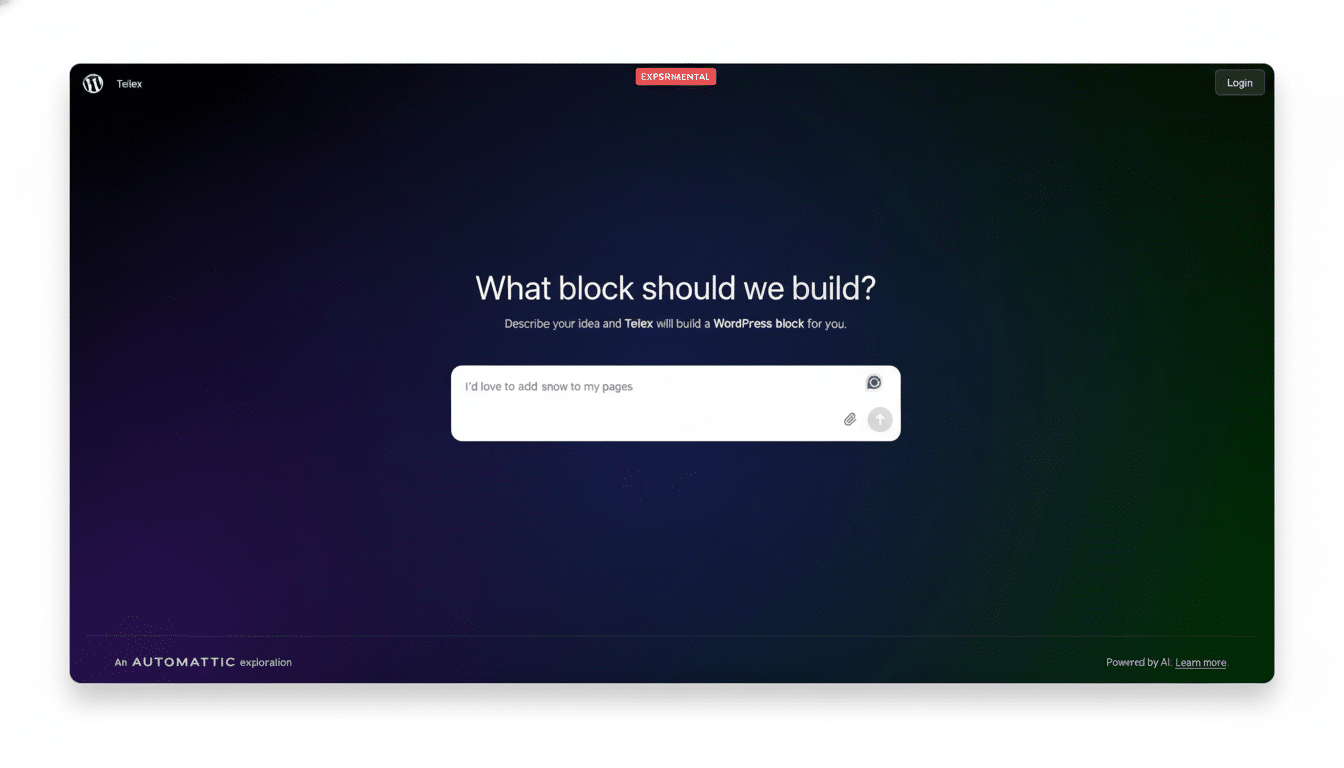
Telex, WordPress’s experimental “vibe-coding” tool, has graduated from demo to delivered. Unveiled at the company’s State of the Word event, Telex has already generated functional Gutenberg blocks that are powering live sites—proof that AI-assisted component creation is no longer relegated to theoretical whiteboards for the world’s internet behemoth.
What Telex Does: Translating Intent into Gutenberg Blocks
Telex is designed to translate natural-language intent into sensible Gutenberg blocks—the modular building blocks in modern WordPress. Instead of manually writing React and PHP scaffolding, developers write out how they want the behavior and UI, then iterate in the browser as block code, config, and styles are generated by AI. This, essentially, is WordPress’s repository of vibe-coding: defining software by describing the result you want to achieve rather than specifying every excruciating step.
- What Telex Does: Translating Intent into Gutenberg Blocks
- Real-World Examples Already Shipped with Telex Blocks
- Why the WordPress Community Should Care About Telex
- Plugging WordPress into the Modern AI Toolchain
- Risks and Guardrails for AI-Generated WordPress Blocks
- What Comes Next for Telex and AI-Native WordPress Workflows

The tool remains experimental, but its potential is obvious. Telex focuses on the three biggest friction points of web production work: interactive widgets, dataset integrations, and low-variation UI screens that eat into billable time. Shrinking that cycle allows teams to ship and iterate on custom blocks much faster—just like any other WordPress asset.
Real-World Examples Already Shipped with Telex Blocks
Automattic’s Matt Mullenweg shared several live use cases made by Nick Hamze, a creator from the community who had designed stores actively running on WordPress. Among these were:
- A pricing comparison element
- A cost calculator module
- A header module that automatically pulls real-time store hours, the phone number, and a one-tap directions link
Telex also made a partner-logo carousel, a Google Calendar block, and an equal-height post card layout grid for clean, uniform layouts. Taken individually these are small victories, but together they constitute a sort of pipeline of interactive elements that would have previously cost thousands and taken days or weeks to deliver.
Developer Tammie Lister went above and beyond, creating a new block each day for an entire month—from simple fun like a playable ASCII Tetris to seasonal UI like a why-don’t-you-go-trick-or-treating prompt. (Tammie Lister: Patreon)
The lesson: Telex can easily balance business-ready components with creative one-offs without overtaxing engineering time.
Why the WordPress Community Should Care About Telex
According to W3Techs, WordPress runs about 43% of all websites; there are more than 60,000 plugins in the official directory. But advertising agencies and site teams continue to invest immense amounts of energy creating bespoke blocks to bridge the gulf that sits between a generic plugin and exactly the UX a client requires. Telex promises to reduce those costs, turning one-off components into quick-turn deliverables that can be edited, versioned, and reused across projects.
For many small businesses, that could mean quicker launches for pricing tools, appointment widgets, or location modules—elements of a website that directly affect conversion. For enterprise teams, the upside is volume: shipping dozens of brand-aligned blocks across properties without giving designers and engineers a bottleneck.
Plugging WordPress into the Modern AI Toolchain
Telex comes alongside architectural work to make WordPress more legible to AI systems. A new Abilities API describes what a site is capable of in machine-readable language, and an MCP adapter opens these abilities to tools that understand the Model Context Protocol. In practice, this means a WordPress install can “join an AI workflow” through something like Claude or Copilot without having to be integrated from scratch every time.
Devs are also integrating AI within their daily stack via editors and CLIs like Cursor, Claude Code, and WP-CLI. The pitch is pragmatic: search code, refactor, and script repetitive tasks with a helper that speaks WordPress’s language—before passing off to Telex when it’s time to add a new block.
Risks and Guardrails for AI-Generated WordPress Blocks
AI-generated code still requires review. Block security, performance, accessibility, and licensing cannot be taken for granted. The WordPress project has adopted established standards for sanitization, escaping, and accessibility; it’s important that Telex outputs adhere to these norms. Telex should be coupled with tests, code review, and staging gates ahead of production.
What Comes Next for Telex and AI-Native WordPress Workflows
WordPress will provide benchmarks so that AI models can be tested for real CMS tasks—edit content, change something in a plugin, or play with the admin UI using browser agents. That might provide a similar score from developers for models’ performance on WordPress-specific jobs, not just generic coding tests.
The higher-level view here is an AI-native workflow for the block era: describe a component, generate it, validate, and ship. Hot on the heels of such credible real-world deployments, Telex has finally stepped over the threshold from foothill fascination to useful tool—and one that may yet redefine how the WordPress ecosystem constructs the next generation of interactive content sites.
