


A driverless Tesla Robotaxi was seen cruising the streets of Austin this week with no one sitting in the driver’s seat, marking a new stage of the company’s attempt to grow its operations for self-driving cars in Texas. The sighting, which has also been shared widely on social media, shows what seems to be a Model Y navigating under its own power. Tesla’s founder and CEO later confirmed that fully driverless testing using empty cars is being conducted in the city.
What Witnesses Saw During Austin Driverless Tests
By all accounts, the Model Y seen by onlookers was a production-spec model featuring Tesla’s standard camera suite as well as no visible roof-mounted sensors or any exterior modifications whatsoever. That’s in line with Tesla’s vision-only approach that uses onboard cameras, compute and software rather than lidar or high-definition maps. Vehicles, according to the insider, drove in their lanes and went through routes in central Austin as they would without a human driver sitting in the front seat.
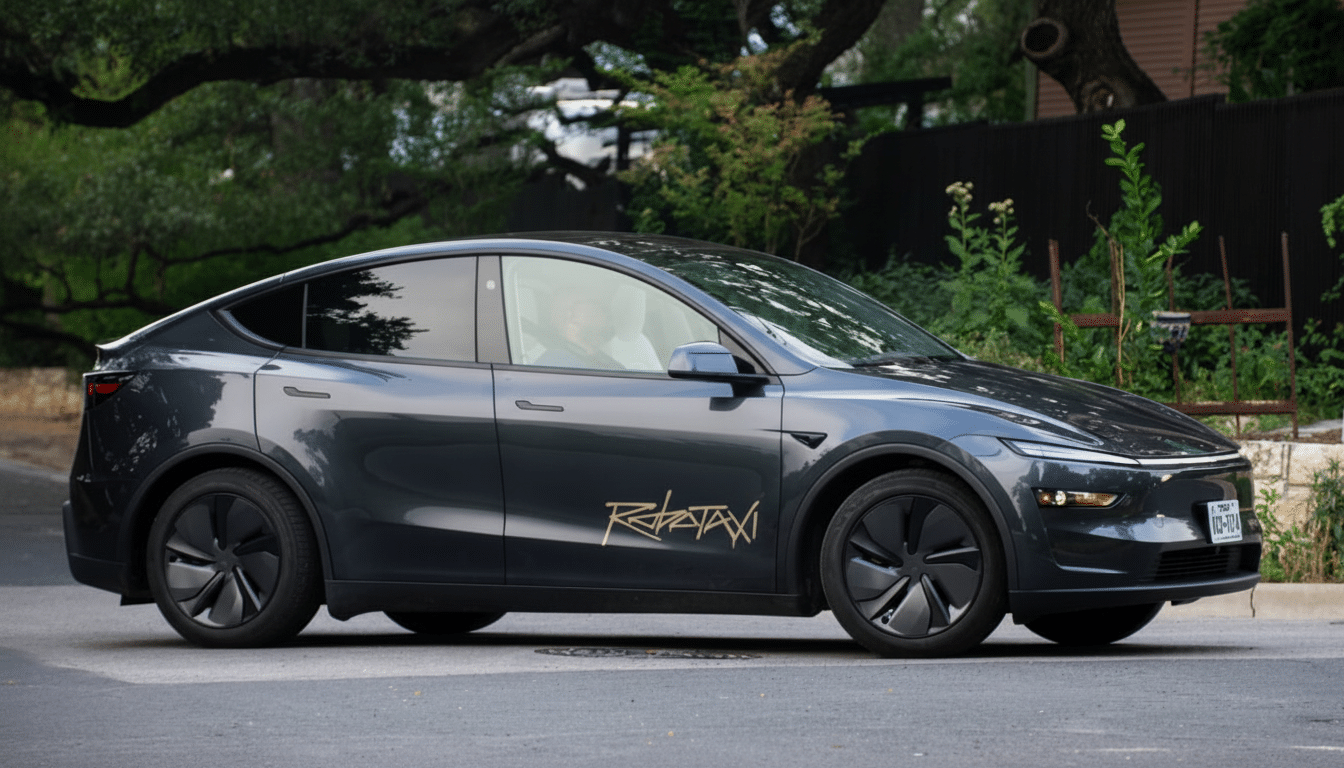
Though Tesla has been conducting robotaxi pilots with safety drivers in Austin for months, this seemed to be the first widely witnessed instance of a Texas-licensed vehicle operating hands-free on local public roads with no occupants at all. The company has been gradually moving its Full Self-Driving stack from reliance on a combination of neural networks and geometric reasoning to end-to-end, recognizing that this computational approach will make the system more robust across unstructured city streets.
How Tesla’s Approach Contrasts With Rivals
Tesla is pursuing autonomy using consumer-grade cars and a camera-only sensor suite, as opposed to rivals who use purpose-built robotaxis with multiple-redundant hardware. Waymo, for example, has racked up tens of millions of autonomous miles on public roads and runs a rider-only service in Phoenix as well as areas in San Francisco and Los Angeles, with Austin under development. Its vehicles rely on lidar, radar and detailed mapping as well as safety redundancies.
Cruise’s experience underscores the stakes. The company suspended driverless operations after a high-profile incident in California and has gradually been reintroducing supervised testing in certain markets as it cooperates with regulators. Tesla’s appearance in Austin gives an indication that it is indeed revving toward riderless operation and offers a striking example of the industry’s diverging philosophies on safety, validation and hardware.
Background of Regulations and Safety in Texas
In Texas, automated vehicles can operate on public roads without a human behind the wheel if they’re insured and meet other compliance standards, making the state an ideal place for AV testing. Unlike California, Texas does not require public disengagement reports, so performance data is likely to be more challenging for residents and researchers to comb through.
Federal oversight remains a factor. The National Highway Traffic Safety Administration has been closely monitoring Tesla’s driver-assistance systems, including a large recall to strengthen driver monitoring and subsequent evaluations of its effectiveness. Riderless operation will force attention to incident reporting, processes for remote assistance and how Tesla deals with edge cases like emergency scenes, nighttime cyclists at the side of the road and work zones—something that has proved problematic for many AV developers.
If commercial service does begin, Austin officials, who have pursued safety-related Vision Zero goals, probably will insist on open coordination and sharing of routes, hours of operation and data. With public reporting not mandated in Texas, voluntary disclosures from operators and independent academic studies will be key to assuring the public.
What The Sighting Means For Tesla’s Roadmap
Tesla has said its current software, which is based on large-scale neural networks trained by fleet video, is expected to evolve from supervised to unsupervised driving. Company updates this year boasted of over a billion miles driven cumulatively with its advanced driver-assistance features active—a data advantage that Tesla has said is crucial to reaching true driverless performance. The Austin sighting indicates Tesla is now testing that leap in the real world of an urban setting.
In practice, if Tesla pursues rider service, expect a staged rollout: testing without passengers in empty vehicles, employee rides and then limited public access within a geofenced area and strict hours. It is much the approach other operators have taken to scale operations and gather safety data. Pricing, pick-up policies and service coverage would probably be conservative at first, concentrating on predictable routes and conditions.
What Happens Next for Austin Riders and Commuters
For residents, a few of the key issues include whether robotaxis will be safe to use, how reliable they are and where they will go. Good early targets are downtown, South Congress, East Austin and the corridors to the airport (steady demand, clearer road geometry). How well they integrate with micromobility and transit hubs may determine whether robotaxis are additive or cannibalistic to existing options.
Further incident-free operation will also need to be demonstrated by Tesla, as well as due diligence and clear communication around interventions and remote support for it to make a strong case for wider use. If not, look for regulators and the public to demand tighter scrutiny. Either way, a driverless Tesla wandering the streets of Austin would represent nothing less than a turn from promise to proof that the city is becoming a test bed for what may be the company’s most pivotal bet yet.
