


All hail 32 Chunk, the burly brown bear whose salmon-sculpted bod and surprising resilience took him straight to the Fat Bear Week title — and into our hearts.
The tumescent champion emerged triumphant from the fierce annual competition held in Alaska’s Katmai National Park and Preserve, which invites fans of portly predators to vote on which heavyweight makes them growl with approval.
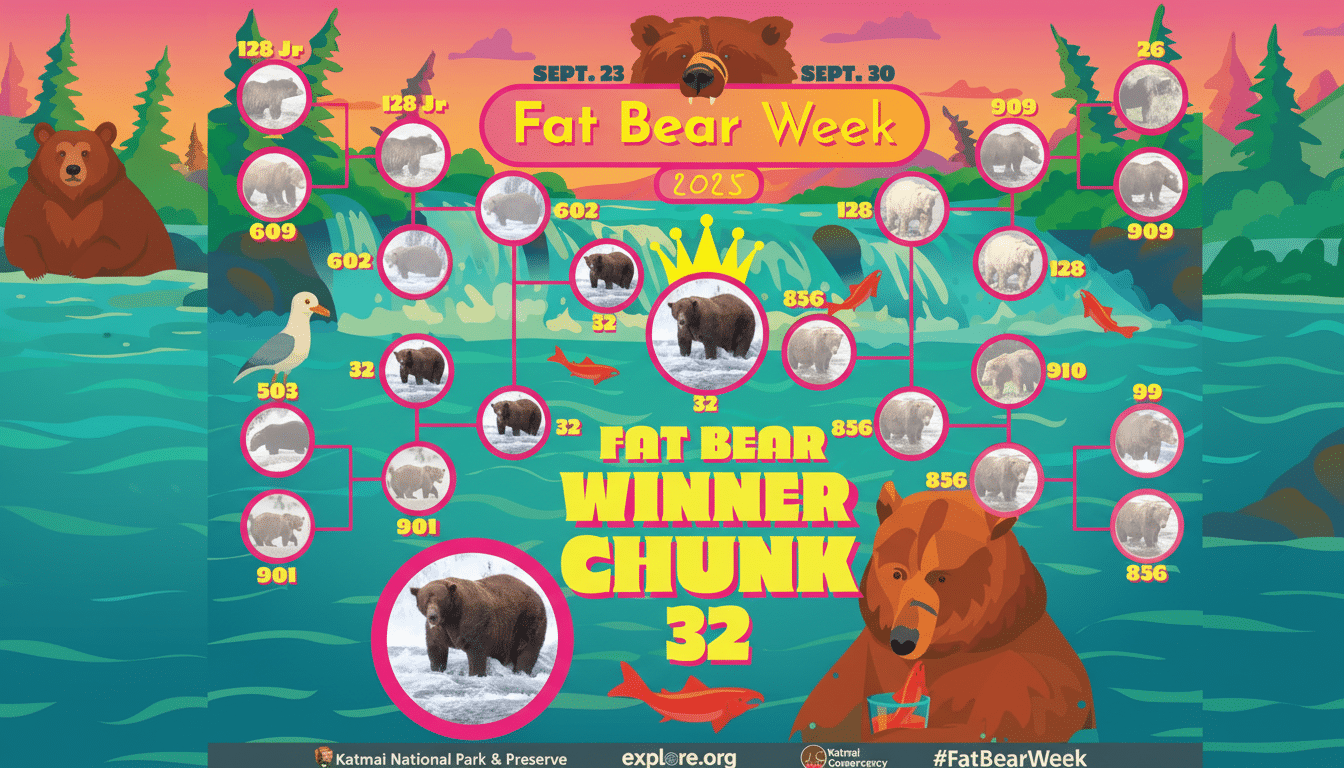
Bears of Katmai National Park’s annual battles concluded with a landslide showing for the widely beloved boar, whose evolution this season was as much an act of biology as it was a storytelling triumph.
Fat Bear Week, organized by Explore.org, along with Katmai National Park and Preserve, has turned a science-based phenomenon into an international public vote: which bear most successfully packed on the pounds in order to fuel hibernation. This year’s race drew a record number of participants, reminding us that a remote river in Alaska has now become an arena for wildlife literacy and shared joy.
Why Chunk claimed the crown in Katmai’s Fat Bear Week
Chunk’s success was never guaranteed. Observers saw him overcome a broken jaw earlier this season — a significant obstacle for the predator, which crushes, tears, and gulps calorie-dense fish. Bears at Katmai do not receive treatment from veterinarians; it’s adaptation and grit that determine survival. Chunk modified his fishing technique, conserved energy, and reclaimed prime territory along the Brooks River, where rotund salmon and minimal wasted movement assume an order that stacks the deck in a bear’s favor.
He is also, simply, enormous. Adult male brown bears at Katmai can top 700 pounds by the fall, with top boars estimated well above that. Chunk’s late-season construction — a deep chest, thick neck, and that unmistakable bulge to the rear end — made me think he had deposited plenty of baggage in his fat reserves for a long winter. Bears can lose a third of their body mass while denned, according to the National Park Service; extra scraps of fat are insurance for survival and next year’s breeding.
How the Fat Bear Week voting competition works
Fat Bear Week is a bracketed competition with before-and-after photos of preferred bears culled from among the season’s live-cam regulars. Voters select the bear whose growth best represents a story of success, not necessarily the heaviest bear. That nuance allows the distinctive personalities and life histories to shine through — dominant males, fierce protective mothers, and subadults learning the fish ladder all get their moments.
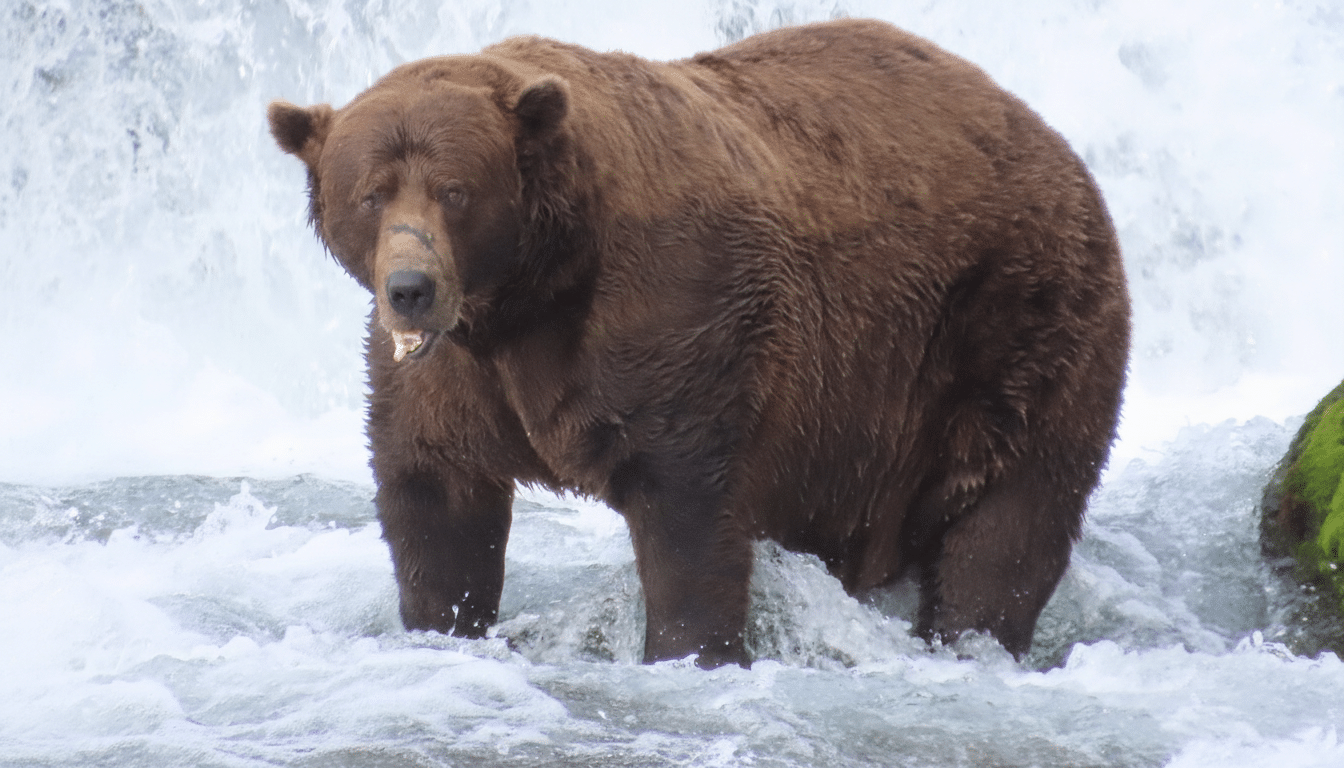
This year’s field was stacked. Two-time champion 128 Grazer — known for her audacity to defend cubs and territory — in the semifinals saw her off-then-on runner-up bid unravel with the presence of a new sow, this time 856, whose body was completely transfigured. Grazer’s own progeny, 128 Jr. to fans, made it out of the first round before falling short. In the end, it was Chunk’s comeback and power of poundage that fueled him to his first-ever crown.
Record turnout and what this year’s vote means
According to Explore.org, votes came in at some 1.7 million this season, squeaking past the previous record of about 1.3 million. And that surge is not trivial. It is evidence of an expanding market for easygoing stories about conservation, and also a rare moment when online virality coincides with ecological fluency.
Katmai protects one of the highest densities of brown bears in the world, and their fall feast is powered by salmon runs that pour into Bristol Bay. Fishery managers have documented historically strong sockeye returns in recent years, a boon for bears and people alike. When salmon are abundant and predictable, bears can partition the river, minimize risky conflicts, and fatten efficiently. The public, guided by ranger interpretation and live cameras, now follows those dynamics almost in real time.
With this victory, Chunk joins a decorated lineage. Four-time winner 480 Otis remains the contest’s elder statesman, recognized as much for patience as for size. Heavyweight 747 — known to fans as “Bear Force One” — has multiple titles. 409 Beadnose and 128 Grazer each have two. Single-title holders like 435 Holly and now 32 Chunk remind voters that the crown shifts with circumstance: salmon timing, social hierarchies at the falls, and the unpredictable calculus of life in the wild. What sets Chunk apart is the arc. Long observed at the Brooks River, he has toggled between deference and dominance depending on who else is on the scene. This year, his strategy, stamina, and physical rebound stitched together the kind of narrative that transcends a single snapshot — a season’s worth of choices, visible on a frame that needed no caption.
For Chunk, there’s no victory parade — only the silent business of hibernation. When the temperatures plunge and the salmon dwindle, he will hunker down into a den, subsisting on energy accumulated. If all goes according to schedule, he will emerge in the spring much skinnier and be ready to restore fishing rights and rebuild that amazing body fat one salmon at a time.
For fans, the lesson is resounding: Fat Bear Week may be lighthearted by design, but it is rooted in natural history. Millions are plugged into the rhythms of a river, the side effects of fat metabolism, and the worth of protected habitat. This season, those threads all came together in a single bear with a scarred jaw and an iron will. Here’s to Chunk, this year’s champion and a reason we tune in.
