


OpenAI is upgrading ChatGPT’s Deep Research with features power users have been asking for: you can now choose which sources it consults, view finished reports directly inside ChatGPT, and monitor or edit long-running jobs in real time. The capability is powered by the company’s latest GPT-5.2 model, which OpenAI says improves accuracy and reasoning for multi-step research tasks.
The rollout starts with Plus and Pro subscribers, with broader availability promised soon. For analysts, academics, and teams that need auditability, the update is a clear swing at making AI-generated research traceable, faster to refine, and easier to share.
- What’s New in Deep Research: Source Selection and Apps
- Built-In Reports and Export Options for Easy Sharing
- Real-Time Progress and Mid-Run Edits for Long Research Jobs
- Why Source Control Changes Trust in AI Research Outputs
- Practical Examples for Compliance, Research, and Finance
- Competitive Context Among AI Research Assistants and Tools
- Availability for ChatGPT Plus and Pro, with More to Come
What’s New in Deep Research: Source Selection and Apps
The new release turns Deep Research from a black box into a guided workflow. You can pre-select websites and publications for the system to use on a run, then tell it to strictly prioritize those sources or merely weight them while it continues to search the web. This simple control meaningfully changes outcomes: if your team trusts certain regulators, journals, or first-party docs, the model now starts from your canon rather than the open internet.
OpenAI also added app integrations. One example shown publicly uses a financial markets app from the London Stock Exchange Group to include structured, real-time market data in research outputs. Expect similar niche apps to emerge for legal, healthcare, and scientific domains where specialized databases matter.
Built-In Reports and Export Options for Easy Sharing
Previously, Deep Research produced a downloadable file. Now, reports open directly inside ChatGPT with a clean reader view. A table of contents sits on the left for quick navigation, while a source panel on the right lists citations so you can jump out to primary materials without hunting.
When you’re ready to share, exports include Markdown for developer workflows, PDF for fixed-layout briefs, and Word for teams that need tracked edits. In editorial and consulting settings, that flexibility cuts busywork from handoff to publication.
Real-Time Progress and Mid-Run Edits for Long Research Jobs
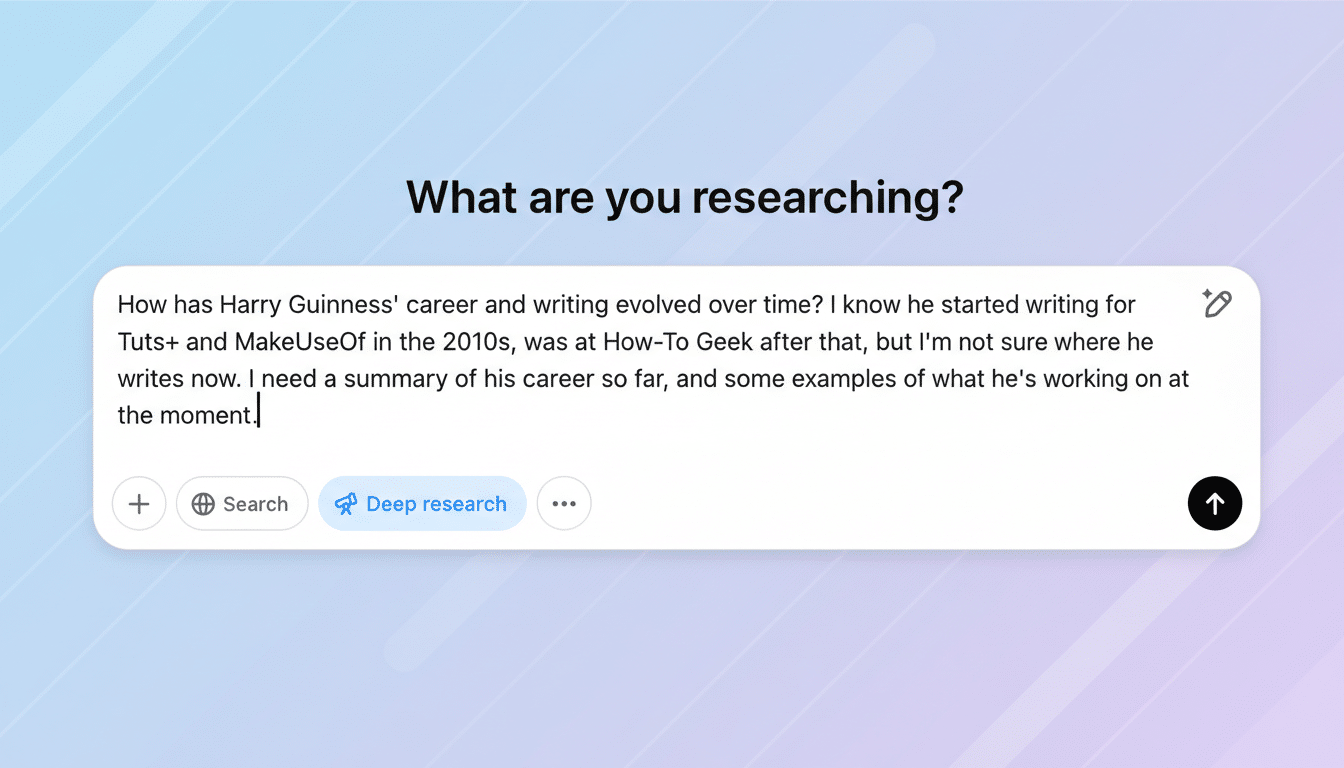
Deep Research tasks can take time—OpenAI says complex runs may last up to 30 minutes. You can now watch progress, step in midstream, and ask for changes without starting over. Common mid-run edits include adding new keywords, inserting a missing source list, or tightening the scope (“focus on 2024–2026 regulatory updates only”).
This matters because research rarely follows a straight line. Iteration inside the same job maintains context while avoiding duplicate cost and wait time—something enterprise buyers have been asking for as they pilot AI agents on real workflows.
Why Source Control Changes Trust in AI Research Outputs
Provenance is the difference between a draft you skim and a brief you sign. The National Institute of Standards and Technology’s AI risk guidance stresses traceability and transparency, and industry analysts have repeatedly flagged citation quality as a barrier to production use. By letting users pick and prioritize sources, OpenAI is aligning Deep Research with those governance expectations.
There’s also a productivity angle. McKinsey research has long estimated that knowledge workers spend roughly 20% of their time searching for and gathering information. If an AI agent starts from the right sources, first passes are cleaner, review cycles shorten, and that 20% shrinks without sacrificing rigor.
Practical Examples for Compliance, Research, and Finance
A compliance lead can direct a run to the SEC, FCA, and ESMA websites, ask the agent to prioritize those regulators, and generate a change log of the newest directives, complete with links to primary filings. A biomedical researcher can anchor a literature review to PubMed and arXiv, then export Markdown to a lab repo. A portfolio analyst might tap the LSEG app to pull sector benchmarks alongside narrative analysis for an investment memo.
Because you can intervene mid-run, each of these users can add a newly discovered source or refine a query the moment they see a gap, rather than wait for a full second pass.
Competitive Context Among AI Research Assistants and Tools
Rivals have pushed toward transparency—research assistants that show citations, notebook-style interfaces, and export pipelines. OpenAI’s move goes a step further by combining user-selected sources, in-app document viewing, and live editability within a single agentic workflow. For teams weighing AI tools, the question shifts from “Can it summarize?” to “Can it be audited, steered, and shipped?”
Availability for ChatGPT Plus and Pro, with More to Come
The upgraded Deep Research is available now for ChatGPT Plus and Pro subscribers. OpenAI says the same features will reach additional tiers soon, though timing for free and ChatGPT Go users has not been announced. If your organization requires strict sourcing, this release is the most compelling reason yet to test Deep Research on real projects.
