


CES has long been the nexus where earnest engineering meets delightful absurdity. This year’s show floor digs deep into that tradition, with startups and research labs showing off AI, sensors, and inventive new materials in gadgets that make you stop and smile before pausing to ask how any of it really functions.
Last year, CES was expected to attract more than 135,000 attendees and about 4,000 exhibitors; in 2026 that buzz feels even more heightened—figuratively and literally—principally because of AI at the edge and a wave of experimental interfaces. Weird isn’t the same thing as dumb, however; these prototypes do provide a glimpse of where categories might be heading once the tech is more mature and the prices come down.
- A Humanoid Robot That Folds Your Laundry
- Computer Vision Hair Clippers For DIY Trims
- A Candy That Makes Music Out of Your Teeth
- A Holographic AI Companion In A Curved OLED
- A Pillow That Promises To Read Your Dreams
- A Self-Filling Bottle That Pulls Water From the Air
- An AR Range Hood to Coach Your Cooking on the Stovetop
- A Suitcase That Walks by Your Side Through Airports
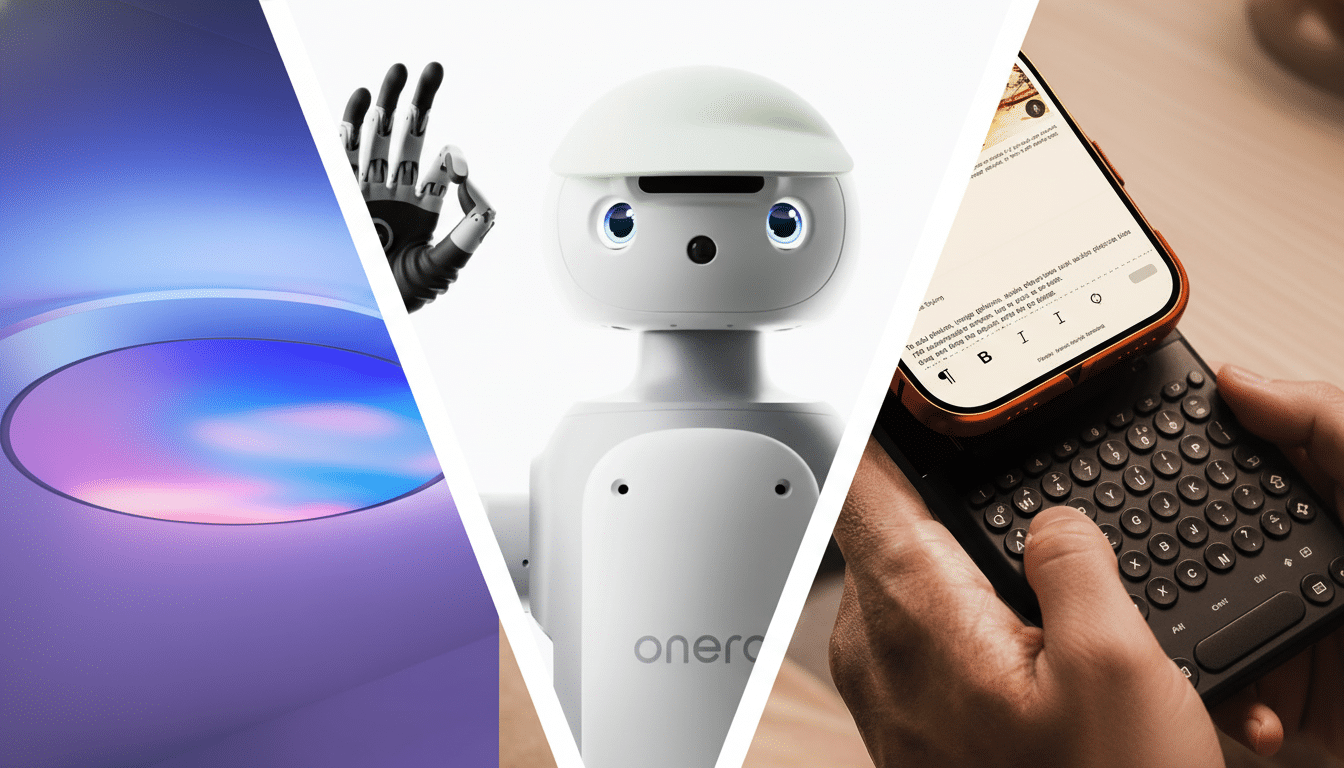
Here are the seven weirdest devices I’ve encountered thus far — and why they might matter, beyond the spectacle.
A Humanoid Robot That Folds Your Laundry
Robotics teams are demoing humanoid-like robots that can recognize a shirt, shake off the wrinkles, then fold it into something kind of sort of store-worthy. The arms aren’t the hard part; it’s the cloth. Deforming objects is particularly difficult, and it’s telling that one of the first demos we’ve seen come out of recent research at MIT CSAIL and Google DeepMind involves fabric modeling. One prototype took about 20 seconds per T-shirt and chucked shirts with buttons in a bin. It’s awkward to watch, but it is also a serious indication that robots are getting better at messy, real-world jobs.
Computer Vision Hair Clippers For DIY Trims
Imagine a cordless trimmer embedded with a small depth camera, a ring of LEDs, and an on-device model that would map your scalp, ears, and cowlicks before advising pass-by-pass strokes. There’s an app that lets you pick a fade, and the clippers buzz and glow when you veer. Is that anything like what coaches experience? That’s part image processing, part haptic coaching. IEEE Spectrum has covered similar types of safety systems in power tools; if anything, it’s both clever and chilling that folks would extend the thinking to bathroom grooming. Like with any smart grooming gear, the best feature of all could be the hardware kill switch.
A Candy That Makes Music Out of Your Teeth
Bone conduction is not new — athletes wear Shokz headsets because they do so with the ear canal open, for example — but a booth demo of one lollipop-shaped transducer turned my jaw into the speaker. Bite down and you get a surprisingly clear audio stream through your cranial bones. The creators boast of it for museum trips and language learning; the doubters wonder about hygiene and sugar. A sugar-free tip is on the way, and the company says the system remains under typical safe listening measurements cited by the World Health Organization. As audio novelties go, it’s a little bit irresistible, and it demonstrates how many places sound can subsist that aren’t in your ears.
A Holographic AI Companion In A Curved OLED
Picture an 8-inch curved OLED with a volumetric feel, and a non-erasing, on-screen persona that recalls your day, your to-dos, even your moods. Light-field displays from companies like Looking Glass Factory have set the stage for this; now, throw in a massive language model festooned with cheerful small talk and routine management, along with full on-device wake-word recognition for privacy. Is it a friendly ambient assistant or Instagram logo-colored Tamagotchi with a cloud bill? Both, possibly. Those privacy questions are valid, but as ambient computing continues to advance, the concept of a “face” for your data isn’t losing steam.
A Pillow That Promises To Read Your Dreams
Sleep tech has evolved beyond step-counting gadgets and wearables to fabrics with sensors woven into them. This pillow conceals flexible electrodes that capture coarse EEG signals as well as the breath and pulse rate, which it then feeds into a classifier that alerts you during REM phases and attempts to haplessly recapitulate dream themes at daybreak. The American Academy of Sleep Medicine consistently warns that consumer EEG isn’t a substitute for clinical polysomnography, and the company acknowledges this fact. Yet, as a home trend monitor — have you not been REM-ing more since you kicked caffeine? — it’s an interesting, if slightly creepy, direction.
A Self-Filling Bottle That Pulls Water From the Air
There have been building-scale atmospheric water generators that do their work for years; this sizes it all down into a stubby bottle that condenses humidity using a high-efficiency heat pump and nanoporous surfaces. In mid-room conditions the team is harvesting on the order of a few hundred milliliters per hour and falls off precipitously below 30% humidity. It’s heavy, expensive, and energy-hungry, but the sustainability pitch is compelling: pair it with a solar bank and you could hike for longer without resupplying. UNICEF’s thumb on the nose to global water scarcity makes this something more than a parlor trick, even if it is early days.
An AR Range Hood to Coach Your Cooking on the Stovetop
A projector and depth camera mounted within a kitchen hood identifies pans, ingredients, and hand movements before superimposing timers, temperature goals, and step prompts on your stovetop. It’s like an H.U.D. for dinner. University labs like the University of Washington’s UbiComp group have published about kitchen computer vision for years; this feels like a glossy, if expensive, step toward the mainstream. Bonus: it auto-logs your cook so you can duplicate that time when your risotto was perfect.
A Suitcase That Walks by Your Side Through Airports
Yes, autonomous luggage has trundled through CES in the past, but this year’s model is lighter, quieter, and pairable. The suitcase follows alongside instead of trailing behind you with a private radio link and a waist-worn tag, and a top-mounted lidar helps it avoid ankles. The battery slides out to double as a plane-safe power bank. Regulators have previously gotten tough on rideable suitcases; this one remains entirely pedestrian. It still seems a little like overkill — until you’ve hustled through an airport terminal carrying two coffees and no hands.
We tend to think of CES in terms of the crowd-pleasers, but it’s the oddballs that usually telegraph where interfaces, AI, and materials are suddenly evolving. There’s a reason Gartner’s Hype Cycle is real, and some of these are going to fade away. But don’t be surprised a year or two from now when a mainstream product quietly adopts some trick from one of these oddball little experiments.
