


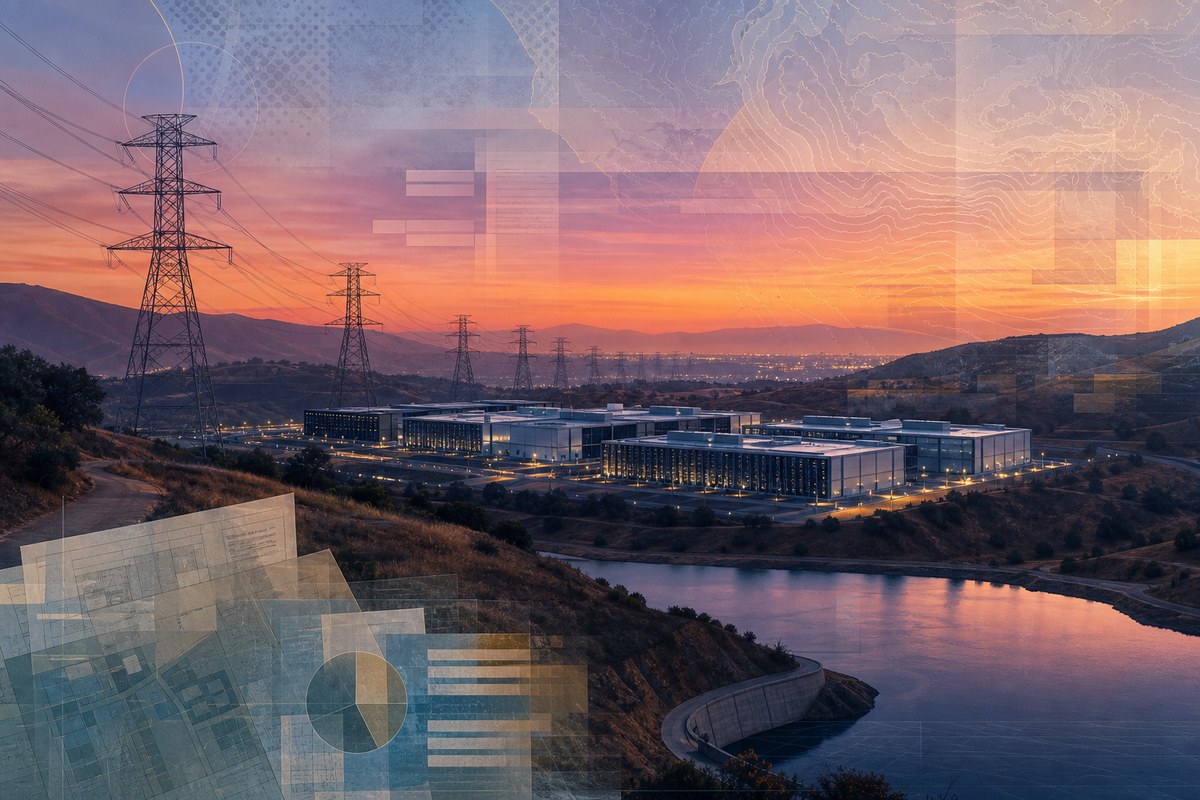
California Gov. Gavin Newsom has signed a seven-bill package placing new reporting, water-planning, utility-cost and environmental-review obligations around data-center development. The measures bring an industry that has often been treated as a conventional commercial load more directly into the state’s fights over electricity infrastructure, drought resilience and who pays for grid expansion.
The laws, signed September 21, cover AB 1577, AB 2383, AB 2469, AB 2619, SB 886, SB 887 and SB 1168. In its announcement of the signings, the governor’s office said the package requires disclosures about water and electricity use, gives communities more information about proposed projects, and addresses the costs of needed grid and water upgrades. It is a consequential intervention in the physical infrastructure behind cloud computing and artificial intelligence, but its practical reach will depend heavily on regulatory work still to come.
From opaque demand to infrastructure planning
Data centers are unusual industrial customers. They may draw very large and continuous amounts of electricity, need transmission or distribution upgrades, occupy substantial parcels, and use water in some cooling designs. The mix varies considerably by facility and location, so a policy built around disclosures and planning is not the same thing as a universal cap on energy or water use.
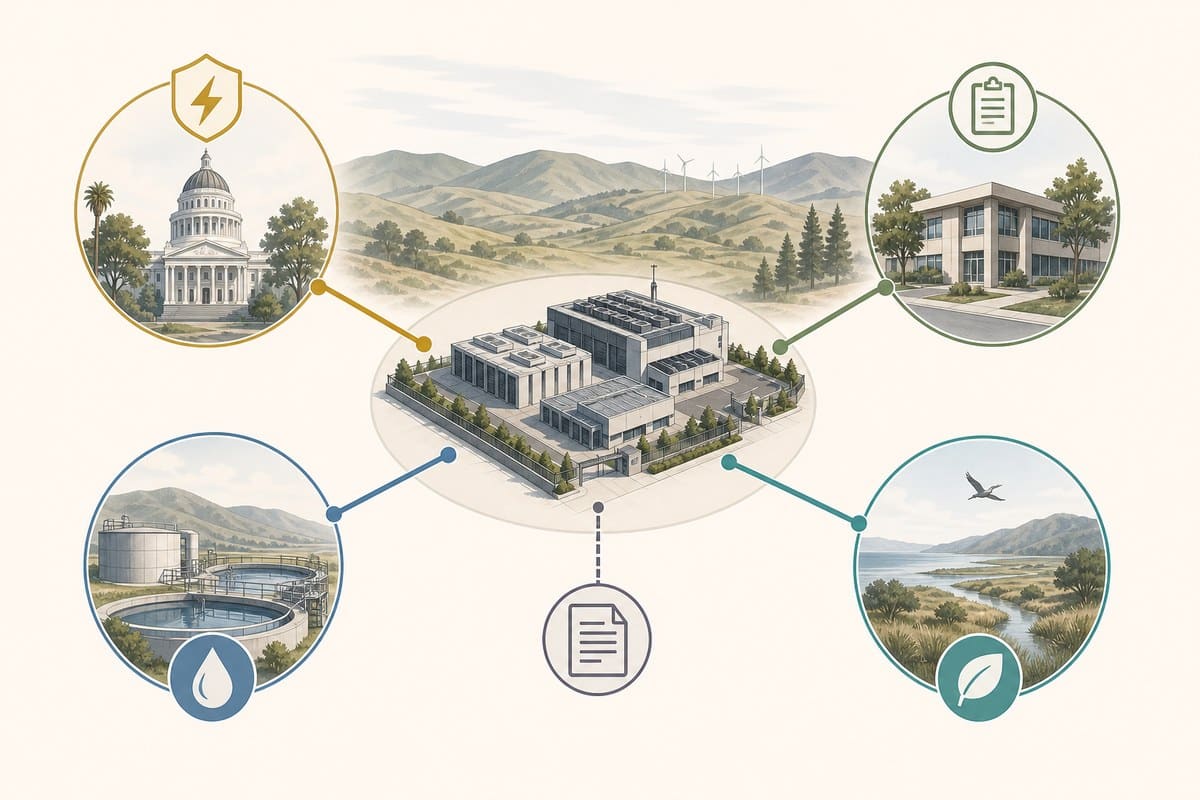
California’s stated approach is to make the resource demands of individual projects more visible before and during development. The governor’s office says proposed facilities will have to give local governments and water suppliers information related to water use, available supply, efficiency and drought planning. Where a project requires water-supply upgrades, the administration says the data center would pay for them.
Those provisions address a recurring political problem around large infrastructure: a project may bring private investment while leaving public agencies and existing utility customers to absorb planning and upgrade costs. Newsom’s office says the new laws are designed to prevent data-center costs from being shifted to low-income customers and other ratepayers. That is a policy objective, not an outcome that can yet be measured. The result will turn on tariffs, utility filings, project-specific upgrades and regulatory enforcement.
Tariffs and permits are the next test
The most immediate change is not a single statewide price or permit rule. It is the creation of several implementation tracks. A Mayer Brown analysis of the package says the California Public Utilities Commission, California Energy Commission and Office of Land Use and Climate Innovation have important roles in translating the statutes into operating requirements.
According to that analysis, SB 886 directs the Public Utilities Commission to establish data-center tariffs by January 1, 2028. Tariffs are more than billing mechanics: they determine how utilities allocate the costs of serving a class of customers, including costs associated with new infrastructure. A separate price structure does not automatically ensure that developers pay every project-related expense, but it gives the commission a venue to decide how costs should be assigned rather than leaving the question solely to general utility-rate design.
The same legal analysis says AB 2469 is expected to require a water-supply assessment and water-scarcity plan in the permitting process beginning January 1, 2028, along with specified workforce disclosures. It also characterizes SB 887 as removing categorical California Environmental Quality Act exemptions for data-center projects and requiring, at minimum, an initial environmental study. Those are consequential descriptions of the bills, but they remain a law-firm interpretation; the detailed thresholds, exemptions and agency procedures will matter as much as the broad legislative labels.
That distinction is especially important for environmental review. An initial study can lead to different paths depending on a project’s expected impacts and proposed mitigation. It does not by itself tell communities whether a particular facility will be approved, delayed or required to redesign elements of its power, water or site plan.
A 2028 deadline, not an instant overhaul
The calendar shows why the signing is the start of a regulatory process rather than its endpoint. The laws are now enacted, while the reported deadline for new data-center tariffs and for the water-assessment and scarcity-plan requirement is January 1, 2028. Between those dates, agencies must convert legislative direction into filings, standards, reporting formats and review practices that developers, local governments and utilities can use.
Some of the seven bills are aimed at transparency, some at water resources, some at electricity costs, and some at land-use and environmental review. Treating them as a single ban, or as a single ratepayer-protection mechanism, would miss the design of the package. Its force lies in tying together decisions that are often made in separate forums: a developer’s resource disclosures, a water supplier’s planning, a local permitting process and a utility regulator’s rate structure.
The governor’s office calls the package the nation’s most comprehensive set of data-center laws. No independent nationwide comparison accompanies that characterization, so it should be read as the administration’s assessment rather than a settled ranking. What is clear is that California has made data centers a named subject of statewide policy at a moment when AI-related computing demand is sharpening concern about the grid, water supplies and development approvals.
For companies planning facilities, the next documents may matter more than the signing ceremony: Public Utilities Commission tariff decisions, agency reporting rules and local requirements for demonstrating water availability. For communities near proposed sites, the value of the new framework will be measured by whether those materials arrive early enough, and in enough detail, to influence real infrastructure decisions.

