


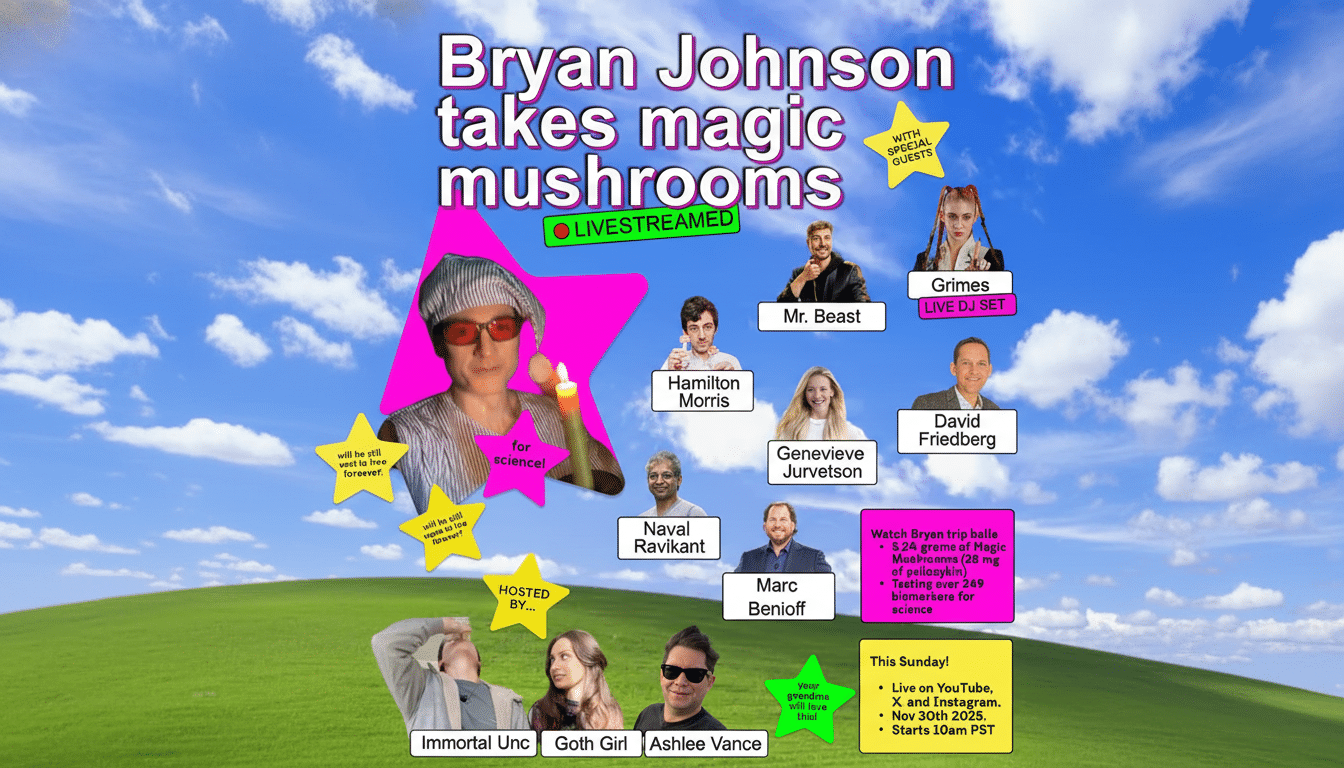
The biohacker and entrepreneur Bryan Johnson transformed a high-dose psilocybin session into a public spectacle, ushering in millions to watch as he consumed mushrooms, slipped on a brain-scanning helmet and vowed insights into living longer. That hourslong livestream included celebrity D.J.s, billionaire commentators, biometric sampling and the sort of production polish typically limited to product launches — not psychedelic trips.
Why This Livestream Was a Tech Spectacle
Nicknamed “the N=1 diet,” it serves as a nod to so-called wellness optimization and Johnson’s personal war against the aging process, if not entire industries built around stoking panic about age-related mental decline and incessant obsessing over life span limitations.
He framed the event in the service of a mission that he calls “longevity escape velocity,” or what is sometimes called his mostly preposterous wager: I’m going to last long enough for medical innovation to catch up. The cast also included two appearances from high-flying founders and investors who both portrayed Johnson as the pioneer for, yet provocateur of, what he himself dismisses as an “industry in control.” The crossover between counterculture aesthetics and Silicon Valley’s hunger for boundary-pushing narratives was underlined by a D.J. set by Grimes.
Backing the effort in part were backers who said that experimentation on stage can help speed acceptance, with other critics saying it was a marketing-focused performance without scientific value.
That was the tension — between spectacle and substance — that defined the stream.
What Johnson Actually Measured During the Livestream
Front and center, though, was a black helmet-shaped device from Kernel, the neurotech company that Johnson founded. The system is intended to leverage near-infrared light for monitoring brain hemodynamics as a proxy for neuronal activity, akin in principle to fNIRS. During the session, his team gathered saliva and other biometrics, trying to correlate subjective experience with physiological information.
On the face of it, that fits with a broader movement to quantify altered states. But, as any clinical trialist would tell you, a nonblinded n-of-1 livestream without controls or an independent protocol will not suffice to answer the big questions Johnson raised. At most, it makes a data diary. At its worst, it blurs the line between research and reality TV.
The Science Versus the Show Behind Psilocybin Claims
Psilocybin really can deliver on therapeutic promise, and we have the receipts to prove it. The FDA’s Breakthrough Therapy designation has been given to psilocybin protocols for depression. Trials from the Johns Hopkins Center for Psychedelic and Consciousness Research and Imperial College London show large effect sizes in major depression and treatment-resistant depression — one JAMA Psychiatry study reported 71% response and 54% remission at four weeks. Small open-label investigations also have reported substantial smoking cessation results which achieved a quit rate of approximately 60% for at least one year.
None of that implies that psilocybin slows one’s biological aging. Currently, the evidence that benefits are psychological or behavioral is stronger: lower levels of depression, greater cognitive flexibility and better adherence to healthy behaviors. Those factors could have a secondhand effect on longevity, but there hasn’t been peer-reviewed evidence published to support the claims that psychedelics reverse epigenetic clocks or extend human life span. Aging researchers such as Aubrey de Grey introduced the concept of “escape velocity” years ago, but integrating that idea with psychedelics is still theoretical.
Dose Drama and the Dangers of Copycats for Viewers
Johnson is said to have consumed an amount akin to what psychedelic literature identifies as a “heroic” dose. In the medical setting, high-dose psilocybin is administered with intensive screening in place, two trained facilitators present in the room, predetermined stopping criteria, and follow-up integration sessions. Adverse events in trials are generally transient — anxiety, nausea, elevations in blood pressure — but serious psychological distress can indeed arise, especially if proper screening for psychosis risk or cardiovascular problems was not conducted.
Livestreaming a heightened experience recontextualizes safety as spectacle. It normalizes high-dose use for a mass audience with no medical safeguards, and could inspire mimicry. Regulators and bioethicists stress the importance of Institutional Review Board oversight, independent data monitoring, and transparent risk communication — components that entertainment formats are not designed to convey.
Silicon Valley’s Psychedelic Turn and Its Implications
The list of tech luminaries rooting for Johnson reflects a wider embrace of psychedelics as aids for creativity, resilience and now longevity. Companies backed by venture capitalists, including Compass Pathways and programs supported by the Usona Institute, have advanced psilocybin through late-stage trials, and MAPS has spearheaded parallel work for MDMA-assisted therapy. The mainstreaming is clear: more conferences, more dollars and more headlines.
But the “move fast” ethos collides with the cadence of clinical science. Psychedelic research is hard to blind, highly sensitive to set and setting, and relies on skilled therapy. It’s a scientific challenge, not a branding exercise, to responsibly scale those variables.
What This Means for Claims of Longevity and Aging
If psilocybin turns out to be long-lasting in treating depression, addiction and existential distress, its second-order effects — better sleep, less inflammation via reductions in stress, continued behavior change — might influence lifespan indirectly. But that is a long way from ending biological aging. To hint at these sorts of benefits, scientists would have to have done longitudinal studies comparing validated epigenetic clocks, proteomics readings with cardiovascular endpoints and then hard outcomes — not a single livestream.
In the end, Johnson’s broadcast managed one thing: it turned the private interiority of a psychedelic session into public material. Whether it moves science forward or just shines the brand is the unanswered question. For now, the data that will matter the most is not viral streams of consciousness, but peer-reviewed trials and careful replication.
