


Our second item is AYANEO’s Pocket AIR Mini, the budget handheld that seems to have come one year too soon. For $89.99, it’s one of the best bang-for-your-buck options, as you get build quality, a retro-perfect display, and performance that wipes the floor with what we can expect from sub-$100 devices. After all that hands-on time, it’s hard to see this as anything other than the biggest line-in-the-sand moment for entry-level gaming portables.
Design That Belies Its Price on a Tiny Handheld
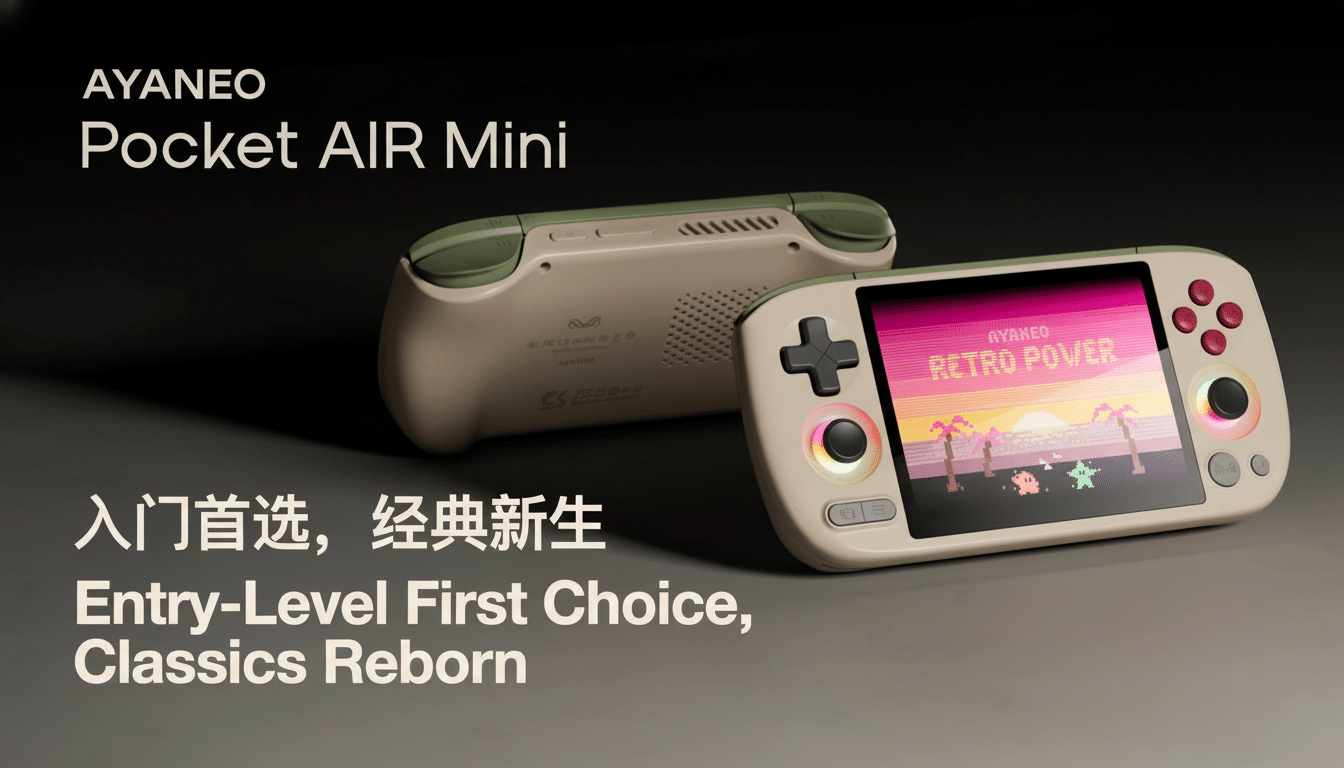
The Pocket AIR Mini carries over the clean, rounded aesthetic of AYANEO’s more expensive offerings but swaps glass for a sturdy plastic that never feels cheap. The chassis itself — a trim 4.2 inches in size — hits that sweet spot between pocketable and comfortable to hold, while the onboard ergonomics are helped along by quiet, tactile buttons and inset Hall-effect analog sticks that help avoid drift over time.
- Design That Belies Its Price on a Tiny Handheld
- It’s a Retro-First Screen Done Right for Classic Games
- Benchmarking a Budget Breakout in Real-World Emulation
- Android Done Light With Handy Tools for Daily Use
- Battery, Charging And Quirks In Everyday Use
- What This Means for the Market of Budget Handhelds
- Verdict: A New Baseline for Entry-Level Retro Handhelds
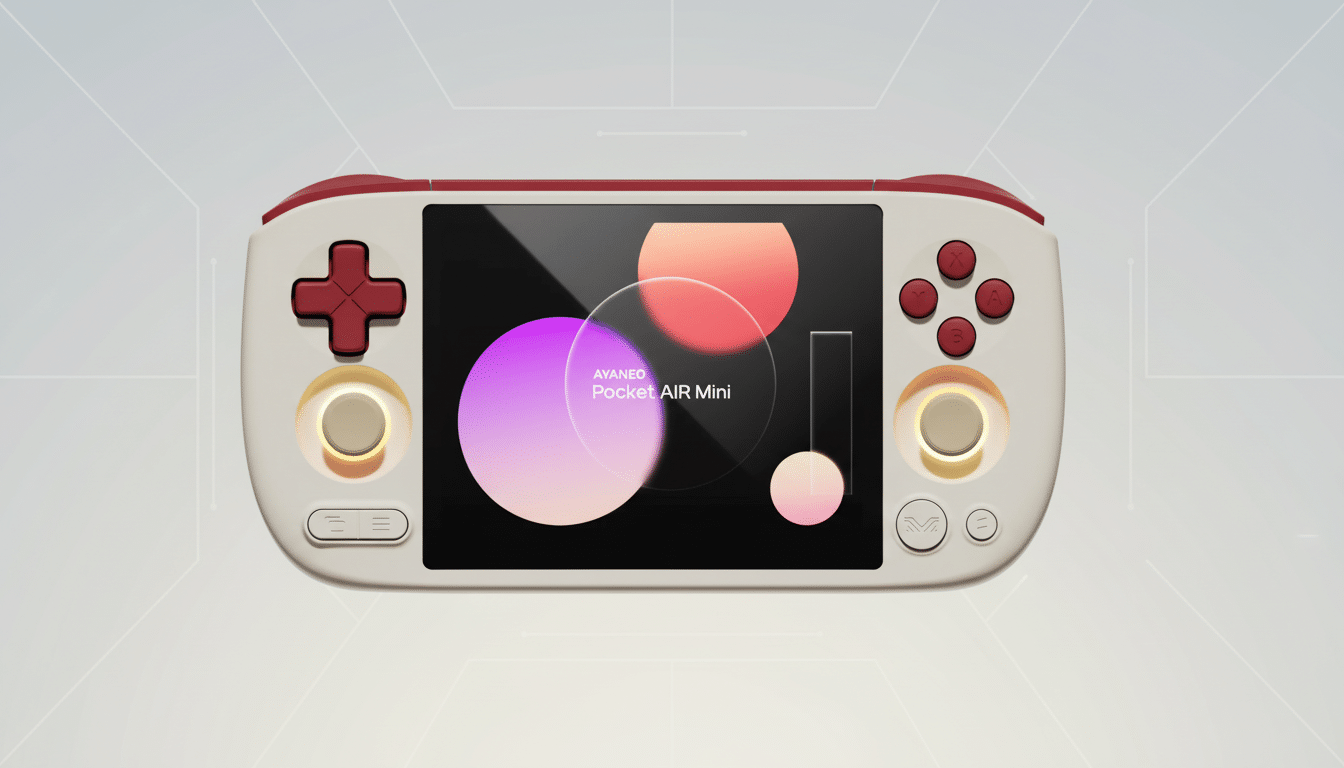
Two more shoulder-adjacent function keys are great for emulator hotkeys, and the AYAHome button has quick controls for performance, brightness, Wi-Fi, and updates. The only real design mistake is the bottom-firing speakers, which are all too easy to smother with your pinkies during long sessions.
It’s a Retro-First Screen Done Right for Classic Games
The 4.2-inch, 4:3 LCD panel runs at 1,280 x 960 and 60Hz—specs that matter quietly. That resolution means clean integer scaling — 4x for PS1-era 320 x 240 content, and 2x for systems outputting at 480p like Dreamcast — so classic games appear sharp and clear with no shimmering. It’s something organizations like Digital Foundry (and emulator maintainers) have been championing further down the line of gaming history for the sake of authenticity, and here it pays off with razor-sharp pixel art exhibited in correct aspect ratios.
Brightness is sufficient for in-room playing and protective on the go with a preinstalled screen protector. The 4:3 panel is, predictably, the tradeoff; widescreen-heavy platforms like PSP feel cramped, and there’s no video-out, so pushing games to dual-screen systems like Nintendo DS is less than ideal.
Benchmarking a Budget Breakout in Real-World Emulation
Using the MediaTek Helio G90T has been an inspired decision by AYANEO. Constructed on a 12nm process and incorporating a 2+6 CPU cluster (Cortex-A76 plus Cortex-A55) and Mali-G76 GPU, it manages to balance CPU and graphics throughput rather better than many budget rivals. Units are available in 2GB/32GB and 3GB/64GB variants; the latter is definitely a wiser pick for modern Android titles and heavier front-ends.
Testing was smooth across 8/16-bit consoles, PS1, N64, and Dreamcast at native or clean scaled output, with RetroArch core frame rates remaining locked to target frame rates in the great majority of these.
GameCube and PS2 wound up being viable on a couple of lighter titles at native resolution, though it still involves dips and crashes periodically—good for poking around, not quite an across-the-board replacement for something like a beefy handheld. The active cooling spins up under load but does not warm the grips, and fan noise remains discreet.
With peers, the picture is nuanced. Handhelds based on Snapdragon G1 Gen 2, like the Retroid Pocket Classic, tend to do better in CPU-focused benchmarks such as Geekbench, but—should they rely on graphics hardware for some portion of performance—can be bottlenecked when dealing with emulators that depend more heavily on GPU rendering. With its balanced profile, the Pocket AIR Mini generally comes out ahead in many real-world retro workloads; meanwhile, ultra-low-cost competitors like the MANGMI AIR X start to feel that they’re being stretched when hitting PS1-to-Dreamcast-era play.
Android Done Light With Handy Tools for Daily Use
It comes with Android 11, presumably to keep the system footprint down on the 2GB version. The experience is a near-stock one, with AYANEO’s AYASpace front-end there in the background but overshadowed by a far more useful overlay called AYAHome. From there you can cap frame rates, switch performance profiles, remap controls, and handle connectivity without going into system menus.
And Android opens up a library of native games these Linux-based budget handhelds can’t even scratch the surface of. Demanding titles such as Genshin Impact are even playable with lower settings on the 3GB version, although you will need to be watchful of what you install due to limited internal storage. Emulator projects like Dolphin and PCSX2 continue to pay dividends if you’re patient with tuning, but the device’s sweet spot is definitely older-to-early-2000s systems.
Battery, Charging And Quirks In Everyday Use
The 4,500mAh cell provided about 4–8 hours of mixed, tested usage; leaning on the long side in 16-bit libraries, but shortening under a lot of shaders and 3D use. Standby drain was 1–2% throughout the night. Recharging from about 10% up to 100% took a little over two hours — perfectly acceptable but not fast. Tiny sticks tire thumbs out on FPS games, and with no video-out, dual-screen emulation is an awkward compromise.
What This Means for the Market of Budget Handhelds
Handheld gaming is stronger now, after the Steam Deck made portable PCs a thing, and it’s something that analysts at companies such as IDC and Omdia have been watching for some time due to continued demand for small-scale gaming hardware. Cutting a well-made, capable Android handheld below $100 makes competitors reevaluate what “bare bones” means. AYANEO itself is making the same point with something more at the higher end in the KONKR Pocket FIT, and even toying with another budget option in the R1 Code, suggesting a wider push beyond premium.
Regardless of the performance limit during its first run, if you prefer to have some widescreen for your PSP, then MANGMI AIR X is a good price-matched alternative.
Or, if you were willing to spend a bit more, the Retroid Pocket Classic’s Snapdragon silicon is versatile, but its Game Boy-esque shell and lack of sticks block access to entire console generations from comfortable play.
Verdict: A New Baseline for Entry-Level Retro Handhelds
The new standard in entry-level handhelds is the AYANEO Pocket AIR Mini. It has a retro-perfect 4:3 screen, quiet and confidently clicky controls, and a surprisingly competent SoC in a feels-anything-but-disposable package. It’s not a good fit for widescreen-first platforms, nor heavy PS2/GameCube ambitions; but for the large retro catalog and light Android gaming, there’s nothing anywhere near its price that comes close to being so all-encompassing. Cheap handhelds just found a new footing — and it’s higher than ever before.
