


AYANEO has announced the Pocket Play, a slider-style gaming phone openly gunning for Sony’s original Xperia Play — complete with a hidden gamepad in addition to modern Android hardware.
It is the most overt effort to regenerate the dream of a legitimate phone-and-console hybrid for players who seek something more tangible than clips and Bluetooth pads.
- A slider design that revisits the original Xperia Play
- Native games and emulation-ready controls onboard
- Design details suggest cooling, comfort, and balance
- What chipset and price might look like for Pocket Play
- Why this launch matters for the future of mobile gaming
- Bottom line: where Pocket Play could fit in gaming
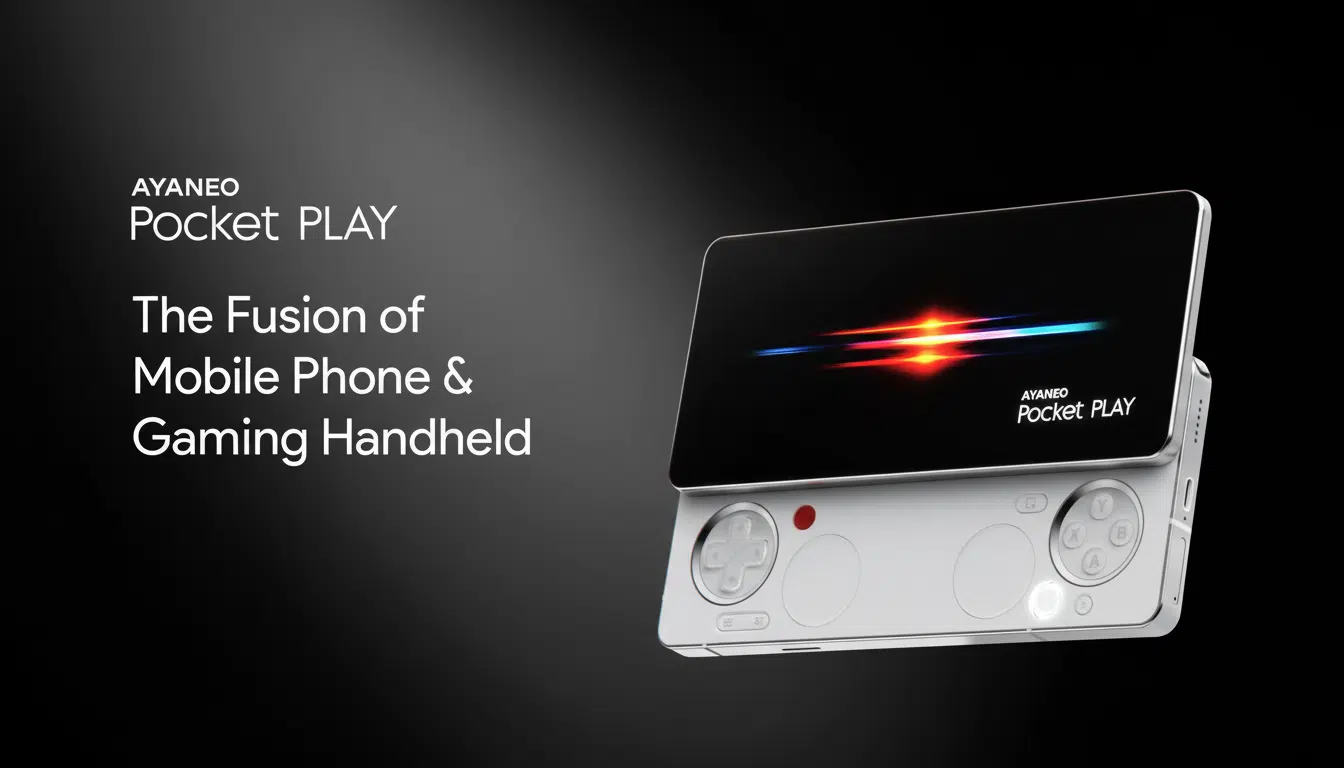
A slider design that revisits the original Xperia Play
The Pocket Play follows in the footsteps of 2011’s Xperia Play, a sideways slider that reveals a complete control deck when slid open — though it improves on ergonomics by offering a horizontal rather than vertical form.
In a market where sliding designs have nearly altogether vanished, this is the first slider gaming phone to make any sort of splash in about 15 years. Recent retro handhelds such as the ANBERNIC RG Slide, and certain modular concepts, have flirted with sliders, but smartphones have almost entirely relied on snap-on controllers up until this point.
AYANEO’s tribute extends to aesthetics, and the clean look features a minimal face (with two colourways — white/silver and black). A white version nods to the PSP Go’s slick, portable aesthetic, but really this is definitely an AYANEO machine — discreet, symmetrical and keynoting landscape play comfort.
Native games and emulation-ready controls onboard
And when you slide the phone open, you’ll find a D-pad, ABXY and four shoulder buttons along the top edge — not to mention two “smart touchpads.” You don’t see touchpads on phones, but they can be invaluable for genres that thrive on mouse-like precision, like strategy titles, classic PC ports and emulators. AYANEO has also confirmed that it will implement a similar technology to its forthcoming Pocket VERT, which implies a more wide-reaching input approach across the board.
There’s an AYANEO button, a hallmark of the company’s handheld PCs that usually activates control mapping, performance profiles and overlays. The neighboring keys almost certainly call up an app drawer as well as some kind of quick-access function that could be connected to multitasking or picture-in-picture. If AYANEO’s suite of handheld software ports over, anticipate plenty of rich per-game profiles and detailed remapping — a line-in-the-sand kind of distinction between purpose-built gaming devices and an Android phone with a jacked-on controller.
Design details suggest cooling, comfort, and balance
The back of the chassis features two flush rear cameras, so there’s nothing to snag your grip, and a bottom USB-C port. The port placement may hinder cabled charging if you’re gaming in landscape, but it leaves the top edge free for shoulder inputs and airflow. AYANEO has drilled several grilles: presumably stereo speakers at either end (although in this day and age nothing is certain) as well as more holes which look very much like they are for active cooling, a rarity among phones. Of course, fans are locked to dedicated handhelds because of the continued strain on thermals required by certain workloads; to see that mindset make the transition to a phone suggests AYANEO is going for longer sessions rather than shorter bursts.

A more practical question is that of palm coverage. On landscape devices, if you’re playing with the device in your hands, speakers on the side can be muffled by fingers, and we’re going to need to figure out vents, grilles and grip contours so we don’t block up airflow or sound during heavy play. Still, the integrated slider gamepad should offer better balance than clip-on controllers that can leave phones top-heavy and tiring over time.
What chipset and price might look like for Pocket Play
AYANEO CEO Arthur Zhang suggested the Pocket Play won’t have the very highest-end mobile SoC, which will probably eliminate Qualcomm’s top-tier flagship. That points to upper-mid silicon being the sweet spot — something like a performance-tier chip such as a Snapdragon 8 series or a Dimensity equivalent, combined with active cooling to maintain those clocks. So that might give us better battery life and thermals, yet still drive demanding Android titles and emulators all the way through the 3D console era.
Actual specs, pricing and availability are still up in the air. This is a platform first for AYANEO, who previously went a different route and chose another crowdfunding service. It might be that turning to Kickstarter reflects changing campaign policies across the industry, and a desire for greater visibility. With any crowdfunded hardware, clear timelines and transparent updates will matter as much as raw performance.
Why this launch matters for the future of mobile gaming
Mobile is gaming’s biggest platform by revenue — and industry trackers like Newzoo have estimated that it represents about half of global games spending. But the hardware world has bifurcated between gaming-first handheld PCs and more regular phones that depend on accessories. The Pocket Play wants to do something about that, by rolling in controls and console-like ergonomics, plus a friendly Android app ecosystem — whatever gaming behemoths such as ASUS or REDMAGIC can’t pull off without add-ons.
Should AYANEO successfully deliver robust controller mapping, good thermals and respectable battery life, the Pocket Play might emerge as a default for those in the retro crowd or cloud gamers that prefer tactile input. The REMAKE Retro branding hints at more devices that’ll reinterpret old ideas with added modern parts, and the Xperia Play is a clever first choice — it was too early for its time, but the core idea of it seems to be on time again.
Bottom line: where Pocket Play could fit in gaming
AYANEO’s Pocket Play is an homage that re-envisions the concept of the Xperia Play with clever touchpads, a slider controller layout in widescreen form and teases of active cooling. We don’t know what the specs are yet, but the design makes its intentions clear: make a phone that feels like a handheld console first and like a slab of smartphone second. If the execution meets the ambition, it could be the most interesting slider gaming phone since that OG model which inspired it.
