


A 3D printer on the CES show floor even attracted, for Gizmodo's Brian Barrett, a jam as it did what very few desktop machines are actually quite capable of: truly multi-material, multi-color prints in one go.
The Palette 300 lands a 12-nozzle array and an automatic tool-swapping system intended to shrink full-color, multi-material functionality to a footprint and workflow product teams, studios, or advanced makers can actually sink their teeth into.
- Why Multi-Material Matters for Prototyping and Design
- Inside the Palette 300: Nozzle Array and Swapping System
- How It Compares to Today’s Multi-Material 3D Printers
- Sustainability and Workflow Impact of Reduced Purging
- What It Means for Teams in Design, Engineering, Education
- Availability and Early Access for the Palette 300 Launch
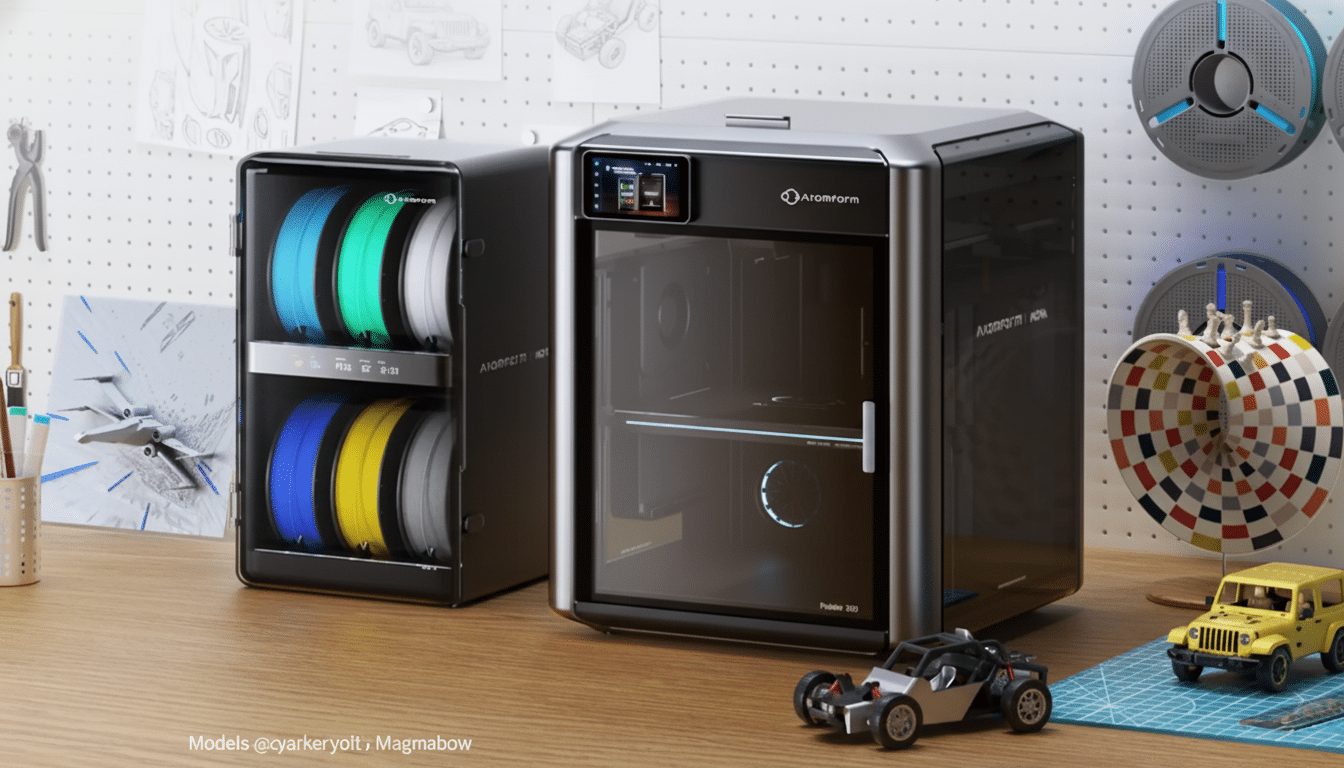
The headline claims are bold. AtomForm says the Palette 300 can blend up to 36 colors and use as many as 12 materials in a single continuous build, while slashing purge waste by up to 90%. If those figures stand up to real-world testing, this is also a significant stride toward folding the capabilities of what was once an industrial-class system into a professional desktop solution.
Why Multi-Material Matters for Prototyping and Design
Designers have long pursued single-pass prints that combine stiff and soft features, embed clear windows, or require a support material that dissolves in water for neat internal geometries — without retooling or repainting. In reality, the average desktop FFF printer will reach one or two different filaments before users are forced to make awkward compromises — whether that’s putting up with assembly after the fact, weak single-material hinges, or laborious post-processing.
For prototypes, color is just as important. To this end, color-accurate visual models allow teams to review branding, UI affordances, and hardware cues early on — prior to tool model creation. Examples such as consumer electronics mockups, footwear midsoles with tuned zones, and robotics grippers with soft-touch pads are classic cases where multi-material and color in one print can cut iteration cycles.
Inside the Palette 300: Nozzle Array and Swapping System
What sets AtomForm apart is its bank of 12 “intelligent” nozzles, each with its own ability to execute on-the-fly commands and simplifying the orchestration of tool changes, color switch-outs, and support strategies using slicer logic. According to the company, the system lets users mix up to 36 colors in a single job and holds as many as 12 separate materials, allowing parts that shift from rigid shells to elastomeric zones or soluble scaffolding without pausing the print.
The other important component is the automatic nozzle-swapping mechanism. Purge towers may be used but also consume time and additional filament, particularly as the number of tool changes increases in traditional multi-material prints. AtomForm claims its swapping and purging approach cuts waste by as much as 90%, with a corresponding decrease in swap-induced idle time. Less waste means lower part cost and fewer containers of colorful purge blocks destined to become garbage.
Although AtomForm did not bring along every spec to the show floor, its intent is clear: “remove/eliminate penalty for tool change” so that designers can specify complex, color-rich parts without worrying about an overnight print half filled with purge material.
How It Compares to Today’s Multi-Material 3D Printers
Most consumer and prosumer filament printers are limited to four or five materials using add-on feeders or switchers; Bambu Lab's machine and Prusa Research's new multi-material upgrade stand out here but still demand aggressive purging and careful tuning.
Toolchanger platforms, such as E3D’s, provide the ability to have multiple heads without compromise but come with a complex setup. At the other end of the spectrum, industrial photopolymer systems such as the Stratasys J55 and Mimaki 3DUJ series display thousands to millions of colors and a gorgeous surface finish — but also deliver at enterprise prices with different material properties.
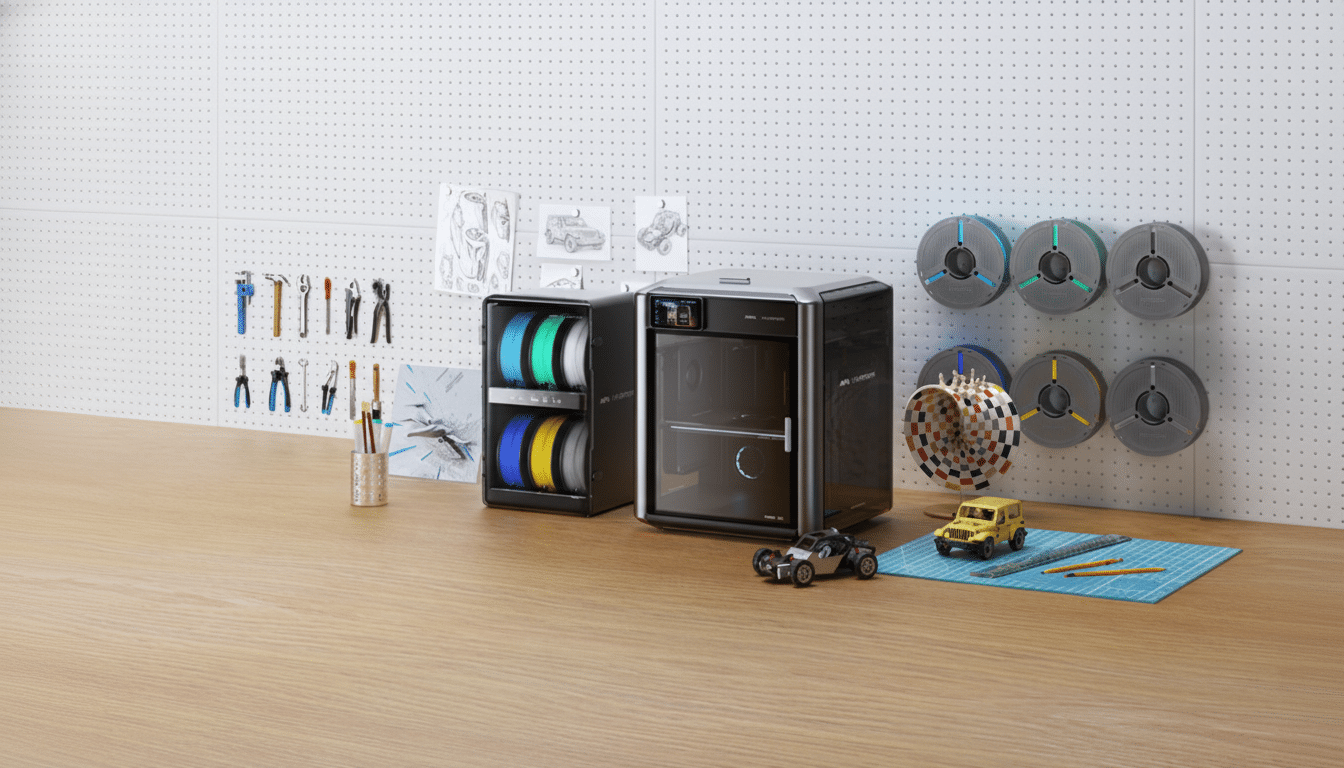
The Palette 300 seems to fall somewhere in the middle — giving you the freedom and potential shared by filament-based printing without requiring a pellet extruder, but with enough nozzle density to unlock true multi-material freedom and an advanced level of color control that can allow for visual prototyping and functional part creation all at once. And if AtomForm’s “cutting the amount of waste” claim is true, then it also solves one of the most common stumbling blocks for multi-material FFF.
Sustainability and Workflow Impact of Reduced Purging
Waste is more than an inconvenience. Material cost is a leading driver of part economics in polymer additive manufacturing, says successive editions of the Wohlers Report, and purge blocks can quietly inflate a bill of materials shop by shop and extend print times by hours. Cutting waste by as much as 90% can change the calculation around whether multi-color is viable for a given prototype or short-run part.
Imagine a product-housing prototype that would normally consume 100 g of purge to obtain two colored and water-soluble supports. If that overhead is cut to single digits with a 90 percent reduction, it both saves money and keeps the schedule on track. This also makes multi-material learning curves less punishing for labs and classrooms, where every spool matters.
What It Means for Teams in Design, Engineering, Education
For industrial designers, the Palette 300 might serve to shrink the gulf between foam-core models created early in the design process and polished presentation prototypes at a later stage. Engineers can verify assemblies using soft-touch seals, threaded inserts, and soluble supports all in a single build. Teachers also have the chance to teach design for additive manufacturing that includes color coding, lattice infills, and multi-material interfaces in a single machine instead of breaking work up among several.
Standards organizations like ASTM F42 have focused a long time on design-for-AM; a machine that makes multi-material more practical helps those guidelines become day-to-day practice.
Availability and Early Access for the Palette 300 Launch
AtomForm says preorders will open for the Palette 300 on Kickstarter at early-bird pricing and that it will be available through a wider range of retailers. The company is marketing the printer for personal and professional applications, marking a shift toward moving more complex multi-material workflows from aging single-extruder desktops and labs.
If the production units perform as well as the CES demo, not only will the Palette 300 add another line to spec sheets — it’ll reset everyone’s idea of what a “desktop” printer should be able to do.
