


The race to make wearable AI anything more than a gimmick has been messy, and yet Motorola is entering the mix with a clear point of view. At CES, the Lenovo-owned brand debuted a pendant-shaped AI companion as a proof of concept — not an early glimpse at a potential toy, but an indicator that it wants to play this game.
Powered by Motorola’s new Qira assistant, the device showed multimodal awareness and a light touch of agency: it could identify objects, sum up information, and set off actions on the paired phone, all without having a screen or buttons.
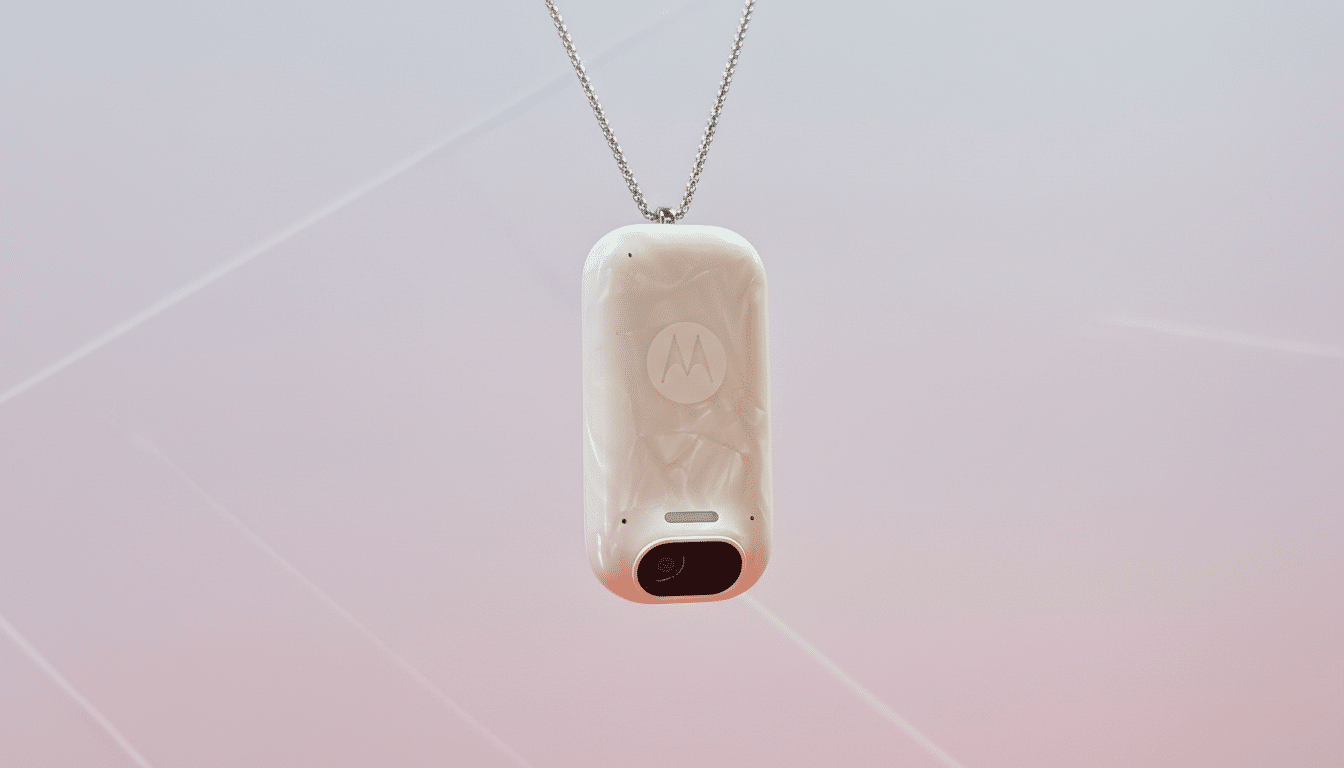
What Motorola showed at CES with its AI pendant prototype
The hardware is unapologetically minimal. Imagine a shiny, pearl-shaped, drop-shaped pendant on an extremely thin chain, no bigger than the face of a USB drive, with a tiny speaker slit and pinhole microphones, surrounded by a camera and sensor array at one end — all undercover, with no buttons or display in sight.
During demos, Qira recognized objects and read text from a flyer — and then went one step further to open Google Maps on a paired phone and autofilled the destination. That sort of agentic action — doing things instead of just dishing out instructions — points beyond the voice assistants that just tell us what to do.
Motorola placed the pendant squarely as an experiment. The company was tight-lipped about specs, pricing, and timing, positioning the unveiling as a chance to solicit feedback on how an AI companion might interact with humans in the real world.
A crowded category for wearable AI, but still unproven
Nothing’s broken out yet for wearable AI. Humane’s AI Pin ended up a cautionary tale about cost, heat, functionality, and inconsistency; a would-be rival necklace was panned amid design controversies. The lesson: novelty alone does not translate to daily use.
Meanwhile, camera-forward smart glasses from the big platforms have demonstrated that there may be an appetite for hands-free capture, real-time captions, and companion apps — especially when they hook into services people already use.
And now, analysts at IDC have noted what we’ve long suspected: Wearables that clearly make sense for your everyday use — watches, earbuds, and fitness bands chiefly among them — are the ones that drive shipments while camera-first companions stay niche. For Motorola, it’s not just stagecraft that matters, but hourly usefulness.
Under the hood and the trade-offs of Motorola’s AI pendant
Motorola did not reveal any silicon, battery capacity, or model size, but the power behavior here suggests a mix of both: an on-device wake word and sensor fusion, coupled with cloud models that handle vision and reasoning — and deep Android hooks for executing tasks on the phone.

The upside is that you have responsiveness and privacy by avoiding sharing details for simple interactions, with heavy lifting offloaded as necessary. The compromises are the obvious ones: battery life, thermals, and social acceptability for an always-listening, camera-equipped pendant.
Look for visible capture indicators, granular mic controls, and explicit pairing permissions as table stakes. Privacy activists, like the ACLU, and regulators, like the FTC, have highlighted opaque data collection efforts (and confusion over consent) as an issue in wearables several times already, setting a precedent for greater transparency.
Why Motorola might have a chance in wearable AI companions
Distribution and backing might be crucial. Motorola can put a companion on the shelf next to phones and use carrier partners, making it that much easier for shoppers to try it while undercutting boutique devices on service and price.
More important is agency. By launching apps and following through steps — kicking off navigation, time-stamping events in your calendar, translating conversations — Qira goes after real, banal friction that demands multiple taps and swipes to complete today.
When the assistant can string together tasks robustly, recall your preferences, and get smarter as you use it, the pendant is no longer a novelty but a daily shortcut — similar to how smartwatches eventually supplanted countless fast phone checks.
What comes next for Motorola’s AI wearable companion
Look for clues around developer access, integrations with core Android services, and a privacy model that lets users know at a glance what is going on. Utility cannot progress without the soundest skills and protections in place.
Battery life and price will either make or break mainstream appeal. A buddy has to last one day, be fast to charge, and feel like a cheap add-on for a phone and not a replacement device fighting in the same pocket of money.
For now, Motorola’s entry indicates that wearable AI is transitioning from spectacle to service. The company doesn’t have to establish or invent a new category; it simply has to deliver an assistant that’s reliably useful, respectful of privacy, and easy to live with — day in, day out, not just under the hot lights.
