


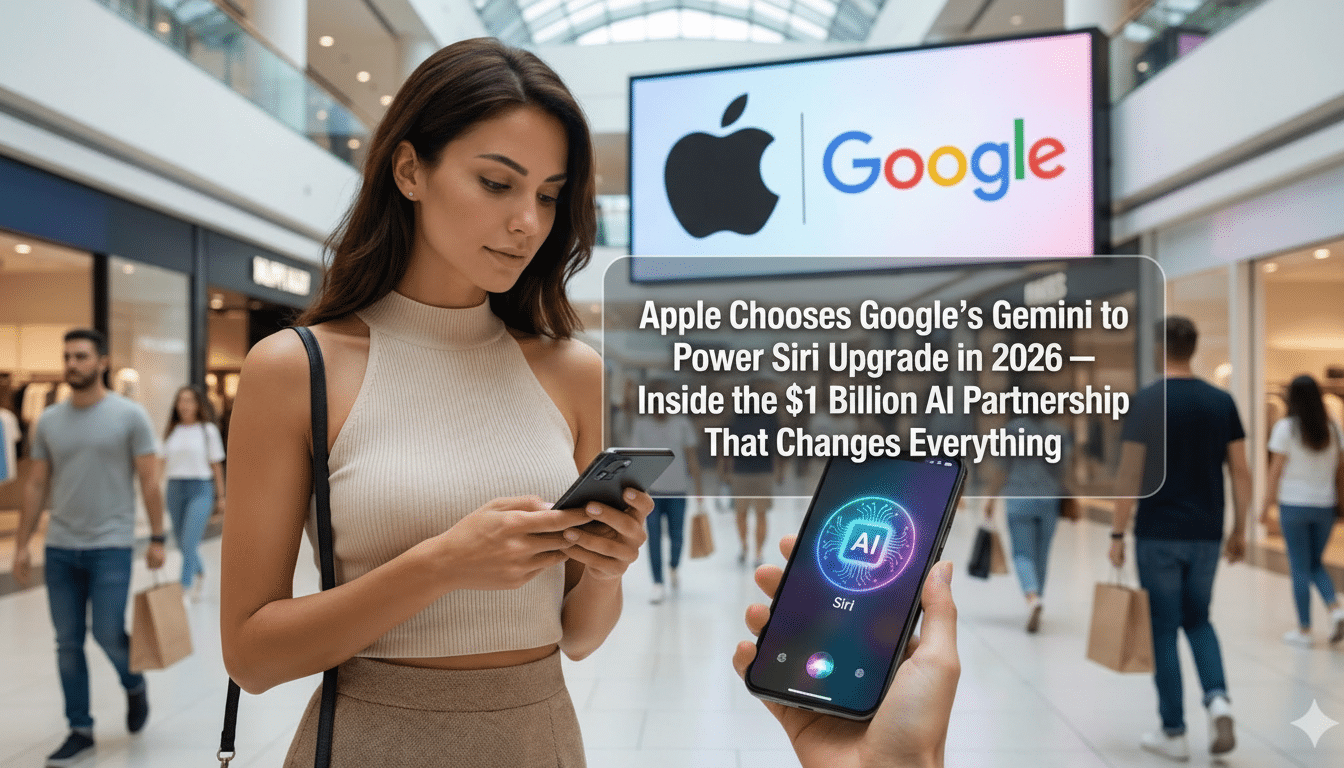
Apple has tapped Google’s Gemini as its core generative AI partner, elevating Google’s models from a contender to the presumptive engine behind the next stage of Siri and system-wide intelligence on Apple devices. The move follows months of industry chatter about Apple testing multiple large language models, and it signals a pragmatic shift: Apple will keep ChatGPT access where useful, but deeper integration is set to come from Google.
Why Apple Picked Google’s Gemini as Its AI Partner Now
Apple’s calculus appears straightforward. Gemini’s family spans massive multimodal systems to lighter on-device variants, matching Apple’s two-track strategy of private, local inference for common tasks with secure cloud handoffs for heavier workloads. Reporting from Bloomberg and The Information has long suggested Apple evaluated OpenAI, Google, and others; choosing Gemini indicates Apple wants breadth (text, image, audio, code) and tight performance-per-watt for phones and wearables.
- Why Apple Picked Google’s Gemini as Its AI Partner Now
- What Changes Users Can Expect With Gemini-Powered Siri
- The Business Logic Behind the Apple–Google AI Tie-Up
- What It Means for OpenAI and the Rest of the Field
- Safety, Culture, and Energy Pressures for Apple–Google AI
- What to Watch Next as Apple Rolls Out Gemini Features
It also aligns with Apple’s privacy posture. Apple has promoted “on-device first” processing with specialized silicon and private compute services for escalations. Google’s Gemini Nano already runs on smartphones, proving a path for low-latency, partially offline assistance. Marrying those strengths lets Apple ship intuitive features—summarization, context-aware actions, multimodal search—without turning every user request into a cloud round trip.
What Changes Users Can Expect With Gemini-Powered Siri
Expect a more capable Siri that understands sustained context, references what’s on your screen, and blends text, voice, and images in one thread. A Gemini-backed assistant could suggest actions across apps, plan trips from your messages and calendar, summarize notifications, and convert images into tasks without a dozen taps. Developers will watch for APIs that let third-party apps register “capabilities” the assistant can call—think booking, ordering, or creating documents—while inheriting Apple’s permission and privacy models.
Users should also see clearer model choices. Apple is likely to keep optional access to ChatGPT for certain creative or niche tasks while defaulting to Gemini for system features. The critical experience questions: Will power users be able to pick a default model, and how will Apple explain when requests stay on-device versus go to the cloud? Transparent guardrails and consent prompts will matter as AI touches more personal data.
The Business Logic Behind the Apple–Google AI Tie-Up
This is a distribution jackpot for Google and a time-to-market win for Apple. Apple’s active installed base exceeds 2 billion devices, according to its earnings disclosures, and iPhone holds about 60% of the US smartphone market by Counterpoint Research. Giving Gemini privileged access to that audience mirrors the long-running default search deal that the Wall Street Journal has estimated at well over $18 billion a year. Regulators will scrutinize any revenue-sharing or preferential placement terms, especially as the US Department of Justice and European regulators probe platform defaults.
For Apple, partnering avoids the cost and risk of chasing model leaders on cloud scale while it continues to invest in smaller, tightly optimized models that differentiate on-device experiences. It buys Apple time to focus where it wins—silicon, design, and UX—while shipping competitive AI now.
What It Means for OpenAI and the Rest of the Field
OpenAI doesn’t disappear from Apple’s world, but it loses pole position. Its strength in creative generation and developer mindshare still matters, especially for specialized workflows. Meanwhile, Anthropic is pushing into regulated sectors with “HIPAA-ready” offerings for Claude, aiming at healthcare use cases where accuracy, provenance, and audit trails are paramount. That competitive mix will pressure all players to publish clearer model cards, data governance details, and latency guarantees.
On the hardware side, Samsung’s pledge not to upcharge for mobile AI features this year turns pricing into a competitive lever. If Gemini-backed features feel indispensable on iPhone and remain bundled, Apple preserves ecosystem stickiness; if they get paywalled, rivals will pounce.
Safety, Culture, and Energy Pressures for Apple–Google AI
Gemini’s deeper system access raises the stakes for safety. Recent controversies around other chatbots’ image and content moderation underscore why Apple will insist on strict filters and human review for sensitive outputs. Cultural pushback is also shaping product choices: Bandcamp’s ban on AI-generated tracks reflects a wider creative backlash that Apple, a longtime music brand steward, will be keen to navigate.
Then there’s power. AI features drive compute cycles, and compute drives energy demand. Utilities commissions and state regulators are pressing cloud providers on who pays for grid upgrades. Tech companies have started pledging to absorb more costs and expand clean power procurement—an area to watch as Apple scales AI usage across hundreds of millions of daily interactions.
What to Watch Next as Apple Rolls Out Gemini Features
Three signals will reveal how transformative this partnership is:
- First, whether Siri finally retains long, useful context across apps.
- Second, if Apple offers a clear model chooser with strong privacy disclosures.
- Third, how developers can expose app actions to the assistant without sacrificing control or safety.
If Apple and Google deliver on those fronts, this won’t just be a new model under the hood—it could be the first real reinvention of the smartphone UX in a decade.
