


Anthropic is introducing Claude Code Security, an autonomous vulnerability-hunting capability that extends its AI coding assistant into full-blown security analysis. The feature is designed to crawl large codebases, reason about risky flows, and propose focused fixes that developers can review and merge—without the tool itself making any direct code changes.
The move lands as security teams wrestle with alert fatigue and tight release cycles. Rather than match against static rules, Anthropic says its system “thinks like a researcher,” revisiting its own findings to curb false positives and prioritizing issues with severity and confidence scores. Enterprise and Team customers can access a limited research preview, and maintainers of open-source projects can apply for free, expedited access.
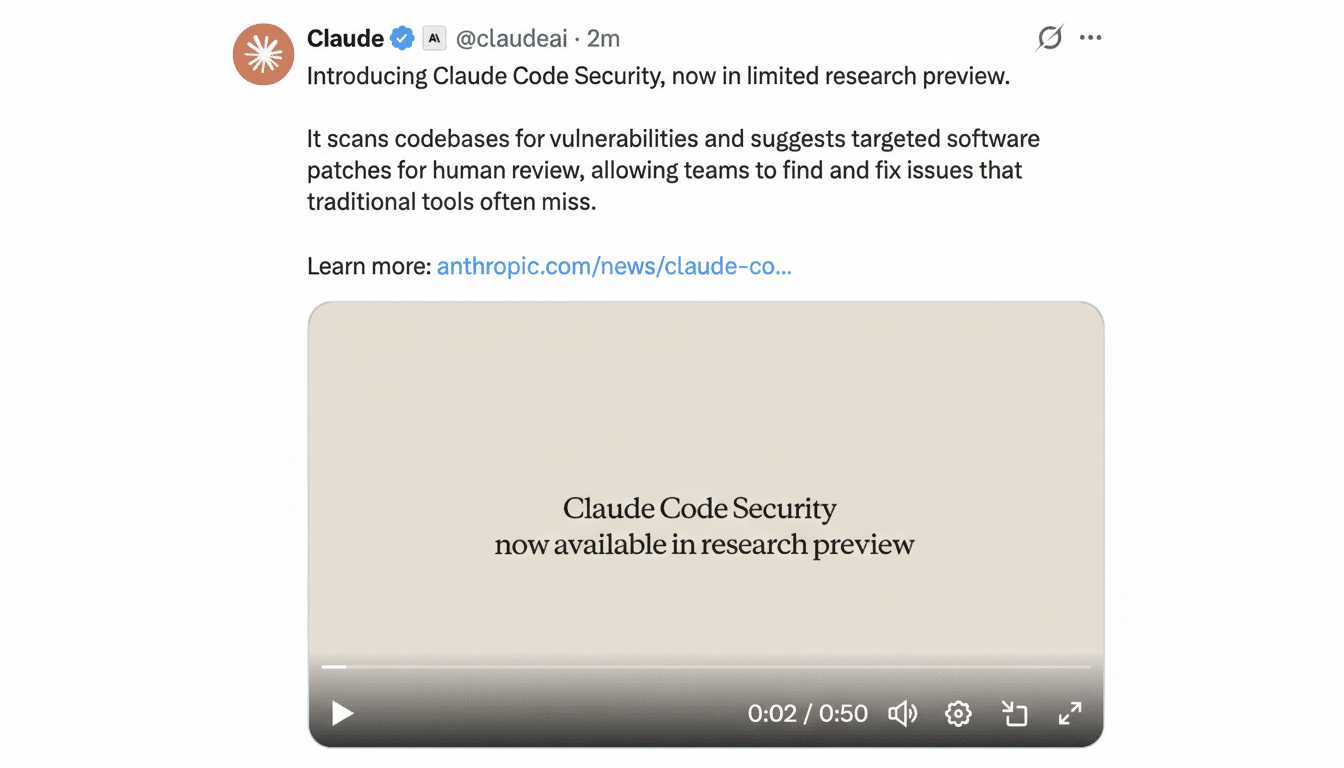
Autonomous Code Scanning With Human Oversight
Claude Code Security analyzes repositories end to end and surfaces suspected flaws in a dashboard for triage. Each issue includes a severity rating to help teams sequence remediation, alongside a confidence ranking that reflects how certain the system is after automatically rechecking its own work for potential false positives.
The human-in-the-loop design matters. Instead of auto-committing patches, the agent proposes targeted code edits and mitigation strategies for review, aligning with secure development life cycle practices recommended by NIST and OWASP. That approach also helps engineering leaders maintain audit trails and code ownership, critical for regulated environments and post-incident forensics.
What Sets Claude Code Security Apart from Legacy SAST
Traditional SAST tools rely on pattern matching and often flood backlogs with low-signal alerts, especially in large monorepos. Anthropic frames its advantage as reasoning across files and contexts: tracing data flows, understanding framework conventions, and identifying risky interactions that might elude rules-based scanners—more akin to a security engineer following a hunch.
In practical terms, that could elevate detection of complex logic bugs and misuses of authentication and authorization controls, not just straightforward injection points. Examples likely to benefit include access control lapses across microservices, insecure deserialization pathways, SSRF conditions behind proxy layers, leaky secrets in configuration sprawl, and fragile cryptographic handling such as weak JWT validation.
The confidence score is also noteworthy. Security teams frequently cite time lost validating noisy findings from legacy scanners. A ranked list that reflects both impact and certainty can improve mean time to remediate by directing limited effort to the highest-leverage fixes first, particularly during release freezes or incident response.
Why It Matters For Defenders in Modern SDLCs
The economics are stark. IBM’s most recent Cost of a Data Breach report pegs the global average breach at nearly $4.9M, and software flaws remain a persistent root cause. OWASP’s Top 10 continues to show injection and access control failures near the top of impact rankings, while cloud-native architectures multiply the number of paths where a minor coding mistake can become a systemic incident.
Agentic code review, if it cuts verification overhead and spots multi-file logic errors early, could shift security left without slowing teams down. The safeguard here is governance: keeping humans in control of merges, documenting rationales for fixes, and aligning AI-suggested changes with policy-as-code rules and threat models. Done well, automated hunting should complement—not replace—threat modeling, peer review, and dynamic testing.
Rising Competition And Market Signals in AI Security
Anthropic’s launch arrives amid a broader pivot to agentic security research. OpenAI has been testing Aardvark, its GPT-5–powered researcher, and developer-first tools are racing to fold LLMs into code scanning and triage. The convergence is clear: general-purpose coding copilots are expanding into security copilots.
Investors are already gaming out the impact. Following the announcement, SiliconANGLE reported that CrowdStrike shares fell almost 8% and Cloudflare just over 8%, reflecting concerns that AI-native code security could encroach on adjacent markets. In practice, endpoint detection, cloud posture management, and runtime defense are distinct from static code scanning; the more likely near-term outcome is integration, where AI findings feed existing SOC workflows and CNAPP dashboards.
Adoption Considerations And Early Access
Teams piloting Claude Code Security should start with a representative service and version-controlled workflow. Measure precision and recall against historical vulnerabilities, track reviewer effort per fix, and compare time-to-merge with conventional SAST/DAST pipelines. Red-team validation—guided by frameworks like MITRE ATT&CK and CWE—can help verify that agent-discovered issues reflect real exploitable risk.
Anthropic says the capability is available in a limited research preview for Enterprise and Team tiers, with an application path for open-source maintainers seeking faster access. By holding the line on human review and surfacing confidence along with severity, the company is signaling that the future of secure coding is not purely autonomous—it is assistive, accountable, and designed to scale with modern software delivery.
