


An AI writing platform called Youbooks is drawing attention for a one-time $49 lifetime deal that promises to turn a single idea into a full-length nonfiction manuscript. Built specifically for long-form projects, the tool blends multiple AI models with web research and document uploads to draft, refine, and export books that can stretch to 200,000 words—an approach aimed squarely at subject matter experts, consultants, and creators who need a fast, structured path from concept to publishable copy at an 86% discount off its listed price.
What the $49 Lifetime Deal for Youbooks Includes
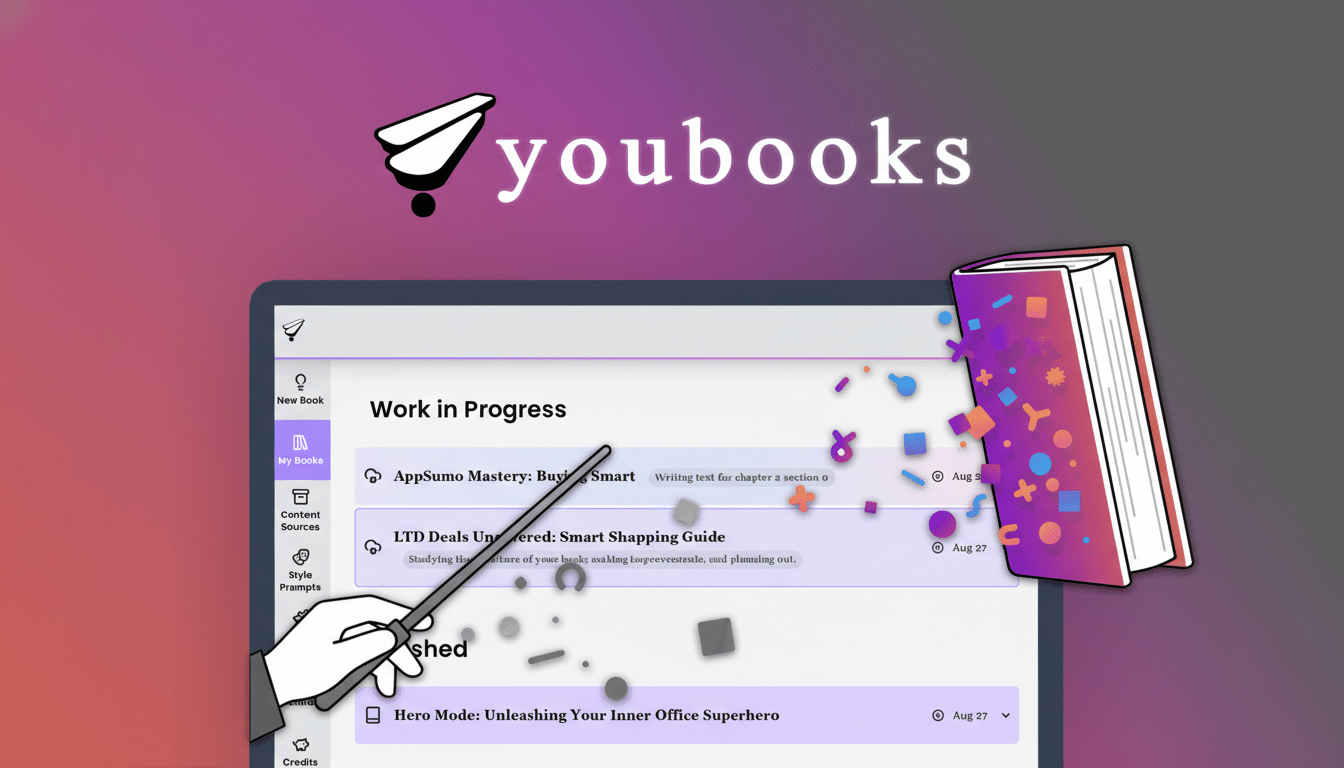
Youbooks’ lifetime access unlocks its end-to-end book generator: outline creation, chapter drafting, tone and style controls, and iterative edits within one interface. It claims to use multiple AI models for coherence and depth, incorporates current facts via built-in web research, and lets users upload notes, transcripts, or research papers so the final voice and substance track with the author’s expertise rather than generic prompts. Exports include DOCX, EPUB, PDF, and Markdown, and the company says users retain full commercial rights to publish or sell their finished work.
- What the $49 Lifetime Deal for Youbooks Includes
- How the Youbooks nonfiction writing workflow operates
- Why This Matters for Today’s Nonfiction Authors
- Quality control, limitations, and best-practice checks
- How it compares in today’s crowded AI writing market
- Realistic use cases for experts and nonfiction teams
- What to watch before you publish an AI-assisted book
- Bottom line for authors considering Youbooks’ $49 deal
How the Youbooks nonfiction writing workflow operates
Authors start by describing the book’s premise, audience, and outcomes, then set voice, reading level, and structural preferences—think case-study heavy or tips-first. You can upload writing samples to train the model toward your style and attach research packets to anchor facts. The system generates a table of contents, drafts chapter sections, and accommodates revision rounds. A nutritionist might transform clinical notes into a client-facing guide, a founder could shape a playbook from keynote transcripts, or a historian could organize oral histories into a narrative overview—with citations and final fact-checking still on the author’s to-do list.
Why This Matters for Today’s Nonfiction Authors
The bottleneck in nonfiction isn’t just ideas—it’s time and structure. Industry guidance from editors and marketplaces like Reedsy pegs typical nonfiction manuscripts at 50,000–80,000 words, a workload that often stretches across months amid research, interviews, and revisions. Meanwhile, Bowker has reported millions of self-published titles each year, and Amazon’s Kindle Direct Publishing remains the dominant route to market. In parallel, studies from firms like McKinsey and BCG suggest generative AI can accelerate drafting and synthesis tasks for knowledge workers, narrowing the gap between raw expertise and a first pass at a cohesive book.
Quality control, limitations, and best-practice checks
No AI tool eliminates the need for human judgment. Generative models can misinterpret sources or invent details, especially on niche or fast-changing topics. Youbooks’ upload feature helps by letting authors ground the model in their own materials, but best practice still calls for verification through primary sources and professional editing. Groups such as the Authors Guild caution writers to review contracts, confirm rights retention, and apply transparent sourcing and permissions—particularly for interviews, images, and datasets. Treat AI as a drafting engine; fact-checking, narrative integrity, and ethical use remain your job.
How it compares in today’s crowded AI writing market
General-purpose chatbots like ChatGPT, Claude, and Gemini can outline chapters or generate sections, but they’re not optimized for managing a 100,000-word manuscript with integrated research, style training, and multi-format export. Dedicated writing tools such as Sudowrite and Jasper offer long-form assistance but typically rely on monthly subscriptions. Youbooks’ pitch is specialization—longer outputs, built-in research, document ingestion—and a flat lifetime price. For an author planning multiple titles or editions, the $49 one-time cost could be compelling against recurring software budgets.
Realistic use cases for experts and nonfiction teams
- A cybersecurity analyst compiles incident postmortems and vendor-neutral frameworks into a practitioner’s handbook, then exports to EPUB for early beta readers while a copy editor polishes the final text.
- A nonprofit director turns grant reports, field notes, and interviews into a policy-focused book to inform donors and policymakers, anchoring claims with uploaded research and a final source review.
- A coach transforms workshop transcripts into a structured program with exercises, then releases a print-on-demand edition for events and a PDF workbook for course students.
What to watch before you publish an AI-assisted book
AI can speed up drafting, but publishing still demands editorial rigor: developmental editing for structure, line editing for voice and clarity, and a legal check on quotes, data, and images. If you plan to distribute via major retailers, review retailer guidelines for AI-generated content and disclose AI assistance when appropriate. Keep a research log, maintain permissions paperwork, and consider sensitivity reads for health, finance, or legal topics where accuracy stakes are high.
Bottom line for authors considering Youbooks’ $49 deal
For experts who know their material but struggle to carve out time, Youbooks’ $49 lifetime deal is a pragmatic way to generate a credible first draft and move faster toward a publication-ready manuscript. It won’t replace your analysis, editing, or design—but as a long-form engine that ingests your research and exports cleanly to common formats, it can turn inertia into momentum and an idea into a book-shaped reality.
