


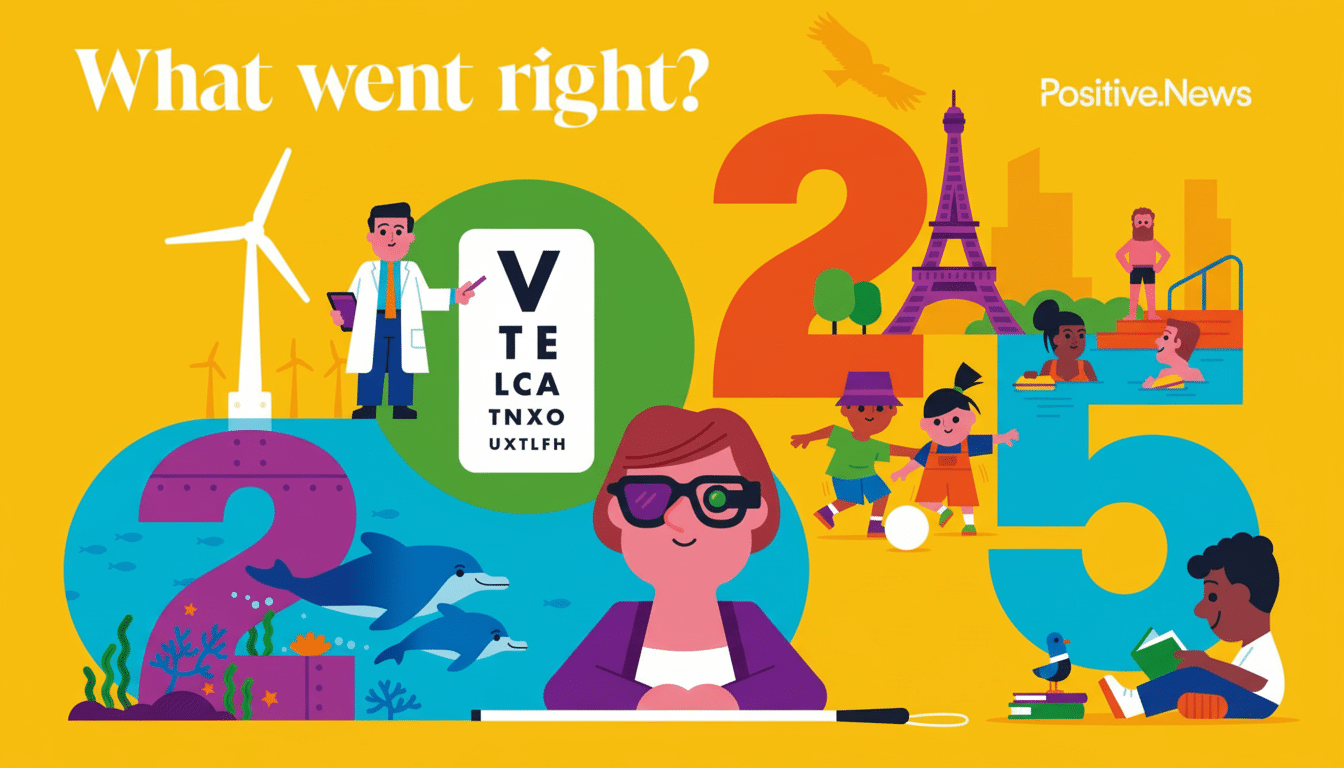
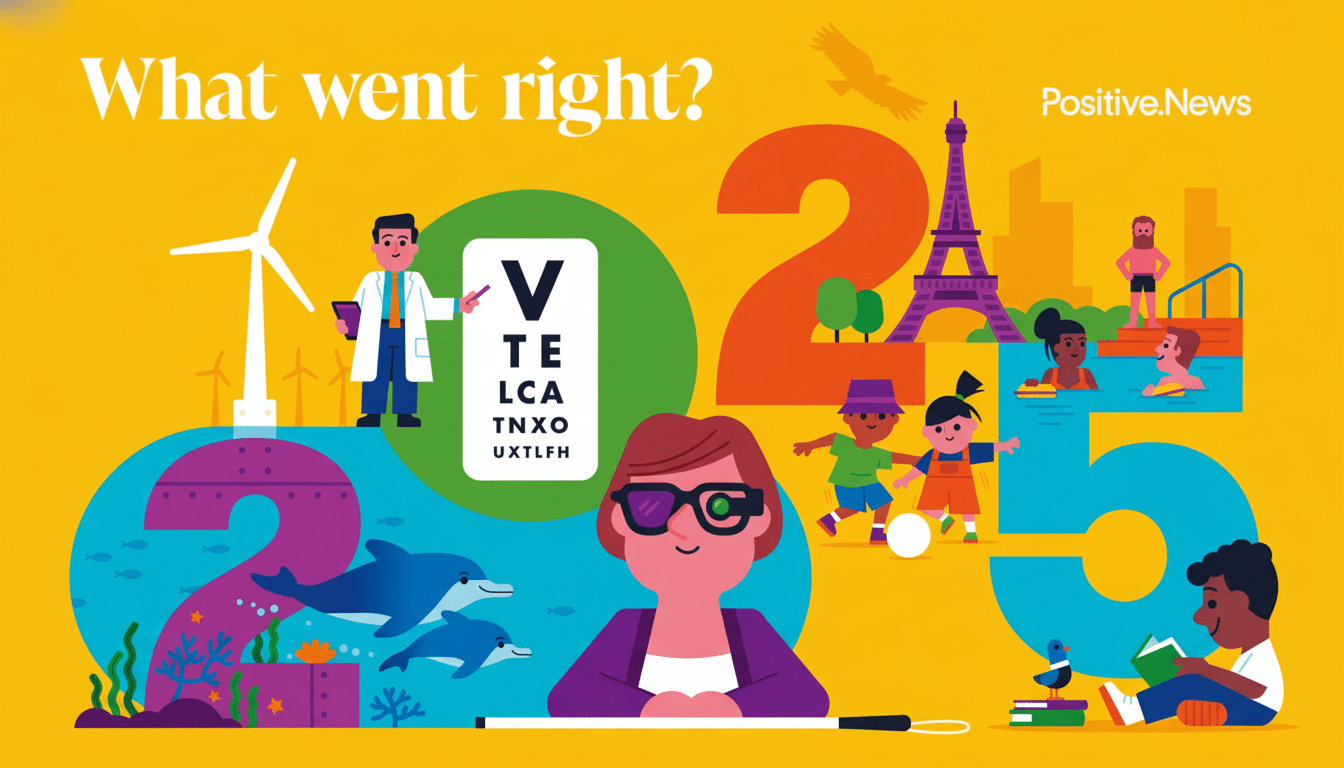
In the din of wall-to-wall headlines, 2025 quietly chalked up wins to savor. From climate action that finally bent key curves to medical breakthroughs once parked under “someday,” the year brought tangible progress on energy, health, oceans, digital safety, and civil rights. Here are 25 of those developments that cut through the noise — based on data, policy, and science — and suggested a more workable future.
Clean energy and climate momentum reach new milestones
Renewables surpassed coal in global power generation for the first time, based on an analysis by Ember — a symbolic and economic tipping point fueled by fast-falling solar and wind costs.
China, the world’s biggest emitter, showed a marked turnabout: Carbon dioxide output declined even while the economy expanded — a trend identified by analyst Lauri Myllyvirta and research colleagues at the Centre for Research on Energy and Clean Air, triggered by new wind, solar, and nuclear outpacing coal.
Beijing also pledged investment through 2035, with new capacity targets that will keep it at the center of global clean tech manufacturing and deployment — much as tracked by the International Energy Agency.
Monthly global EV sales passed the 2 million mark for the first time, Rho Motion noted — a gain particularly strong outside traditional high-performance regions such as China, Europe, and the U.S.
Grid batteries scaled up fast. In the U.S., installed grid-connected storage exceeded 40 GW as of the third quarter, industry data showed, reducing curtailment and firming up renewable power supply during peak electricity demand.
Australia’s rooftop-solar revolution has paid a “grid dividend,” as retailers offered households free hours of electricity during high-solar periods — a foretaste of how plentiful, clean energy can reshape pricing.
Oceans, wildlife, and the sky show signs of healing
The High Seas Treaty surpassed the 60-country ratification threshold established by the United Nations, paving the way for a new era of Marine Protected Areas across international waters and pushing forward negotiations on its first large designations.
A flagship conservation comeback marched on: green sea turtles bounced back enough to be removed from the endangered list in some areas, largely because of decades of work protecting nesting beaches and overhauling fishing gear that has been documented by NOAA and the IUCN.
And the planet’s sunscreen was healing. Scientists, with the World Meteorological Organization and UNEP, reported one of the smallest seasonal ozone holes in recent years, a long-term dividend from the Montreal Protocol’s phase-out of chemicals that deplete ozone.
Medical advances that matter show real-world impact
Regenerating the tissue of a damaged heart moved from theory to laboratory demonstration. A team at the Mayo Clinic showed that it had successfully grown functional cardiac tissue from reprogrammed stem cells, opening a potential new path toward repairing damaged bodies after heart attacks.
Cancer care moved ahead on a number of fronts: an experimental, individualized mRNA vaccine program at the University of Florida raised hopes it could stimulate immune responses, and gene therapies for aggressive leukemias posted striking remissions in initial cohorts.
Sound waves, too, joined the arsenal as growing evidence showed that focused ultrasound techniques could ablate certain tumors without any incision — a practice that clinical groups like the Focused Ultrasound Foundation say can lower side effects and shorten recovery times.
Alzheimer’s diagnostics took a leap. The FDA approved blood tests for biomarkers associated with the illness, which could lead to earlier detection and advance care planning far earlier than serious symptoms manifest.
Dr. Vip Patel performed the first FDA-approved transcontinental robotic prostatectomy procedure, linking Florida with a patient thousands of miles away — a proof-of-concept for high-quality care in remote areas.
Precision medicine really lived up to its name. Children’s Hospital of Philadelphia gave a customized CRISPR-based therapy to an infant with a rare genetic disorder, and early results could be buoying to a new model for ultra-rare diseases.
Vision was restored for many, including preservation of the RNFL in the macula, which is often affected by age-related macular degeneration. A study of a retinal chip plus a smart-glasses visor provides hope to 17 million with AMD. A group of 38 patients regained some or meaningful sight (none were worsened) in a gene therapy trial.
Safer digital spaces and saner AI move into focus
The courts and creators struck a groundbreaking blow for copyright. An AI developer settled with authors for a multibillion-dollar sum after being sued for training on their books, demonstrating, to the Copyright Alliance, that it’s a successful approach to compensation and innovation — but also potentially setting a precedent for similar cases by visual artists.
Markets began to let the air out of AI hype gently. When chipmaker earnings hit without inflicting a hard-landing shock after the surge to all-time-high valuations based on GPU demand, it suggested a healthier reset reminiscent of dot-com soft-landing years.
States pushed ahead on AI oversight, as bipartisan groups of attorneys general supported rules around transparency, safety testing, and accountability — an indication that governance won’t wait for a singular national framework.
Kids’ safety got long-overdue attention. A big gaming platform brought in facial age checks to take on under-13 chat, school smartphone bans spread across districts in the U.S., and Australia pushed to prevent social media use in children younger than 16, mirroring guidance from pediatric and mental health experts.
Rights, democracy, and everyday wins advance in 2025
Marriage equality stood its ground in the U.S., where the Supreme Court refused to revisit settled law, and Thailand became the first country in Southeast Asia to legalize same-sex marriage — with a mass wedding held in Bangkok.
The rule of law bared its teeth as courts further restricted emergency powers over domestic deployments in key cases, reasserting guardrails on civil-military boundaries.
Younger voters also rocked city halls and statehouses with candidates grounded in pocketbook basics: expanding affordable housing, cutting medical debt burdens, improving transit, and demanding that cannabis legalization frameworks prioritize public health and equity.
Transparency was one of the few levers that persuaded a seldom-crossing Congress to move high-profile document dumps over very powerful objections, proof that accountability still finds cross-aisle purchase when it is plain in the public interest.
Together, these 25 bright spots do not cancel out the world’s challenges. They accomplish something better: They show that progress is, in fact, not theoretical. It is measurable, replicable, and taking place in a manner that makes 2026 worth discussing with clear eyes and at least an ounce of faith.
