


Microdosing refers to the ingestion of 1 mg to 5 mg of THC, and in some cases, CBD. It should be pointed out that one cannabis edible contains about 10 mg of THC and can be bought legally in California. The amount used for microdosing is half of it, or even less.
This is neither total prohibition nor being high; rather, it is something in between. Many people living in Sacramento and other areas around it, such as Rosemont, say they feel calmness in the head and relaxation when the day ends, but without affecting the mind or physical functions.
- Why So Many First-Time Adults Are Starting Here
- Choosing the Right Format Before You Start
- Your 7-Day Starter Protocol
- What to Expect and What to Do If It Goes Wrong
- Where to Source Low-Dose Products You Can Actually Trust
- Frequently Asked Questions
- How is microdosing cannabis different from regular cannabis use?
- How long does it take to feel the effects of a microdose?
- Can you microdose cannabis every day?
- Is microdosing cannabis legal in California?
- What is the difference between CBD and THC when microdosing?
- Do I need a medical card to order cannabis delivery in California?
- Starting Small Is Starting Smart
Why So Many First-Time Adults Are Starting Here
Microdosing has become the preferred entry point for cannabis-curious adults precisely because it removes the two things that keep most people from trying it at all: fear of feeling out of control and uncertainty about where to begin.
The existing cannabis market has always thrived on the basis of THC percentage, with dispensaries promoting the highest THC strains, and all marketing language pushing for potency. While such an approach has worked for long-time consumers of cannabis, it has had the unfortunate effect of turning away those adults simply seeking a relaxed state after work without getting high on Friday.
The most recent data available is from the 2020 study published in the journal Drug and Alcohol Dependence, wherein it was found that the majority of those adults who microdosed cannabis for their own benefit were doing so to improve their mood and alleviate anxiety without getting intoxicated.
Microdosing shifts the focus completely. Rather than asking “how potent is this?”, you are asking “how small an amount will it take for this to have an effect?” This is a much healthier mindset around consumption, especially considering how busy and health-conscious adults are these days.
There has been a huge change in the form factor realm as well. There are low-dose products, like 2.5mg gummies, 1mg mints, and exact dose tinctures available on menus, and not just occasionally but always! This wasn’t the case five years back.
Choosing the Right Format Before You Start
Not only does the format affect the potency of the experience, but also its timing, duration, and ability for you to effectively fine-tune your dosage from session to session.
This is the mistake most people make when first choosing their format because they base their choice on what they are familiar with instead of compatibility. Here is what each format provides at microdose levels:
- Low-dose edibles (gummies, mints, chocolates): These are the most widely used form by beginners. Effects can take anywhere from 45 minutes to 2 hours to set in, making it a slow but reliable high. This is a good option for nighttime use or during weekends when you have more time to wait. It’s better to look for edibles with markings that say either 2.5mg or 5mg per portion than dividing a full 10mg edible into portions.
- Tinctures (sublingual drops): This comes next in terms of speed after inhalation. Sublingual tinctures usually take 15 to 45 minutes, depending on whether it is left under your tongue. This is easier to regulate since you can manage how many drops to use at once. Good choice for adults who seek precision.
- Low-dose capsules: Act like edibles with regard to onset, but they provide consistency like a pharmaceutical product. Each capsule has precisely the same dosage. Ideal for adults who want predictability in their routine.
- Vape pens (low-dose, not high-potency): Provide the fastest onset from any product form, generally within minutes. More difficult to microdose accurately because each vaporization period can vary slightly. Not suggested as the initial form for first-time users.
For a first-time protocol, tinctures or clearly labelled low-dose edibles give you the best combination of accuracy and predictability.
Your 7-Day Starter Protocol
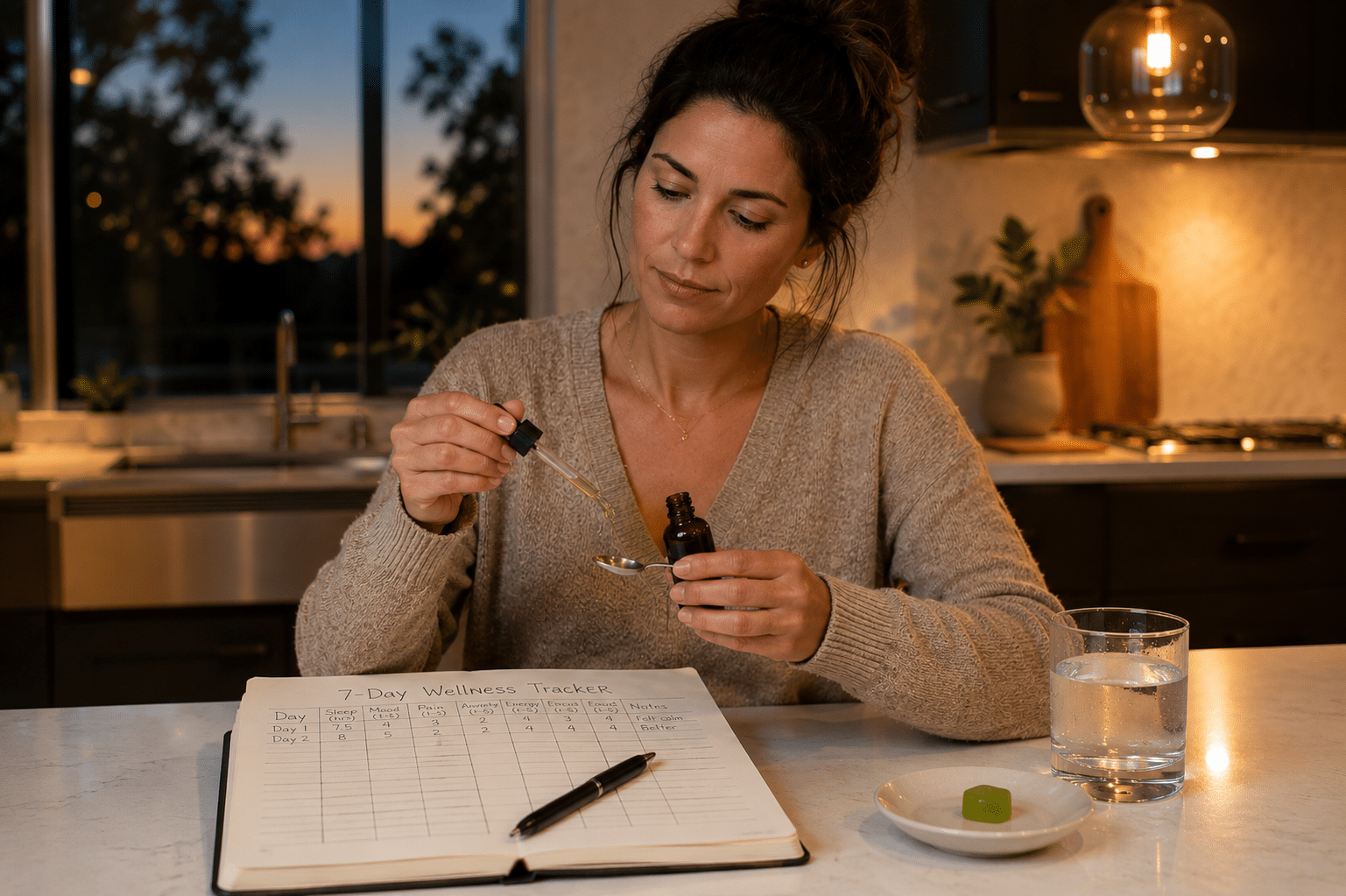
A structured first week removes the guesswork and gives you real personal data to work with, which is far more useful than any general dosing chart.
This process is not aimed at finding the dose that will make you feel great on your first try. This experiment seeks out the smallest possible dose of LSD that would have an observable and replicable effect. And each individual adult will have a different threshold.
Days 1 to 2: Establish your baseline. Take between 1mg and 2.5mg of THC about an hour prior to your desired wind-down time. Do not take anymore if there is no effect during that initial hour. Record the time, the product used, and the dosage. Document what you experienced at the one-hour mark and two-hour mark. Record mood, stress levels, and body tension from 1 to 5.
Days 3 to 4: Hold or adjust. If no effect was felt at all over the previous two days, then increase to 5mg on day 3. Should any subtle yet positive effect be felt, then maintain your original dosage amount while still documenting your experience. In the case of feeling too much, then stop for day 3 and restart with a reduced dosage.
Days 5 to 7: Identify your functional dose. By the end of this period, you’ll have gathered enough data to determine what your functional dose is. It’s usually somewhere between 2.5mg and 5mg for a first-time user. Some people will require only 1 mg, while others might need 7.5 mg to 10 mg.
- Keep notes brief but consistent. Time, dose, product, and a one-sentence effect summary.
- Do not mix formats during the protocol. Changing variables mid-week makes it impossible to isolate what is working.
- Do not consume alcohol on days you are microdosing. The combination changes how both substances affect you and compromises your data.
- Choose a consistent time of day. Evening use is the most common starting point because the stakes of getting the dose wrong are lower than in a morning or midday session.
What to Expect and What to Do If It Goes Wrong
Most microdosing mistakes fall into one of two categories: not feeling enough and doubling up too soon, or feeling more than expected and panicking unnecessarily.
The first mistake is by far the more common one. Edibles in particular require patience that most people do not extend to them on the first try. If you take a 2.5mg gummy at 7 pm and feel nothing by 8 pm, the instinct is to take another. Resist this. The onset window for edibles extends up to two hours, and stacking doses before the first one activates is how a microdose becomes an uncomfortable experience.
According to Healthline, one of the most widely cited causes of an overwhelming first cannabis experience is dose stacking, where a second dose is taken before the first has fully activated. This is entirely avoidable with a structured protocol.
If you do take more than intended and feel more than you wanted, the appropriate response is:
- Find a quiet, comfortable space and sit or lie down.
- Drink water and eat something light if your stomach allows.
- Remind yourself that the sensation will pass, typically within one to three hours for edibles.
- Avoid panicking or seeking medical attention unless you have a pre-existing condition that warrants it. No adult has experienced a fatal cannabis overdose from oral consumption.
The experience of feeling too much is unpleasant but not dangerous, and it is almost always the result of impatience rather than a bad product. Adjusting your dose downward on the next session is the only correction needed.
For context on how the body responds to physical stressors and recovers, the principles discussed in the article on wound recovery offer a useful parallel: the body’s response to any external input, whether physical or chemical, is individual, gradual, and best managed with patience rather than escalation.
Where to Source Low-Dose Products You Can Actually Trust
Precise milligram dosing is only possible if the product you are buying was manufactured and tested to the standard it claims on the label.
This is where legal, licensed delivery makes a material difference for first-time microdosers. A gram of cannabis flower from an unlicensed source has no verifiable THC content. A 2.5mg gummy from a licensed California retailer has been third-party tested by a state-licensed laboratory and must display a Certificate of Analysis confirming that the potency claim is accurate within a narrow margin.
According to the California Department of Cannabis Control, all licensed retailers must provide verified batch testing for every product sold, covering not only cannabinoid potency but also the absence of pesticides, heavy metals, and residual solvents. When you order through a licensed dispensary weed delivery Rosemont service, that documentation is accessible for every product before you place your order.
Sourcing well is not a luxury consideration for microdosers. It is a functional requirement. A product labelled 2.5mg that actually contains 8mg makes your entire protocol meaningless. For Rosemont residents specifically, a licensed dispensary weed delivery Rosemont service removes that variable completely by putting verified, lab-tested products on your doorstep without a storefront visit.
What to look for when reviewing a delivery menu for microdosing:
- Products labelled in milligrams per piece, not just total package content.
- A visible or downloadable Certificate of Analysis linked to the product listing.
- Staff or chat support that can answer questions about onset time and format differences.
- A menu that includes multiple low-dose options across at least two formats, giving you flexibility as your protocol develops.
Reading a product listing carefully before ordering is the same skill that applies to any health-related purchase online. The fundamentals of informed buying — verifying specs, checking third-party documentation, and understanding what labels actually mean — apply directly to choosing cannabis products from a licensed menu.
Frequently Asked Questions
How is microdosing cannabis different from regular cannabis use?
Generally speaking, cannabis consumption involves the ingestion of the substance in quantities intended to elicit psychoactivity. In contrast, microdosing utilizes smaller amounts of cannabis where the user generally doesn’t feel any impairment but feels a change in their mood, stress levels, and physical tension. The quantity used in microdosing, which is usually between 1mg and 5mg of THC, falls way below the normal recreational amount of 10mg to 25mg of THC.
How long does it take to feel the effects of a microdose?
It all depends on the method. Sublingual tinctures work within 15-45 minutes. Edibles and capsules require first passing through the digestive process and therefore take 45 minutes to two hours. Vaporizing works instantly, though its dosage is harder to measure. Remember to give yourself the entire onset time for the method you have chosen before determining whether your dosage needs tweaking.
Can you microdose cannabis every day?
There are many people who take low doses of cannabis on a daily basis but do not face any tolerance-related problems because regularity plays an important role. Taking breaks, even just one or two times a week, can help keep your sensitivity level to support effective microdosing.
Is microdosing cannabis legal in California?
Yes, using cannabis is legal for individuals above the age of 21 years in California. The legal means for acquiring cannabis is from a licensed cannabis delivery or cannabis retailer, and all licensed dispensaries must confirm the age of the individual purchasing cannabis during delivery. Using cannabis in your private residence is legal, but public use is prohibited.
What is the difference between CBD and THC when microdosing?
THC is the primary psychoactive cannabinoid and the one that produces both the desired subtle effects and the unwanted impairment if overconsumed. CBD is non-psychoactive and does not produce intoxication at any dose. Many first-time microdosers start with products that combine a low amount of THC with a higher ratio of CBD, which some find produces a gentler and more balanced experience than THC alone. A 1:1 or 2:1 CBD-to-THC ratio is a common starting point for cautious beginners.
Do I need a medical card to order cannabis delivery in California?
No. California operates an adult-use recreational market, meaning any resident 21 or older can legally purchase cannabis from a licensed delivery service without a medical recommendation. A valid government-issued ID confirming your age is the only requirement at the point of delivery.
Starting Small Is Starting Smart
The microdosing process is not settling for something between cannabis usage and no cannabis usage at all. It is an approach that allows you to be in charge right from the very beginning. This is because the process takes into account what the body requires, which is time, accuracy, and consistency.
Start at 1mg to 2.5mg. Track your response. Adjust once. Repeat. Within seven days, you will know more about how cannabis works for your specific body than most people learn after months of trial and error.
The products exist. The legal, transparent sourcing exists. The only thing left is deciding to begin.