


There’s a new sideshow on the Strip in Las Vegas. I hopped aboard Zoox’s driverless shuttle and took several free rides up and down the Strip to compare Amazon’s toaster-shaped robotaxi with the incumbent in this space, Waymo. Short version: Zoox feels like a well-engineered prototype that’s impressively capable on smooth surface streets, but still lags behind Waymo in terms of comfort, coverage and polish.
Inside Zoox: Built for a Purpose, With Trade-Offs
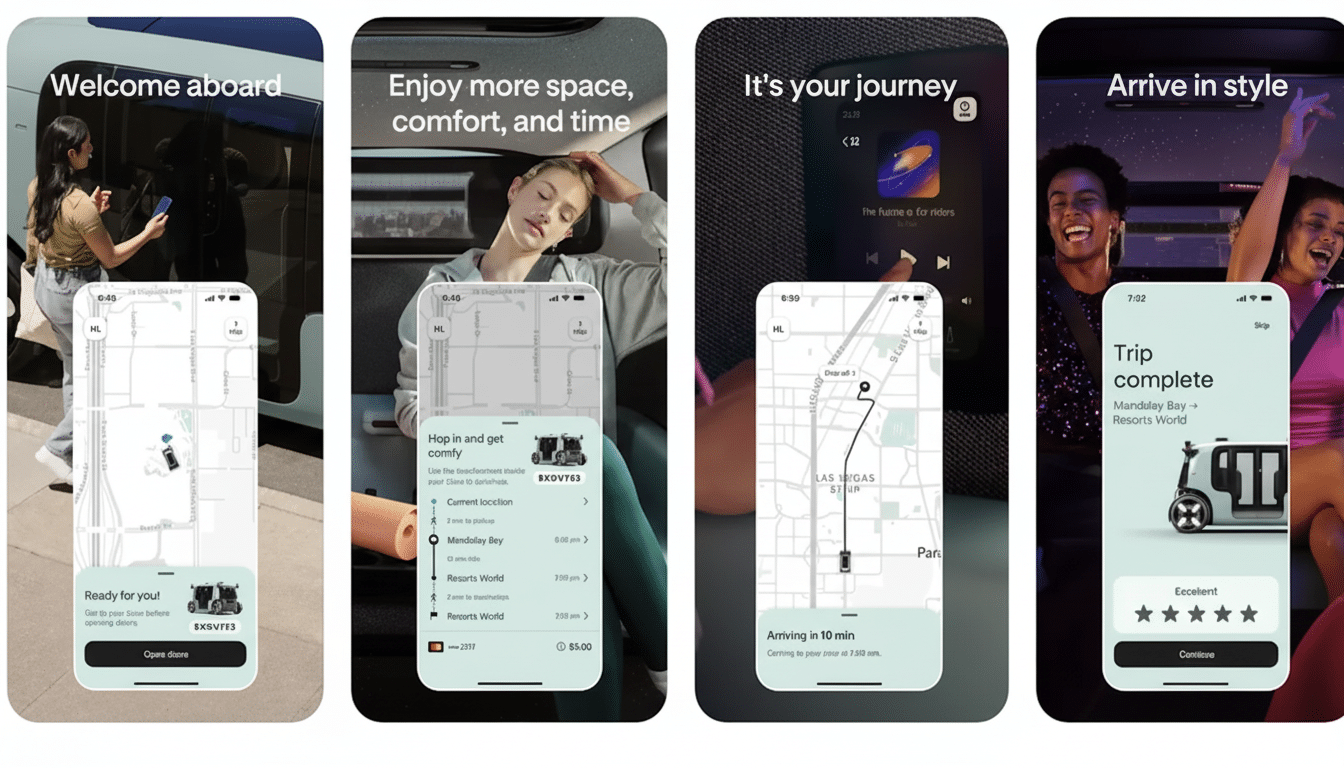
Booking was just like any ride-hail: I plugged my origin and destination into the Zoox app. The catch is that you’re reined in — Zoox currently restricts trips to a curation of stops, and rides are free while it builds up service. That limitation alone would make it different from the broader, fare-based coverage Waymo offers in its active markets.
Zoox’s vehicle isn’t a transformed S.U.V.; it’s a bespoke, bi-directional pod with no steering wheel or pedals and sliding glass doors striped armadillo-like from the floor to the ceiling on both sides. Four passengers face each other, two to a bench. It’s sociable, and the car is so symmetrical that it can drive in either direction without resorting to three-point turns. But if anyone in your group is subject to motion sickness while seated backward, prepare appropriately.
The inside feels almost plush premium transit: sturdy, but not lush. That’s been kind of an issue, however, so two Qi pads per side now line the transmission tunnel, and Malibu-like cupholders sit next to a smaller touchscreen for climate, music and ETA. Ten minutes in, I wished for more lumbar support — the seats lean more toward durability than cushioning. It’s a stark contrast to the converted Jaguar I‑Paces that Waymo uses, which keep more of the traditional car comfort and ergonomics drivers are accustomed to.
Less is more when it comes to thoughtful touches in a clean-sheet design. There’s no clicky turn-signal soundtrack, which may be trivial until you sit at a long light and find yourself enjoying the silence. Less polished: emergency egress cues. I located a manual release that tucks in behind the seat only because I was looking for it. In a panic, that matters. For most riders in traditional cars — like Waymo’s — how to unlock it and get out is a no-brainer.
On the Strip: Conservative, Relatively Smooth
On the road, Zoox drove as if a finicky DMV examiner were judging her every move. It braked early, yielded assertively and left generous gaps — which can feel overly cautious to drivers but generally cuts down on conflict points in dense traffic.
I had one glitchy moment when the car dropped itself to an absolute crawl for no apparent reason, and then recovered on its own. In other scenarios, the system acted just as you’d expect it to: It stopped when an ambulance wanted to turn across our path and when an impatient human honked behind us, it didn’t flinch. That pattern — an odd hesitation among otherwise uneventful rides — matches the early robotaxi rollouts I’ve ridden in other places.
Zoox’s bi-directional chassis is supposed to be ideal for close quarters, but it’s not magic. When another car wedged the vehicle to its left after it had deposited me at Luxor, it hung around for a while before nudging out of line and then clearing. They have the ability; it’s just that they seem to also be conservative in when they call for it.
Zoox vs. Waymo: Coverage and Comfort Versus Capability
The hardware approach is the ideological divide. Designed specifically for Zoox’s custom pod, it maximizes sightlines while allowing a nimble turning radius and ensuring redundancy. Waymo’s retrofits take advantage of mass-produced cars, known crashworthiness and familiar passenger expectations. In practice, Waymo’s cabin is more spacious for extended rides, and the company’s standard-size doors, seats and controls make onboarding easier for first-time users.
Service breadth is Waymo’s home turf. The company offers paid rides in a handful of metro areas and is still growing access to airports and freeways where regulators allow. Public filings and company reports suggest that Waymo has driven tens of millions of miles autonomously, has a large fleet on the road, routing thousands of trips per week in its core markets. Zoox, on the other hand, is only now opening its public pilot in Las Vegas with a tightly geofenced map and not yet any published pricing.
Freeways and airports are bellwethers. Waymo has tested, and in some markets operates, segments on limited-access highways, and has begun structured airport pilots after mapping and permitting. For now, Zoox is concentrating on crowded city streets. That’s a simpler proposition for many travel cases — as of now, Waymo just covers more things you might use a traditional rideshare-type service for.
Safety, Oversight and Public Trust in Robotaxis
Both of the companies are subject to a patchwork of state and federal oversight that includes the Nevada DMV for testing and deployment authorizations and the National Highway Traffic Safety Administration for vehicle safety standards and recalls. Waymo has released both independent and internal analyses estimating its crash rates are lower than human baselines under similar conditions; it has issued software recalls when necessary — an important indication the industry is beginning to take advantage of many of the same error-corrective mechanisms as traditional automakers.
Zoox’s purpose-built design raises different questions: how emergency features are labeled and accessed, how riders are briefed on procedures and how regulators assess vehicles without manual controls. Those are solvable through clearer signage and more passenger education, but they matter as deployments scale.
The Bottom Line: Cost, Comfort and Convenience
My own rubric is cost, comfort and convenience. Zoox wins on cost today, because it is free; but loses on comfort and map coverage. Convenience is where Waymo tends to win, thanks to broader service areas and more comfortable rides for long-distance commutes, and fares that broadly match the cost of a ride hail in supported cities.
If Zoox can beat on price once it starts charging and smooth the rough edges — seat comfort, clearer emergency signs and more assertive low-speed maneuvering — it will be a compelling option beyond the Strip. For the time being, it is a highly promising, decidedly futuristic ride that points to where urban mobility is headed; Waymo remains the superior alternative for most real-world trips.