


Bolt Graphics claims its long-teased Zeus GPU is faster than Nvidia’s flagship RTX 5090 in path tracing, but it uses less power and has significantly more memory.
It’s the sort of claim that sticks out in a market one vendor or another utterly dominates at the high end. But if you want to separate the sizzle from the silicon, then you need to also look at architecture, software stacks, and testing standards—not just headline figures.
- What Zeus Says on Paper: Architecture and Memory Specs
- Why the Raw Path Tracing Numbers Might Mislead
- Memory Capacity Versus Bandwidth in Real-World Gaming
- Software and Driver Reality Check for Games and Apps
- Power, Thermals, and Form Factor Considerations Explained
- Who Zeus Serves Best: Creators, Researchers, and Gamers
- What Is Likely to Determine the Overall Verdict
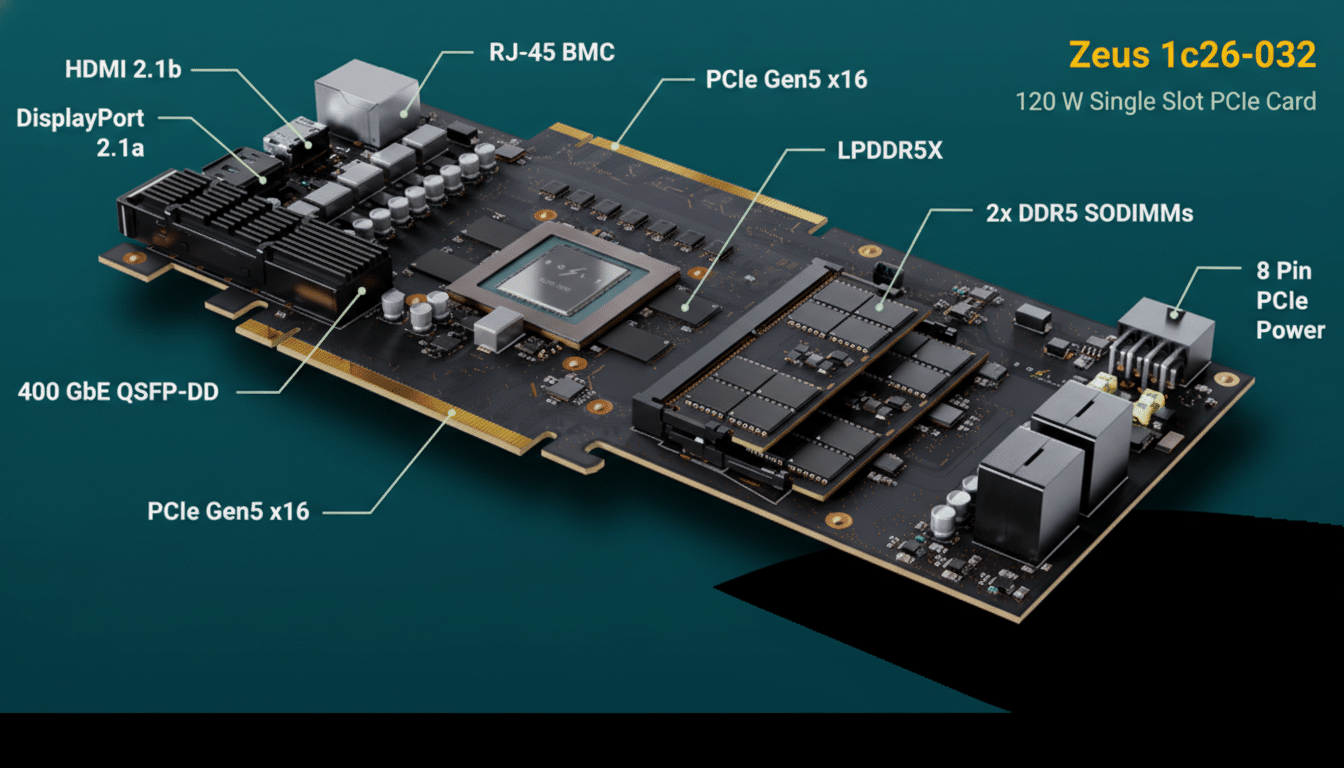
As TechPowerUp reports and as disclosed at CES, Zeus has ambitions for both gamers and creators with support for DirectX 12 and Vulkan, engine optimizations for Unreal and Unity, along with a big performance story: up to 2.5 times faster than an RTX 5090 in path-traced lighting. The question is just how well those gains stand up beyond controlled demos and into shipping drivers and real games.
What Zeus Says on Paper: Architecture and Memory Specs
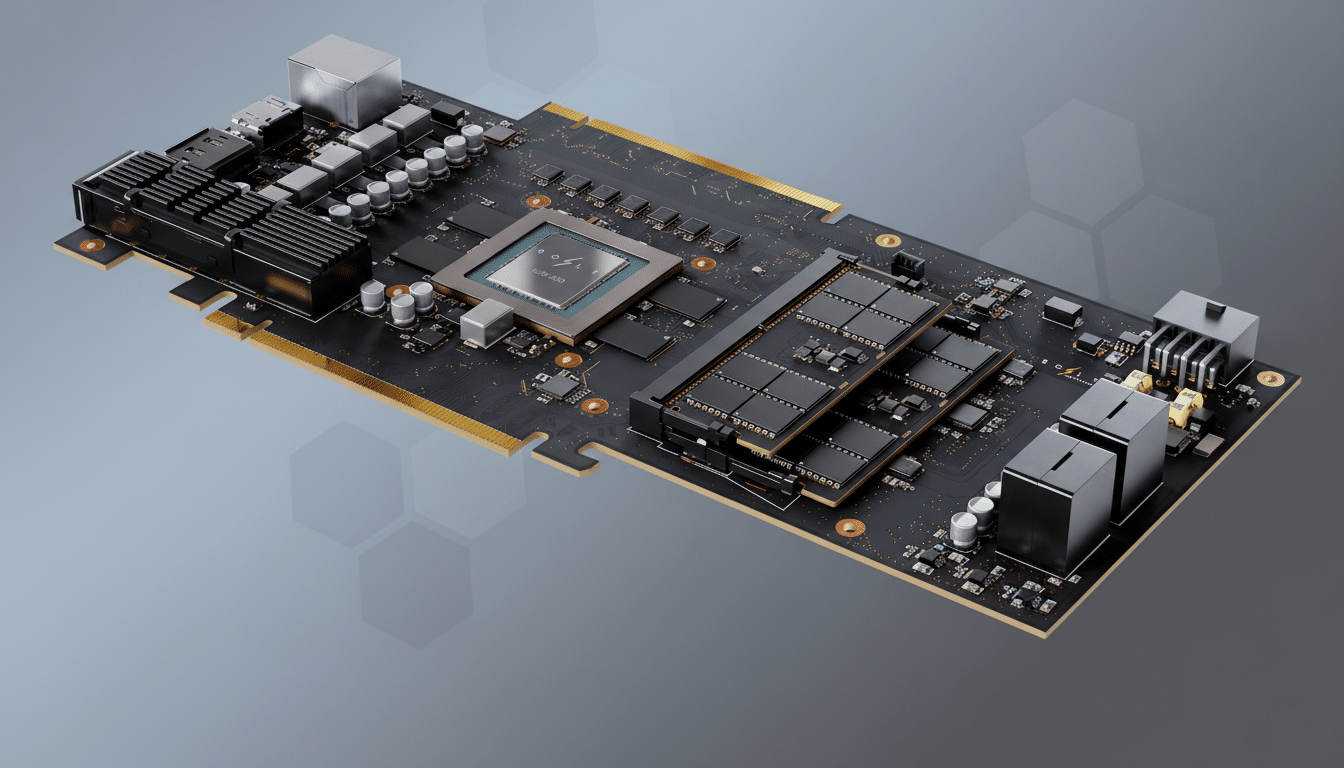
Zeus is a fresh design that’s SIMD-centric and governed by a RISC-V command processor. The card is designed on a PCIe 5.0 x16 interface and offers LPDDR5X onboard memory along with user-expandable DDR5 SODIMM slots. Bolt boasts a ceiling of 384GB total capacity—a jaw-dropping number compared against the RTX 5090’s often-cited 32GB. There’s a focus on enterprise, too: optional 400/800 Gbps networking and multi-GPU clustering for scaled workloads.
On raw features, that’s compelling. PCIe 5.0 x16 provides approximately 64 GB/s combined bandwidth—great for asset streaming and compute. The rest of the gory details: LPDDR5X also saves power and board area. And massive memory pools can be relevant for offline rendering, large-scene VFX, or neural graphics research. But capacity and speed aren’t the same thing, and with interactive gaming, that difference is very important.
Why the Raw Path Tracing Numbers Might Mislead
Performance of path tracing is not only about ray accelerators. Frame times may be affected by BVH build/update speed, shader compilation, denoiser quality, and scheduling. A 2.5x win could represent cherry-picked scenes, one setting of the denoiser, or just a feature set that maps peculiarly well onto the Zeus pipeline.
Third-party testing is required across several engines and games. Sample checks include UL Solutions’ 3DMark Speed Way and Steel Nomad RT as well as real titles like Cyberpunk 2077 RT Overdrive, Alan Wake 2, and Portal RTX. It is normal that reviewers will normalize for upscaling and frame creation to give a comparison of native ray behavior. Without that scope, single-metric proclamations risk over-reading niche strengths.
Memory Capacity Versus Bandwidth in Real-World Gaming
Zeus’s 384GB figure does make for a dramatic headline, but gaming throughput often depends on memory bandwidth and latency. Nvidia’s top-of-the-line part achieves its breakneck speeds via ultra-fast GDDR7/next-generation memory controllers that push 1 TB/s-plus. LPDDR5X is power-efficient, but it offers slightly smaller bandwidth headroom. If Zeus leans on DDR5 SODIMMs, the slower memory pools could be a bottleneck in action-packed scenes.
The takeaway: huge capacity is a win for DCC workloads (e.g., Blender Cycles, Octane, or Redshift) where you can’t fit the scene and need to avoid out-of-core thrashing. For 4K gaming at high RT, instant bandwidth and cache behavior usually determine smoothness and details more than the 1% low.
Software and Driver Reality Check for Games and Apps
API endpoints or API badges don’t mean ready to go for game time, either. Vulkan, DirectX 12, and shader compilers that don’t suck can only work together with per-title tuning and good frame-pacing. New GPU stacks generally tend to swing by double digits in first-batch benchmarking as the drivers are maturing—that’s a trend we’ve seen extensively throughout our testing, and one that’s been well-documented across independent reviews for past launches.
Key milestones to track:
- Khronos Vulkan conformance
- Microsoft WHQL driver certification
- ISV certifications for pro apps from the likes of Autodesk and Chaos
Engine integrations are at stake as well; a native plug-in for Unreal and Unity should be good through major versions. Until all of those boxes are checked, day-one players will be at risk of reversions and compatibility crevices.
Power, Thermals, and Form Factor Considerations Explained
Bolt is promising as much efficiency as an RTX 5090, which is quite appetizing for the high-end tier. However, the board-level reality encompasses the VRM design, cooler capability, memory power, and any add-on networking that you may consider. And while LPDDR5X may assist with idle and light-load draw, continual RT workloads wring every watt out of the power budget. Independent measurements with the same loops will show you perf-per-watt in practice.
Who Zeus Serves Best: Creators, Researchers, and Gamers
The feature mix—clustering, high-speed NICs, boatloads of memory—reads as much like a small compute accelerator as it does like a gaming card. It could be a sweet spot for boutique render farms, research labs trying out neural rendering, or studios churning between complex shots. If Zeus nails game drivers too, it might find a market among creators who game as a hobby.
What Is Likely to Determine the Overall Verdict
Two things will tell whether Zeus really can outshine an RTX 5090: independent appraisal, and shipping availability. Assume more cross-checks from different labs with 3DMark, Blender OpenData, SPECviewperf, and an extensive games suite. Stability and any kind of frame-time consistency are just as important as peak FPS. If Bolt can consistently win across titles and workloads—as in, not just a few selected demos—then the conversation changes.
In the meantime, Zeus is a compelling contender whose aspirations are high and that combines gaming with workstation DNA. Be excited, but be patient. Promise—not proof, at least without third-party testing and mature drivers.