


YouTube’s long-awaited native app for Apple Vision Pro has arrived, bringing the world’s largest video platform into Apple’s spatial computing ecosystem with a full-featured experience that goes far beyond a browser tab. After initially steering users to Safari and sidelining third-party workarounds, the official visionOS app delivers immersive playback, offline support, and a streamlined path to discover spatial video.
What the Native Vision Pro YouTube App Delivers
The new app mirrors the breadth of YouTube’s catalog, from standard long-form videos to Shorts, while treating Vision Pro owners to a theater-scale virtual screen that takes advantage of Apple’s micro‑OLED displays. A dedicated Spatial tab surfaces 3D, VR180, and 360-degree clips—formats YouTube has supported for years but which have often been buried for casual viewers. Centralizing them in one place matters: frictionless discovery is what turns niche formats into daily habits.
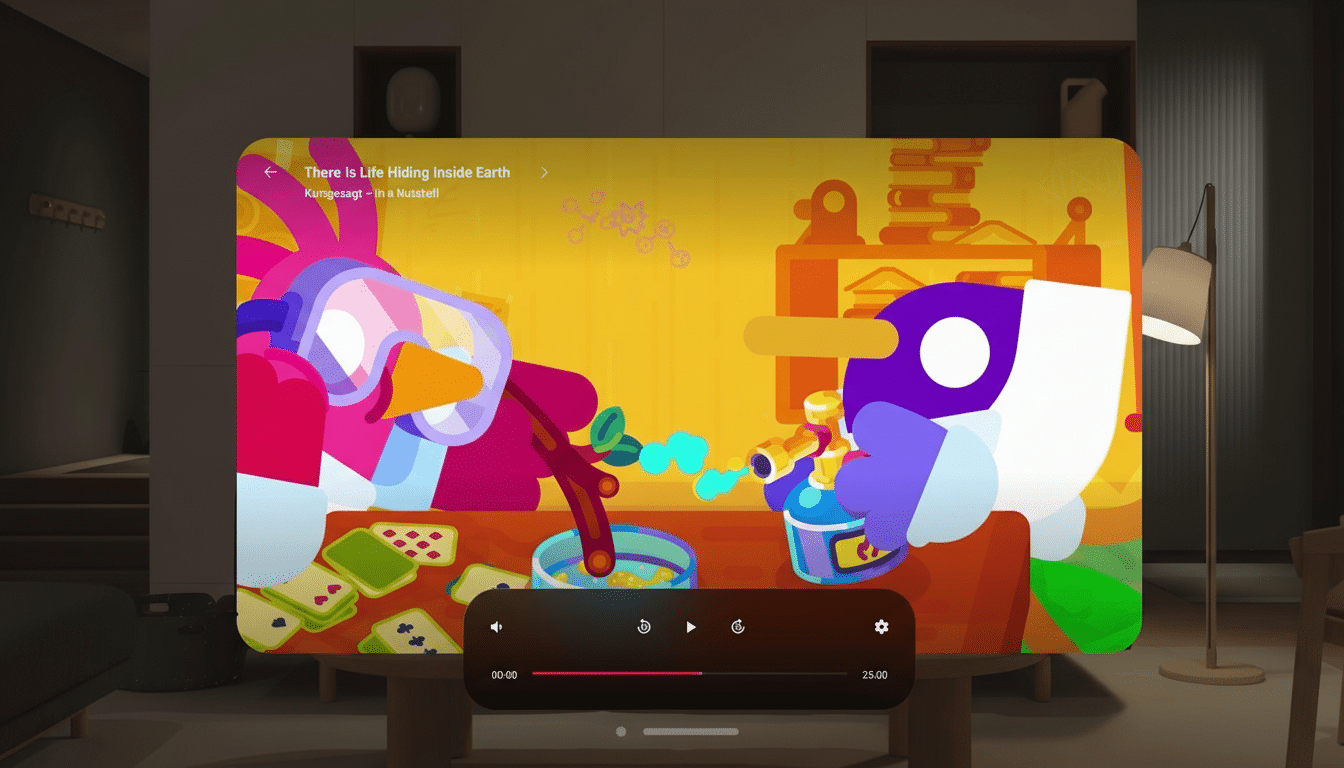
For users on the latest Vision Pro models equipped with Apple’s M5 chip, the app supports 8K playback—a meaningful step up for high-resolution VR180 and 360 content where text legibility and fine detail can make or break immersion. Gesture-first controls let viewers resize or reposition windows with their hands, scrub through timelines with precision, and quickly hop between subscriptions, playlists, and history. Offline downloads—available to YouTube Premium members—round out the package for flights and spotty connections, a capability missing from the prior web-only approach.
Crucially, the app is built for visionOS conventions. Instead of transplanting a flat TV interface into 3D space, it leans on spatial affordances—ambient environments that dim distractions, responsive scaling that preserves clarity at large sizes, and input that treats your gaze and gestures as first-class controls. The effect is less “YouTube on a floating rectangle” and more “personal cinema that happens to be YouTube.”
Why the Timing Matters for a Native YouTube visionOS App
YouTube’s hesitation wasn’t trivial. When Vision Pro launched, most major streamers shipped native apps on day one, while YouTube pointed users to Safari and later moved against third-party clients that filled the gap. The company appears to have waited for clearer signals on sustained engagement and for Apple’s platform tooling—and creator supply of spatial content—to mature.
Market momentum has been choppy. Reports have suggested lukewarm headset engagement and softening unit shipments, with one analysis estimating around 45,000 new Vision Pro units in the fourth quarter of 2025. The Financial Times reported that production was paused at one point due to weaker-than-expected demand. Against that backdrop, a native YouTube app is notable: it’s less a bet on immediate hardware scale and more an investment in owning the default video experience wherever attention concentrates.
YouTube brings unmatched gravity to any ecosystem. The platform counts more than 2 billion logged-in monthly users, and it already hosts the internet’s deepest library of 3D, VR180, and 360 videos. Turning that library into a one-tap experience on Vision Pro could lift session length and give creators a clearer path to audience growth in spatial formats.
A Boost for Spatial Video and Creators on Vision Pro
Spatial video has long wrestled with a bootstrapping problem: creators hesitate without audience reach, and viewers hesitate without consistent quality. YouTube’s Spatial tab directly addresses this by elevating the best 3D and 360 content into a curated funnel. For VR180 creators, 8K support on M5 models is especially meaningful, preserving sharpness across a wide field of view and reducing the “screen door” effect that can appear at lower resolutions.
Monetization and metrics also benefit. Because the app ties into the core YouTube stack—subscriptions, watch history, and (where applicable) ads—creators can earn and analyze performance without splintering across platforms. Expect to see more standardized guidance on capture rigs and post-production workflows for VR180 and 360 as best practices consolidate around what performs inside the new app.
How It Compares and What to Watch on Vision Pro Next
On competitive headsets, YouTube’s VR app has been a staple for years, but parity with Vision Pro wasn’t guaranteed. Apple’s hardware brings distinct advantages—ultra-dense displays totaling roughly 23 million pixels and tight integration with eye and hand input—that can make standard 2D videos feel newly premium in a quiet, distraction-free environment.
Two open questions will shape the next phase. First, social viewing: Vision Pro supports shared experiences systemwide, and synchronized watch parties remain a top request for living room replacements. Second, creator tools: as spatial content gains visibility, better in-app surfacing of capture tutorials, format badges, and quality tiers could pull more channels into 3D and VR workflows.
The app’s arrival doesn’t guarantee a wave of new headset buyers. But it does remove a conspicuous gap in Vision Pro’s media lineup and gives existing owners a reason to return. For YouTube, it’s a strategic foothold in spatial computing at a moment when attention is the scarcest commodity in tech—and when controlling the front door to video still matters more than the size of any single screen.